
More Than Entertainment
Influencer content is often described as entertainment — a way of passing time, finding inspiration or staying connected to trends. The description is not wrong, but it significantly underestimates what the content is doing while you consume it.
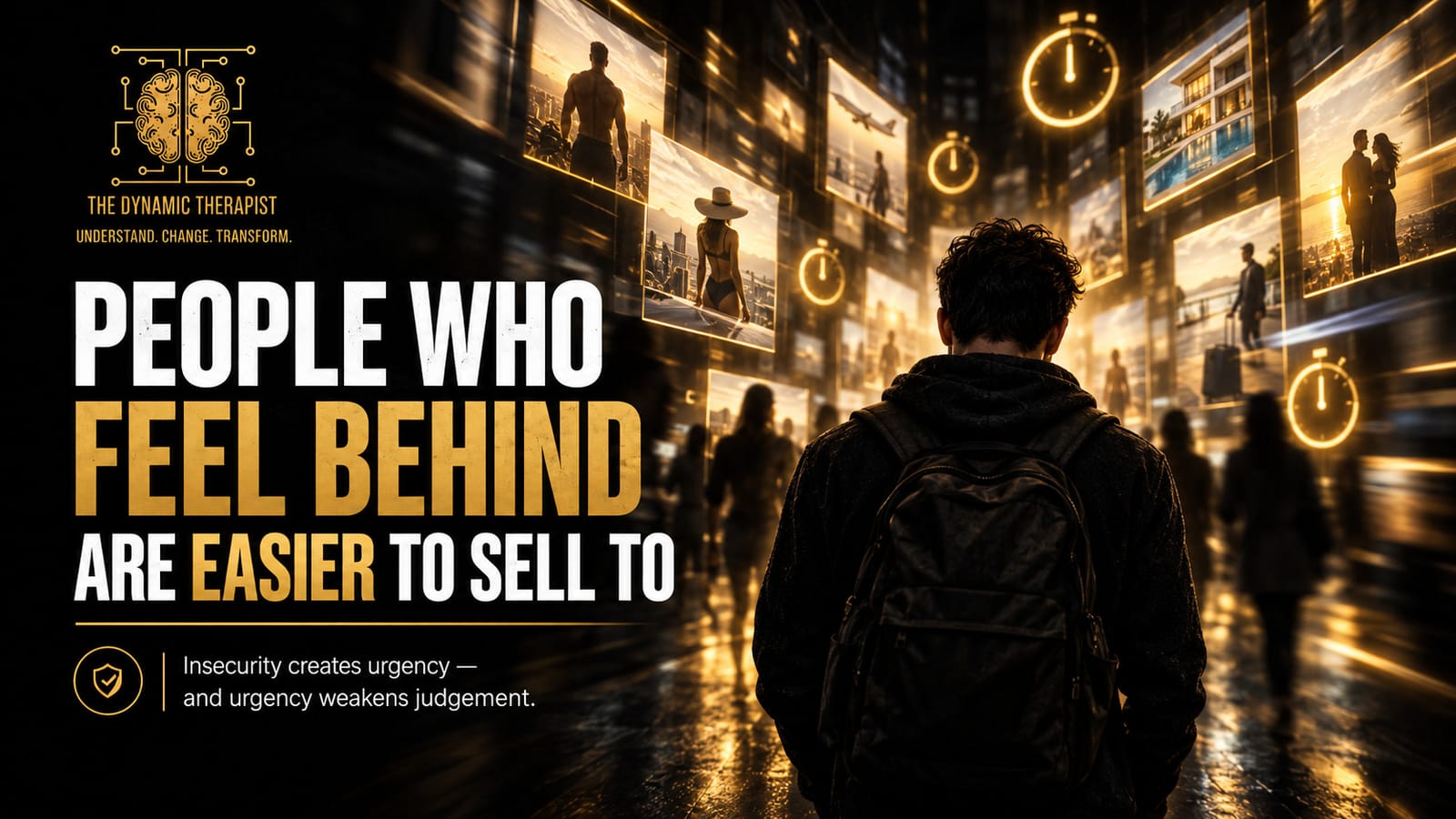
Influencer culture is, at its core, a systematic upward comparison environment. The people whose content dominates the algorithm are, by definition, the most successful at presenting aspiration. The most attractive bodies. The most enviable lifestyles. The most impressive achievements. The most fulfilled-looking relationships. This is not accidental — it is what the algorithm rewards, and what the algorithm rewards is what gets created.
Spending significant time in this environment has predictable effects on your Confidence, your self-perception and your relationship with your own life — regardless of how media-literate you consider yourself to be.
The Specific Mechanisms
Body image and physical Confidence
The bodies that dominate visual social media platforms are not representative. They are selected for visual appeal, often enhanced through training regimes that are not compatible with ordinary life, frequently photographed under optimal conditions with professional lighting, and routinely edited. Research on exposure to idealised body imagery is consistent: it produces downward shifts in body satisfaction, increased body-related Anxiety and reduced physical Self-Confidence in the majority of people exposed to it, regardless of their baseline body image.
Lifestyle comparison and financial Anxiety
Influencer lifestyles — the travel, the homes, the products, the experiences — are frequently not representative of the influencer's actual financial situation. They are often partly or wholly supported by brand partnerships, gifted products, press trips and commercial arrangements that are not disclosed with the prominence they warrant. The follower comparing their financial situation to a lifestyle that is commercially subsidised is comparing two incomparable things.
Achievement comparison and professional Confidence
The professional content that performs best on platforms like LinkedIn and Instagram presents a specific version of career success: rapid progression, early achievement, entrepreneurial wins. The ordinary middle of most professional lives — the years of incremental progress, the sideways moves, the periods of uncertainty — does not generate engagement. The person whose career is proceeding at a normal pace, measured against a feed of exceptional trajectories, tends to experience their ordinary progress as inadequacy.
The Parasocial Confidence Drain
The parasocial relationship — the sense of genuine familiarity with someone who does not know you exist — adds a specific dimension to the Confidence drain. When someone you feel you know presents a version of themselves that is more capable, more attractive or more successful than you feel you are, the comparison has the emotional weight of a comparison with an actual acquaintance. It is not the same as seeing a billboard of an unattainable ideal. It feels personal.
The influencer has spent considerable effort making you feel this familiarity — the parasocial relationship is valuable to them commercially because it produces loyalty, trust and purchase behaviour. The Confidence drain is an unintended cost of a mechanism that serves other purposes.
Two Examples
The fitness account that made her feel worse
Emma followed the fitness account for motivation. It has 800,000 followers and posts daily workout content and meal ideas. After three months of following it, Emma exercises less than she did before she started following it — because every interaction with the account reminds her of the gap between her body and the one in the content, and the gap produces avoidance rather than motivation. The account intended to inspire. The mechanism produced the opposite effect.
The entrepreneur content that produced Anxiety
David follows several entrepreneurship accounts. The content consistently presents a version of business building characterised by rapid success, clear vision and confident execution. David is building a business. It is proceeding slowly, with significant uncertainty and frequent doubt. The comparison between his actual experience and the content he consumes has produced a specific Anxiety: that he is doing it wrong, that he lacks something the successful people have, that his uncertainty is evidence of inadequacy rather than a normal feature of building something new.
Three Reflection Questions
- Which specific accounts or types of influencer content most consistently affect your Confidence — and what is the specific domain in which the effect is strongest?
- If you removed the five accounts that most often leave you feeling inadequate by comparison, what effect do you think that would have on your Confidence over the following month?
- Can you identify a piece of influencer content you consumed in the past week that produced genuine value for you — and compare that to the content that produced comparison and inadequacy?
Key Takeaways
- Influencer culture is a systematic upward comparison environment that the algorithm selects for and rewards.
- The bodies, lifestyles and achievements presented are not representative and are frequently not what they appear.
- The parasocial relationship adds emotional weight to the comparison by making it feel personal.
- The Confidence drain is domain-specific — most pronounced in the areas where your Self-Esteem is least secure.
- Deliberate curation of your feed, removing content that consistently produces comparison rather than genuine value, is a practical and effective intervention.
Frequently Asked Questions
Is all influencer content harmful?
No. Some influencer content provides genuine value — accurate information, honest experience, real community. The question is whether specific content is producing value for you or primarily producing comparison and inadequacy.
What about accounts that are honest about their struggles?
These tend to produce significantly different effects — often reducing rather than increasing comparison, and producing genuine connection through honest shared experience. They exist and they are worth seeking out.
Does unfollowing accounts help?
Research on deliberate social media curation suggests yes — removing accounts that consistently produce negative comparison effects produces measurable improvements in mood and Self-Esteem over time.
What if I am an influencer myself?
Then understanding the effect your content has on your audience — and the gap between what you present and what you experience — is particularly relevant, both for your own wellbeing and for the responsibility that comes with the platform.
Can Simon help with the Confidence effects of influencer culture?
Yes. The specific Confidence deficits produced by sustained upward comparison, and the underlying Self-Esteem that determines how much they affect you, are directly relevant to the work.
Your Feed Is an Environment. Curate It Deliberately.
You would not fill your physical environment with things that consistently made you feel inadequate. Your digital environment deserves the same consideration. What you consume shapes how you feel about yourself. That is not trivial. It is worth choosing deliberately.
Simon Taylor helps people rebuild Confidence eroded by sustained comparison. A Free 30-Minute Consultation is a good place to start.
Book Your Free 30-Minute Consultation | Get The Little Book of Big Changes