The Old Version
The concept of keeping up with the Joneses — the social pressure to match the consumption, status and lifestyle of your immediate peers — is not new. Research on relative income and social comparison has documented its effects for decades. The experience of feeling inadequate relative to the people immediately around you is as old as human social organisation.
But the old version had natural limits. Your comparison group was bounded by geography and direct social contact. You compared yourself to the people on your street, in your workplace, in your social circle. The number of people you had meaningful comparative information about was limited — perhaps a few dozen. The information you had about them was imperfect and incomplete. And the comparison was mutual — they could see your life as clearly as you could see theirs.
Every one of these limiting factors has been removed by social media.
Why the New Version Is Worse
The comparison group is now global and unlimited
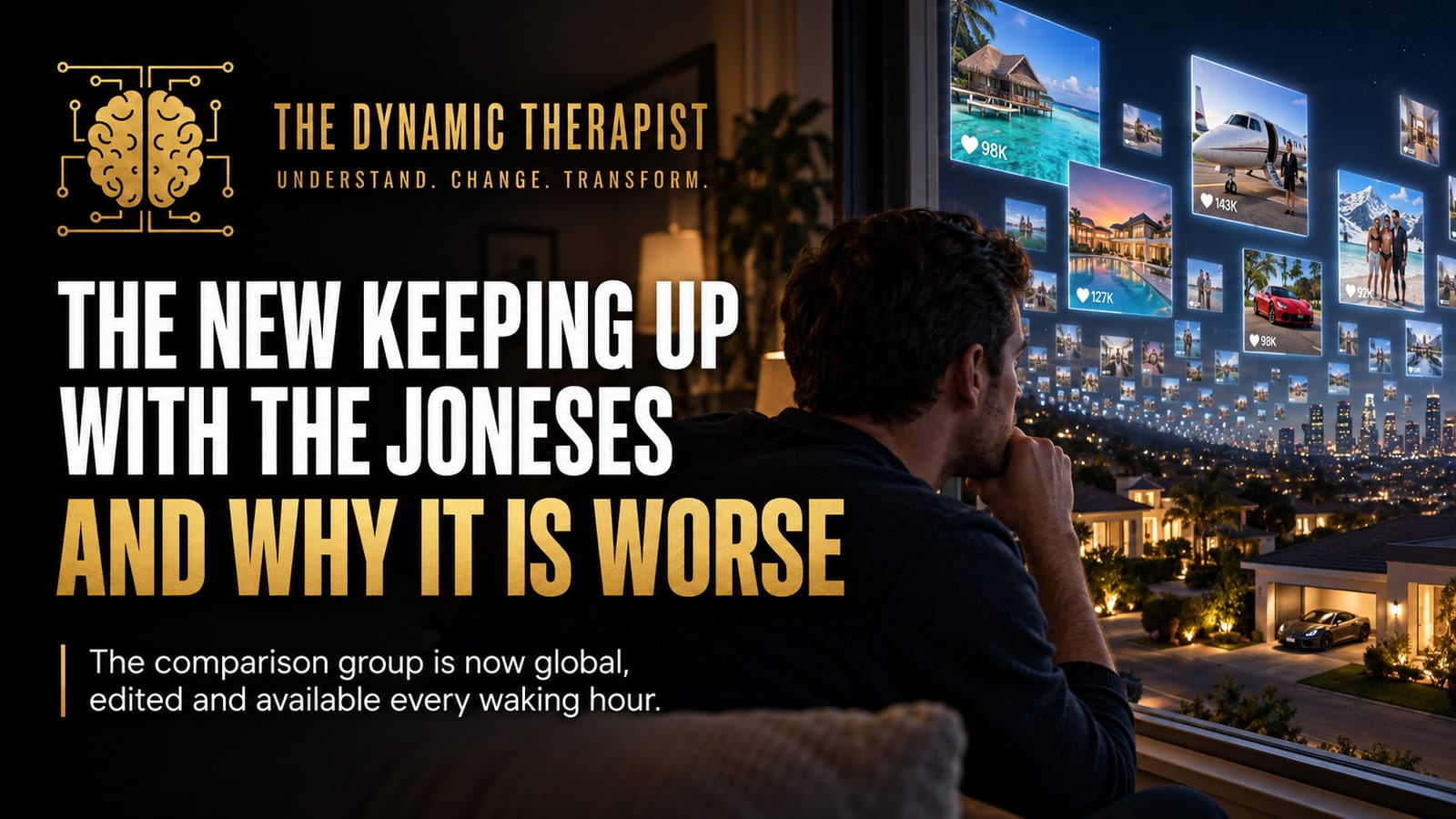
Where the old comparison was bounded by geography, the new one is global. You are no longer comparing yourself to the people on your street. You are comparing yourself to the most aspirational version of millions of people simultaneously — including people whose income, resources and circumstances are entirely different from yours, whose lifestyle is commercially subsidised, and whose presentation is professionally managed.
The comparison is continuous rather than occasional
The old version of social comparison was episodic — triggered by specific encounters with neighbours, colleagues or friends. The new version is continuous. The phone is present at every moment of the day. The comparison inputs are available at 3am, on the commute, in the queue for the supermarket, in the five minutes before sleep. There is no natural endpoint and no recovery period between exposures.
The algorithm selects for the most aspirational
The old version presented a relatively random sample of your comparison group. The algorithm presents a systematically distorted sample — selected for maximum engagement, which means maximum aspiration. You are not seeing a representative cross-section of how people your age are living. You are seeing the most successful, most attractive and most aspirational content that the algorithm has determined will keep you on the platform.
The comparison is no longer mutual
In the old version, your neighbour could see your life as clearly as you could see theirs. The comparison was mutual and the information was roughly symmetric. In the new version, the person you are comparing yourself to has no idea you exist. You are consuming their curated presentation while they are completely unaware of your life. The asymmetry is total.
The Specific Damage
The combination of these factors produces a comparison environment that is qualitatively different from anything that preceded it — and the psychological effects reflect that. Research on social media and life satisfaction consistently documents a relationship between heavy social media use and reduced satisfaction with income, housing, appearance, relationships and career. The mechanism is not that social media changes these things objectively. It changes the standard against which they are measured.
The house that would have seemed adequate measured against your actual neighbours seems inadequate measured against a global feed of aspirational interiors. The salary that would have felt reasonable in the context of your actual peer group feels insufficient measured against a feed of conspicuous consumption. The relationship that would have felt good measured against the ordinary relationships around you feels deficient measured against curated romantic presentations.
Three Reflection Questions
- If your comparison group were limited to the people you actually know personally, how would your assessment of your own life change?
- Can you identify a specific area of your life — income, home, relationship, appearance — where your satisfaction has reduced in recent years in ways that do not reflect an actual change in your circumstances?
- What would the benchmark for your life look like if it were based on your own values and previous experience rather than on an algorithmically curated global sample?
Key Takeaways
- The old version of social comparison was bounded by geography, limited in sample size and mutual in information access.
- Social media has removed every one of these limits — making the comparison global, continuous, algorithmically distorted and entirely asymmetric.
- The effect on life satisfaction is measurable and consistent — heavy social media use reduces satisfaction with circumstances that have not objectively changed.
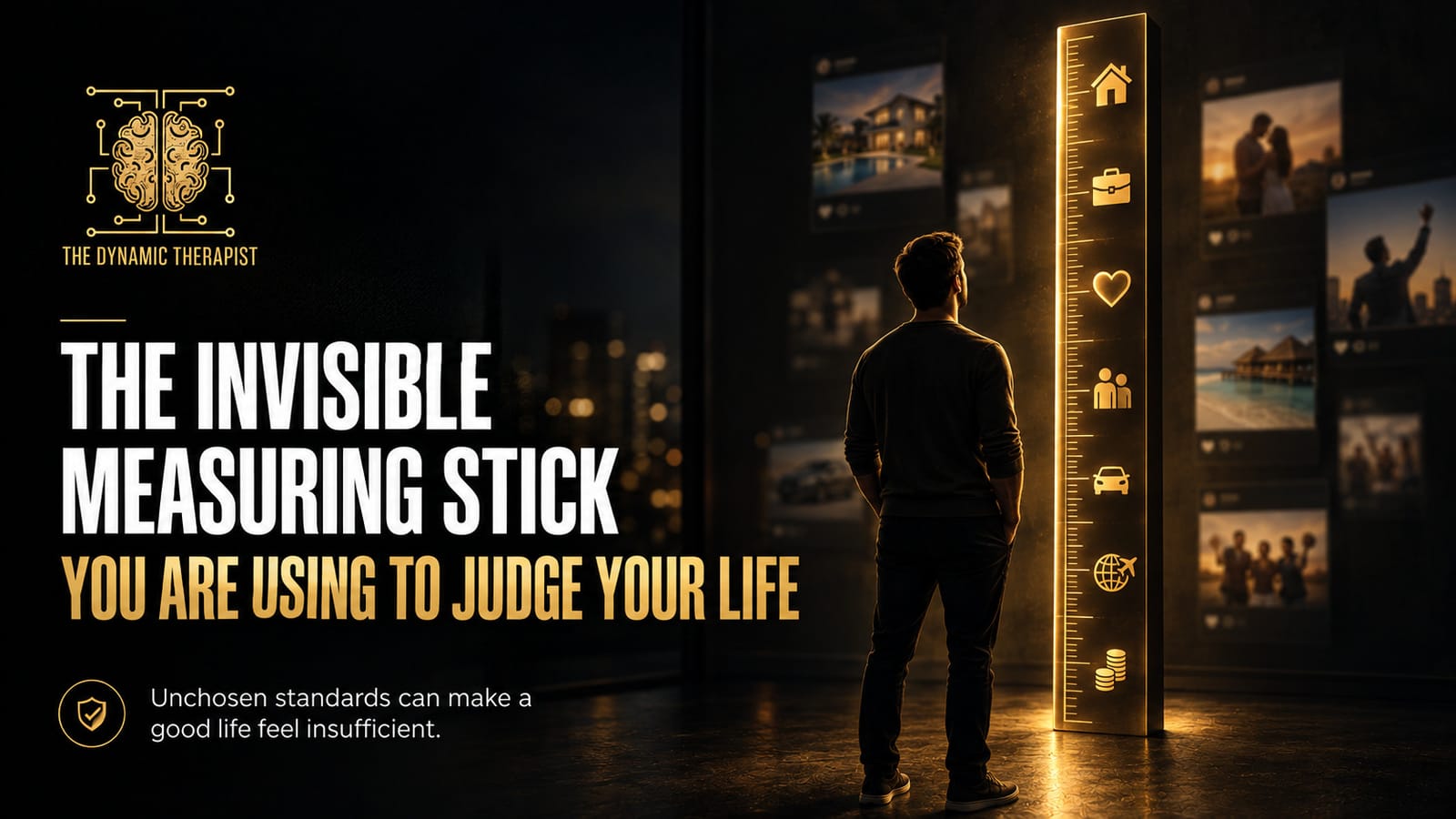
- The mechanism is standard-setting — the algorithm raises the benchmark against which your actual life is measured.
- Returning to a more bounded, locally relevant comparison group is both psychologically protective and more accurate.
Frequently Asked Questions
Is this just nostalgia for a simpler time?
No — the research is clear that the specific features of social media comparison produce measurably worse outcomes than the bounded comparison that preceded it. This is not sentiment. It is documented in the data on life satisfaction.
Can you opt out of the comparison entirely?
Not entirely — the mechanism is too fundamental. But you can deliberately limit the comparison inputs by curating your feed, reducing passive consumption and maintaining awareness of the distortion the algorithm introduces.
What about the benefits of a global information environment?
Real and significant. Access to information, community, opportunity and connection that was not previously available is genuinely valuable. The point is not to abandon the global information environment but to use it with awareness of the specific comparison distortion it introduces.
Does this affect some people more than others?
Yes. People in the specific life stages where social comparison is most active — early adulthood, major life transitions — and people with lower baseline Self-Esteem show stronger effects. But the mechanism operates across the population.
Can Simon help me recalibrate my comparison standard?
Yes. Developing a more internally grounded, values-based benchmark for your own life — one that does not depend on a globally distorted sample — is exactly the kind of work a consultation is designed to support.
The Joneses Are Not Your Neighbours Any More
They are a global, algorithmically curated collection of the most aspirational content that exists. You were never going to keep up. The more important question is why you are still trying — and what it would feel like to measure your life against something more honest instead.
Simon Taylor helps people develop a more honest, internally grounded standard for their own lives. A Free 30-Minute Consultation is a good place to start.
Book Your Free 30-Minute Consultation | Get The Little Book of Big Changes