Who Actually Joins
The cultural image of cult membership — isolated, psychologically fragile, socially marginalised people recruited through obvious manipulation — is substantially inaccurate. Research on high-control groups documents that members tend to be of average or above-average intelligence, often educated and professionally functional, and frequently in a specific life stage characterised by transition, questioning or unmet need for belonging and purpose.
High-control groups are not primarily recruiting the fragile. They are recruiting people in transition — students, people who have recently moved, people in the aftermath of loss or relationship breakdown, people whose existing community has dissolved or does not adequately meet their needs for meaning and connection. These are ordinary human experiences, not markers of special vulnerability.
The Needs Being Exploited
Belonging
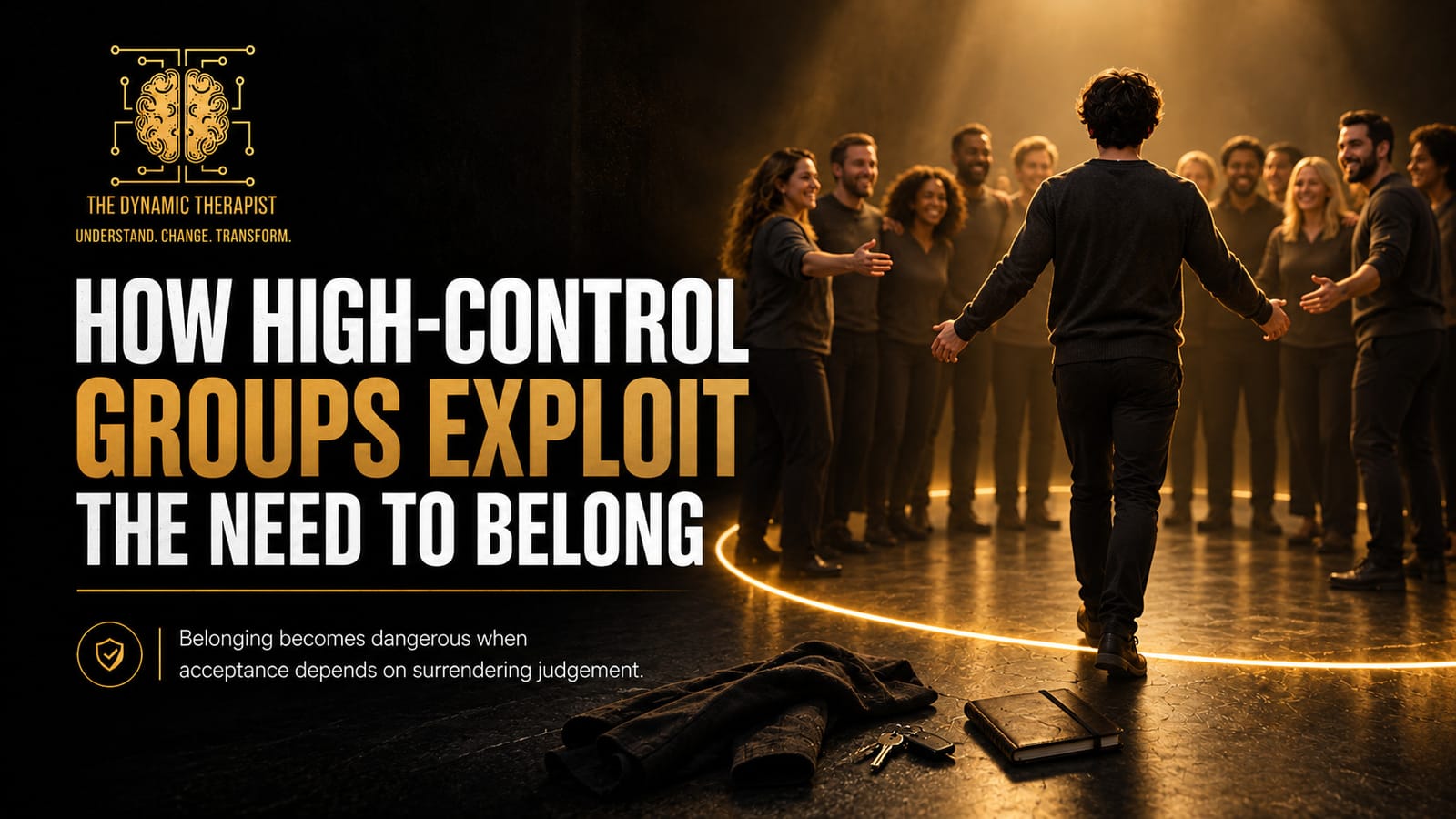
The need for genuine community — to be known, accepted and valued within a group of people who share your values and commitments — is one of the most fundamental human needs. It is also increasingly poorly met in contemporary society, where traditional community structures have weakened and the comparison trap has made many people acutely aware of the gap between their actual social life and an aspirational standard.
High-control groups are typically exceptionally good at providing an immediate, intense experience of belonging. The love bombing dynamic applies at the group level — new members are welcomed with unusual warmth, given significant attention, and made to feel that they have found the community they have been looking for. The belonging feels real because it is real, in its early form. The control comes later.
Purpose and meaning
The sense that your life has genuine direction and significance — that what you do matters and connects to something larger than yourself — is consistently identified as a central component of psychological wellbeing. The comparison trap, by orienting attention towards external achievement and status, tends to undermine rather than support the development of genuine purpose.
High-control groups offer purpose with unusual clarity and certainty — a mission, a worldview, a set of answers to questions about meaning that the wider culture leaves largely unresolved. For people in a state of genuine existential uncertainty, this clarity is exceptionally attractive.
Identity
The erosion of identity that the comparison trap produces — the uncertainty about who you actually are beneath the performance and the absorbed standards — creates a specific vulnerability to groups that offer a clear, meaningful identity. You are not a person uncertain about your direction and worth. You are a member of this group, with this identity, this purpose and this community. The relief of that clarity is significant.
The Recruitment Process
High-control group recruitment is typically gradual and rarely presents its full nature early. Initial contact — at a public event, through a friend, online — is warm and non-threatening. Early involvement is pleasant and the community seems genuinely good. Commitment is escalated incrementally — each step is small enough to seem reasonable, and each step deepens the investment that makes the next step easier.
The control elements — the demand for conformity, the isolation from outside relationships, the control of information and thought — typically appear gradually, after the belonging and identity needs have been sufficiently met that leaving feels like losing what you most needed.
The Connection to the Comparison Trap
The comparison trap contributes to high-control group vulnerability through two specific pathways. First, by creating and maintaining the unmet needs — for belonging, purpose and identity — that make the group's offering so attractive. Second, by eroding the Self-Worth and stable identity that would otherwise provide a more resistant internal foundation.
The person with a stable sense of identity, a secure existing community and a clear internal sense of their own values is significantly harder to recruit than the person whose comparison environment has made their identity uncertain, their community feel insufficient and their sense of purpose unclear.
Three Reflection Questions
- Are there genuine unmet needs in your life — for belonging, purpose or clear identity — that are currently acute enough that a group offering all three simultaneously would be powerfully attractive?
- Is there a group or community you are currently part of that you have noticed restricting your contact with outside perspectives or questioning of the group's beliefs?
- What would genuinely meeting your need for belonging, purpose and identity look like outside of a high-control context?
Key Takeaways
- High-control groups recruit people with genuine, unmet needs — not primarily the fragile or unintelligent.
- Belonging, purpose and identity are the primary needs being exploited.
- Recruitment is gradual and pleasant — control elements appear after investment is sufficient.
- The comparison trap contributes by creating unmet needs and eroding the stable identity that would otherwise resist recruitment.
- Genuine community, purpose and identity built through ordinary life are the sustainable alternatives.
Frequently Asked Questions
How do I recognise a high-control group?
The BITE model (Behaviour, Information, Thought and Emotional control) provides a useful framework. Key indicators include: restrictions on outside relationships and information sources, requirements for conformity of belief and behaviour, consequences for questioning or leaving, and a worldview that positions the group as uniquely right or uniquely good.
What if I am already in a group and am uncertain?
Talk to someone you trust who is entirely outside the group. Read accounts of former members. Consult organisations that support people leaving high-control groups — Reclaim Social Media and the Cult Information Centre provide UK-based support.
Can people leave high-control groups?
Yes. Leaving is often difficult — the emotional investment, the social consequences and the identity disruption are significant — but it is entirely possible and the research on former members documents genuine recovery.
Is this the same as organised religion?
No. The distinction is not between religious and non-religious groups but between groups that allow genuine autonomy, questioning and outside connection and those that restrict them. Many religious communities provide genuine belonging, purpose and identity without any control elements.
Can Simon help with this?
Yes — both with understanding whether a current group involvement is concerning and with addressing the underlying unmet needs that create vulnerability.
The Need Was Genuine. The Group Was Not the Right Answer.
Belonging, purpose and identity are real needs. They deserve real responses — built through genuine relationships, meaningful work and an honest relationship with your own values. A group that provides these things by controlling your access to everything outside itself is not meeting your needs. It is replacing them with its own.
Simon Taylor helps people address genuine needs for belonging, purpose and identity through genuine means. A Free 30-Minute Consultation is a good place to start.
Book Your Free 30-Minute Consultation | Get The Little Book of Big Changes