
FOMO as a Vulnerability
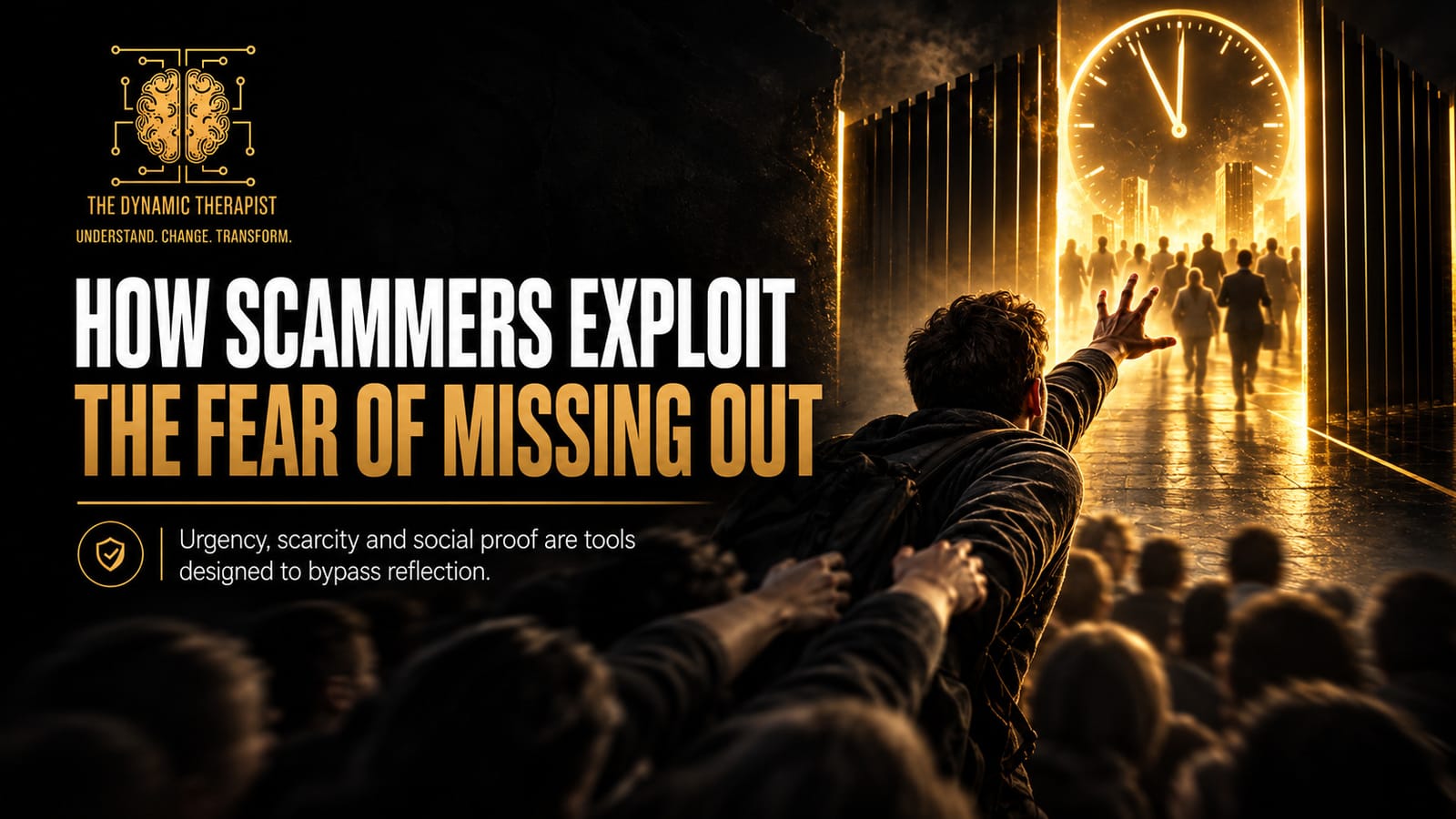
The fear of missing out — FOMO — has been widely discussed as a social media phenomenon: the Anxiety produced by awareness of experiences, opportunities and connections you are not part of. Less discussed is FOMO as a specific vulnerability that scammers, fraudsters and predatory salespeople identify and exploit with considerable sophistication.
The person who feels they are missing out — on financial opportunity, on lifestyle, on connection, on status — is in a specific psychological state that makes them easier to manipulate than someone who feels their situation is adequate. The sense of inadequacy and the desire to close the gap produces motivation that can be redirected by anyone skilled enough to offer the right closing of the right gap.
The States Scammers Look For
Financial FOMO
The perception that others are accumulating wealth faster than you — through investment returns, property, cryptocurrency, business — produces a specific Anxiety that is significantly amplified by social media content showing conspicuous financial success. The person in this state is primed to believe that the right opportunity exists and that they have been missing it. They are motivated to act quickly when an opportunity is presented — because the additional FOMO of missing this opportunity compounds the existing Anxiety.
Status and lifestyle FOMO
The chronic awareness, produced by the comparison environment, that other people are living more fully, experiencing more, achieving more and belonging to more desirable communities produces a generalised desire for inclusion in something better. Scams and predatory schemes that offer access to exclusive communities, insider knowledge, special status or aspirational lifestyle experiences specifically target this state.
Relational FOMO
The sense that other people's social and romantic lives are richer, more connected and more fulfilling than your own — amplified by social media content of exactly this type — produces relational FOMO that creates vulnerability to approaches that offer connection, belonging or romantic attention. Romance fraud and high-control groups both exploit this specific state.
How Scammers Identify Targets
The identification of targets is increasingly data-driven. Social media profiles, public posts, group memberships, reactions to specific content and engagement patterns all provide information about a person's specific FOMO state. Someone who consistently engages with investment content, responds to posts about financial freedom and expresses dissatisfaction with their financial situation in public posts has provided detailed information about their specific vulnerability.
At a more interpersonal level, scammers who approach targets directly — through dating apps, social media messages, cold calls — are skilled at reading the signals of vulnerability in early conversation: the degree of dissatisfaction expressed, the specific gaps described, the eagerness to find a solution. The skilled scammer is listening for the specific gap that their offering is designed to appear to close.
The Exploitation Techniques
Artificial scarcity and urgency
'This opportunity is only available until Friday.' 'There are three places left.' 'I can only offer this to a limited number of people.' Artificial scarcity and urgency are standard tools for bypassing deliberate evaluation. The FOMO state is already present — the scarcity narrative compounds it by adding the specific fear of missing this particular opportunity to the existing generalised Anxiety. The decision that should be made slowly is made quickly, before the opportunity disappears.
Social proof
'Thousands of people are already doing this.' 'Look at the results our members are getting.' 'Everyone I know who tried this has transformed their situation.' Social proof exploits the comparison mechanism — if others are benefiting and you are not, you are missing out in a very specific and addressable way. The proof is typically fabricated, cherry-picked or presented without context.
Exclusive access
'I am only sharing this with a small group of trusted people.' 'This is not available to the general public.' 'You have been selected.' Exclusive access flatters and simultaneously triggers FOMO — you are being offered the thing that most people are missing, which activates the desire to be on the right side of that gap.
Three Reflection Questions
- Can you identify a specific area of your life where FOMO is most active — and how has that affected your response to opportunities presented in that domain?
- Have you made a financial, relational or other significant decision under the influence of urgency or scarcity framing — and what was the outcome?
- What would your decision-making process look like for significant decisions if you deliberately removed all time pressure and consulted trusted people before acting?
Key Takeaways
- FOMO is a specific psychological vulnerability that scammers identify and deliberately exploit.
- Financial, status and relational FOMO are the most commonly targeted states.
- Target identification is increasingly data-driven — your public social media behaviour provides information about your specific vulnerability.
- Artificial scarcity, urgency, social proof and exclusive access are the standard exploitation techniques.
- The most effective protection is time — any legitimate opportunity can withstand a period of deliberate evaluation and consultation.
Frequently Asked Questions
How do I know if an opportunity is legitimate or a scam?
Legitimate opportunities do not require immediate decisions, do not become unavailable if you take time to research them, are verifiable through independent sources, and welcome questions about how they work. If any of these is not true, that is significant.
What should I do if I feel pressure to decide quickly?
Slow down. The urgency is designed to prevent you from thinking clearly. Tell the person you need time to consider and to consult trusted people. A legitimate opportunity will still be there. A scam will escalate the pressure or disappear.
Where can I report suspected scams?
Action Fraud (0300 123 2040) is the UK's national reporting centre for fraud and cybercrime. The Financial Conduct Authority (FCA) maintains a register of authorised financial services and a warning list of known scam operations.
What if I have already lost money to a scam?
Report to Action Fraud immediately. Contact your bank — if you paid by bank transfer, they may be able to recover funds under the Contingent Reimbursement Model. Do not pay additional money to 'recovery services' that approach you following a scam — these are typically secondary scams targeting people who have already been defrauded.
Can the underlying FOMO be addressed?
Yes. The FOMO state is produced by comparison, by unmet needs and by the chronic awareness of the gap between current circumstances and an aspirational standard. Addressing those underlying factors reduces the vulnerability significantly.
The Urgency Was Manufactured. The Loss Will Be Real.
Every piece of pressure to decide now, to act before it disappears, to claim your place before someone else takes it — is designed to move you past the point of clear thinking before you arrive there. The one consistent protection is time. Take it regardless of what you are told about the cost of taking it.
Simon Taylor helps people address the underlying states that create vulnerability to exploitation. A Free 30-Minute Consultation is a good place to start.
Book Your Free 30-Minute Consultation | Get The Little Book of Big Changes