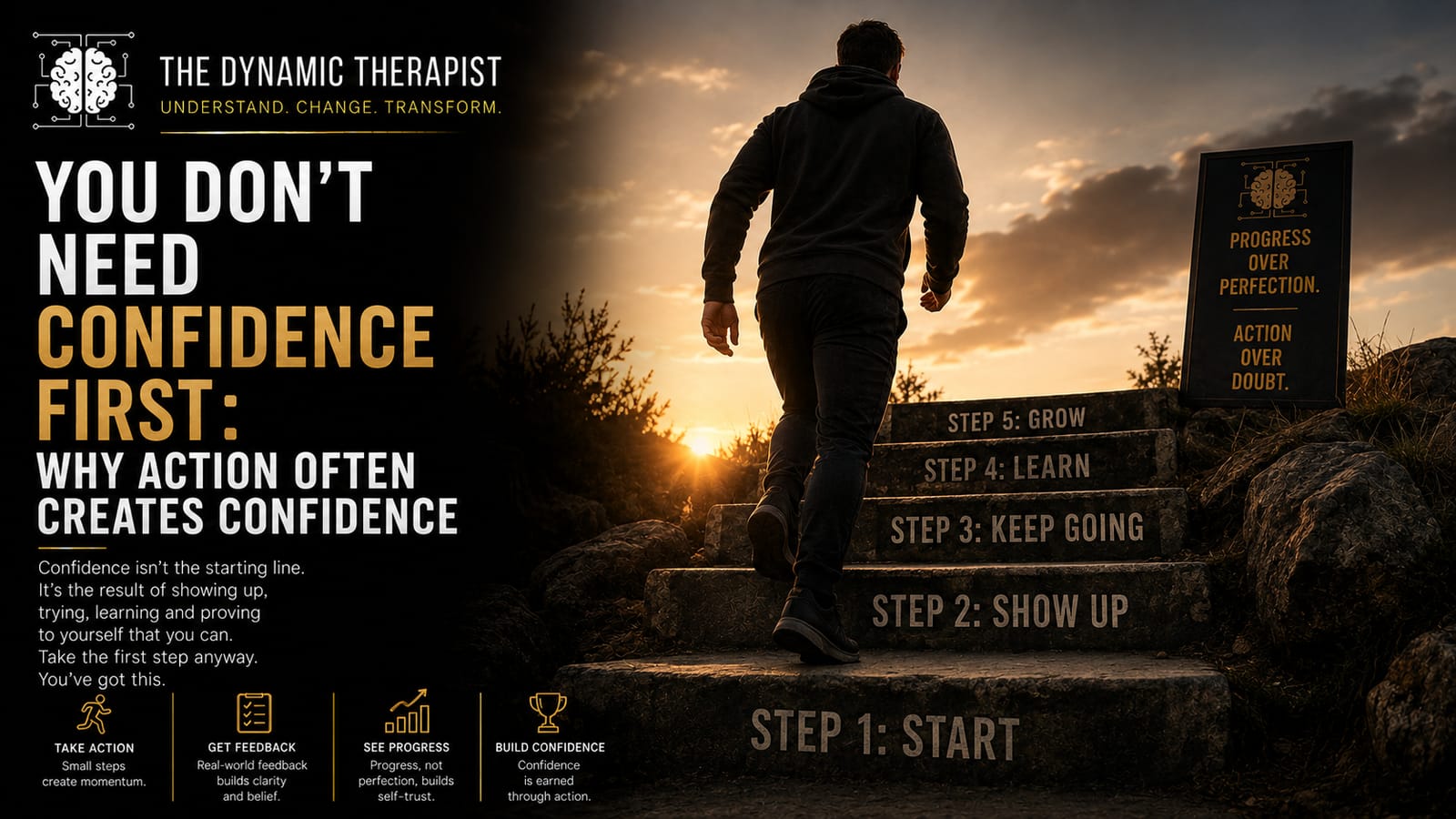
You Don’t Need Confidence First: Why Action Often Creates Confidence
A common trap is waiting to feel confident before you take action. You tell yourself: “Once I feel ready, I’ll apply.” “Once I feel calm, I’ll speak up.” “Once I feel certain, I’ll start.”
The problem is that Confidence often doesn’t arrive first. For many people, Confidence is the result of action — because action creates evidence.
This post explains the relationship between action, evidence, competence and Confidence, why avoidance keeps you stuck, and how to build a step-by-step Confidence ladder with a realistic worked example. We’ll also cover how to handle setbacks without treating them as proof of failure.
The relationship: action → evidence → competence → Confidence
Confidence isn’t a personality trait you either have or don’t have. It’s often a feeling that comes from evidence: “I did it — and I coped.”
- Action creates experience.
- Experience creates evidence.
- Evidence builds competence (skills + coping).
- Competence makes Confidence more likely.
If you wait for Confidence before acting, you often end up waiting forever — because you’re not collecting new evidence.
Why avoidance feels helpful (and why it keeps you anxious)
Avoidance works short-term. It reduces Anxiety quickly, which teaches your brain: “Avoiding kept me safe.”
But long-term, avoidance has a cost: it prevents you from learning what you can handle. Without new evidence, your brain keeps treating the situation as dangerous.
Avoidance doesn’t prove you can’t cope. It prevents you from finding out that you can.
A practical tool: the Confidence Ladder
A Confidence ladder is a step-by-step plan that helps you build evidence gradually. You don’t jump from “terrified” to “fine”. You climb.
Step 1: Define the target action
Be specific. Not “be confident”. Something observable.
Example targets:
- Speak up in a meeting once a week.
- Go to the gym alone.
- Post one piece of content for your business.
- Make a phone call you’ve been avoiding.
Step 2: Rate your fear (0–10)
This helps you choose steps that are challenging but doable.
Step 3: Break it into 6–10 smaller steps
Each step should be slightly harder than the last. Aim for steps in the 3–7/10 range — not 10/10.
Step 4: Repeat each step until it feels more manageable
Confidence grows through repetition. One attempt is data, not transformation.
Step 5: Record evidence (so your brain can’t erase it)
After each step, write:
- What I did (facts).
- What I predicted would happen.
- What actually happened.
- What I learned about what I can handle.
Worked example: speaking up at work
Let’s say your target is: “Contribute in meetings without Overthinking for hours.”
Confidence ladder (example)
- Step 1 (2/10): Write one sentence you could say in a meeting (privately).
- Step 2 (3/10): Ask one question in a low-stakes chat or email.
- Step 3 (4/10): Speak once in a small meeting (even a short clarification).
- Step 4 (5/10): Share one idea you prepared in advance.
- Step 5 (6/10): Speak once without scripting every word.
- Step 6 (7/10): Disagree politely on one small point.
- Step 7 (8/10): Present a short update to the group.
Notice what this does: it creates repeated evidence that you can tolerate the sensations (heart rate, uncertainty, being seen) and still function.
Handling setbacks without turning them into proof of failure
Setbacks are part of learning. If you treat every wobble as proof you’re not capable, you’ll stop collecting evidence.
Instead, use this reset:
- 1) Name it: “That was a hard moment.”
- 2) Separate outcome from identity: “This doesn’t mean I’m a failure.”
- 3) Extract learning: “What would I do differently next time?”
- 4) Return to the ladder: repeat the step or drop one rung temporarily.
Confidence isn’t linear. It’s built through returning — not through never struggling.
A helpful mindset shift
Instead of asking “Do I feel confident enough?”, try:
- “What is the smallest step that creates evidence?”
- “What would I do if I didn’t need certainty?”
- “Can I do this while anxious?”
When support can help
If avoidance is strong, Anxiety is intense, or you feel stuck in fear loops, support can help you build the ladder safely and address the beliefs underneath.
At The Dynamic Therapist, I use a blended approach — hypnotherapy, NLP and grounded coaching (and where appropriate, evidence-based tools such as CBT/DBT) — to help you reduce fear of sensations, change limiting beliefs, and take action without needing perfect Confidence first.
Key Takeaways
- Confidence often grows after action because action creates evidence.
- Avoidance reduces Anxiety short-term but prevents new learning long-term.
- A Confidence ladder builds capability through small, repeatable steps.
- Setbacks are data — not proof of failure. Return to the ladder and keep going.
Final Call to Action
If you’re stuck waiting to feel ready, book a free 30-minute consultation. We’ll map your avoidance pattern and build a Confidence ladder that fits your life.
Book your free consultation: https://tidycal.com/fws-tdt/free-30-minute-consultation
If you’d like a practical, grounded read that supports mindset shifts and everyday change, you may also find my book useful:
The Little Book of Big Changes: https://amzn.eu/d/00gxh8X1