
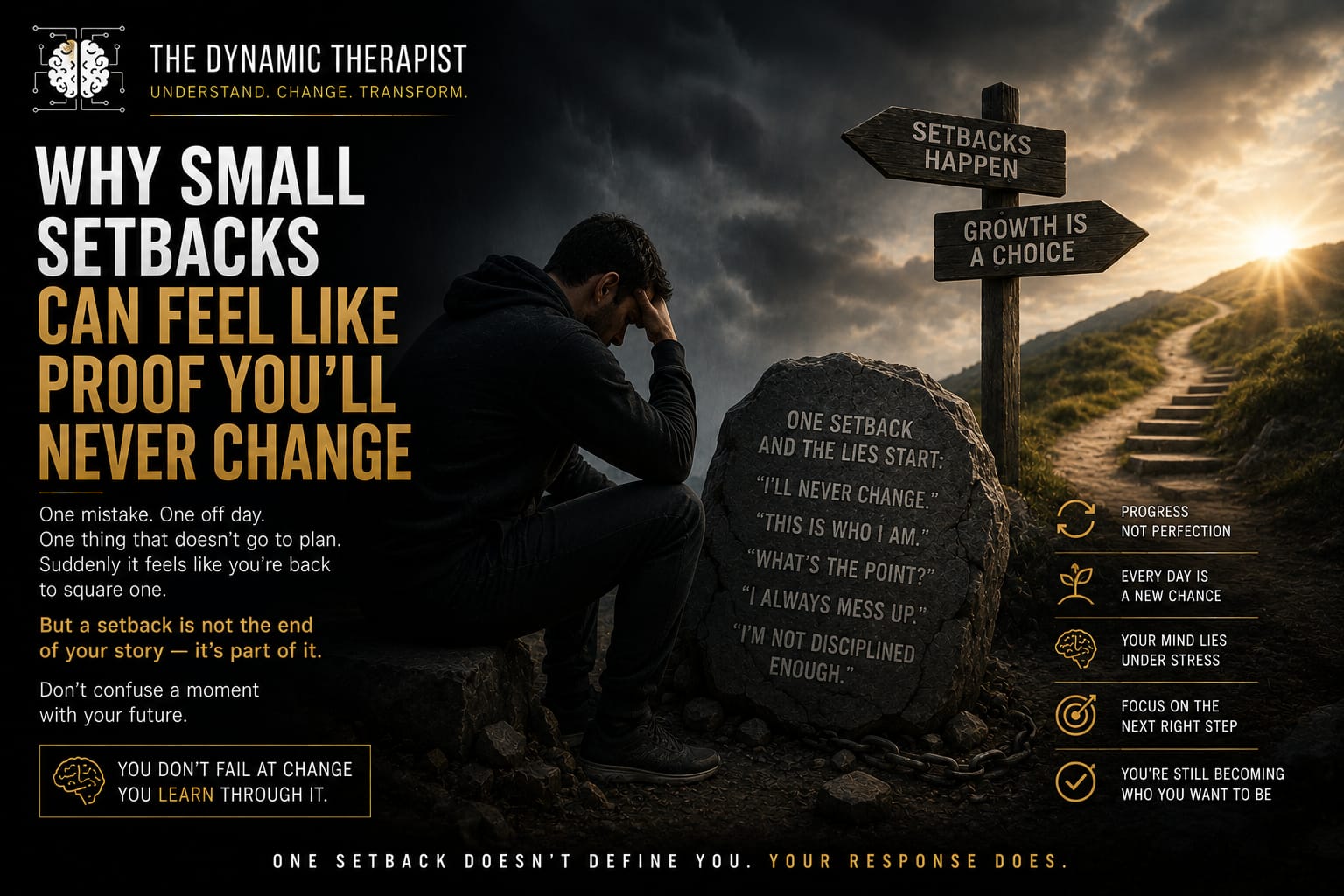
Why Small Setbacks Can Feel Like Proof You'll Never Change
You'd been doing well. Better sleep, more exercise, calmer thinking, a few good weeks in a row. And then one difficult day arrives and the whole thing feels like it's collapsed. Not just the day — the entire effort, the entire idea that change was possible. If you find yourself feeling discouraged after a setback in a way that feels disproportionate, all-or-nothing thinking is almost certainly part of what's happening.
What All-or-Nothing Thinking Does
All-or-nothing thinking divides experience into two categories: complete success or complete failure. Progress that doesn't reach the standard becomes the same as no progress. A single bad day erases the preceding good ones. A slip becomes a collapse.
This way of processing experience is exhausting and demoralising, and it almost always produces more of what it's trying to prevent. The perfectionist standard makes sustained effort feel pointless, because any imperfection confirms the worst story.
Why One Difficult Day Becomes an Identity Statement
This is where it gets interesting. A setback is an event. But all-or-nothing thinking converts it into an identity conclusion: 'I can't stick to anything.' 'I always do this.' 'I knew I wouldn't be able to change.' The specific instance becomes evidence for a general verdict about who you are.
This matters because you respond to events very differently from how you respond to believed-in facts about yourself. If a difficult day is an event, you can have a better one tomorrow. If it's proof of a fundamental inadequacy, there doesn't seem much point.
The Mathematics of Change
Actual change — the kind that sticks — almost always involves setbacks. Not occasionally, but as a structural feature. The trajectory is not a smooth upward line. It's irregular, with bad days, with backwards steps, with periods where nothing seems to be moving. This is not failure. It's how change works.
A setback that occurs within a genuine effort to change is completely different from not trying at all — even though all-or-nothing thinking treats them as equivalent.
What to Do After a Difficult Day
The single most useful thing is not to make major decisions about your capacity to change on the day itself, or in the immediate aftermath. The narrative that arises in those moments is almost always distorted by the emotional state. Wait 24 hours before drawing conclusions.
Then: what actually happened? What triggered it? What would you do differently? What was still working even in a difficult day? Getting specific and factual is more useful than allowing the all-or-nothing story to run.
When This Pattern Is Worth Working On
All-or-nothing thinking is one of the core patterns that The Little Book of Big Changes addresses — it covers how to recognise it, challenge it and develop a more realistic and useful relationship with setbacks. For people who want to address it more deeply, one-to-one work with The Dynamic Therapist can help.
Key Takeaways
All-or-nothing thinking converts setbacks into identity statements rather than events. A difficult day within genuine effort is not the same as failure. Change involves setbacks structurally — they're not evidence that change is impossible. Avoid drawing conclusions immediately after a difficult day. Getting specific and factual after a setback is more useful than global narratives.
One Bad Day Doesn't Define You. Let's Talk About What Does.
Book a free 30-minute consultation with The Dynamic Therapist, or get your copy of The Little Book of Big Changes to start working on the thinking patterns that make setbacks feel so final.