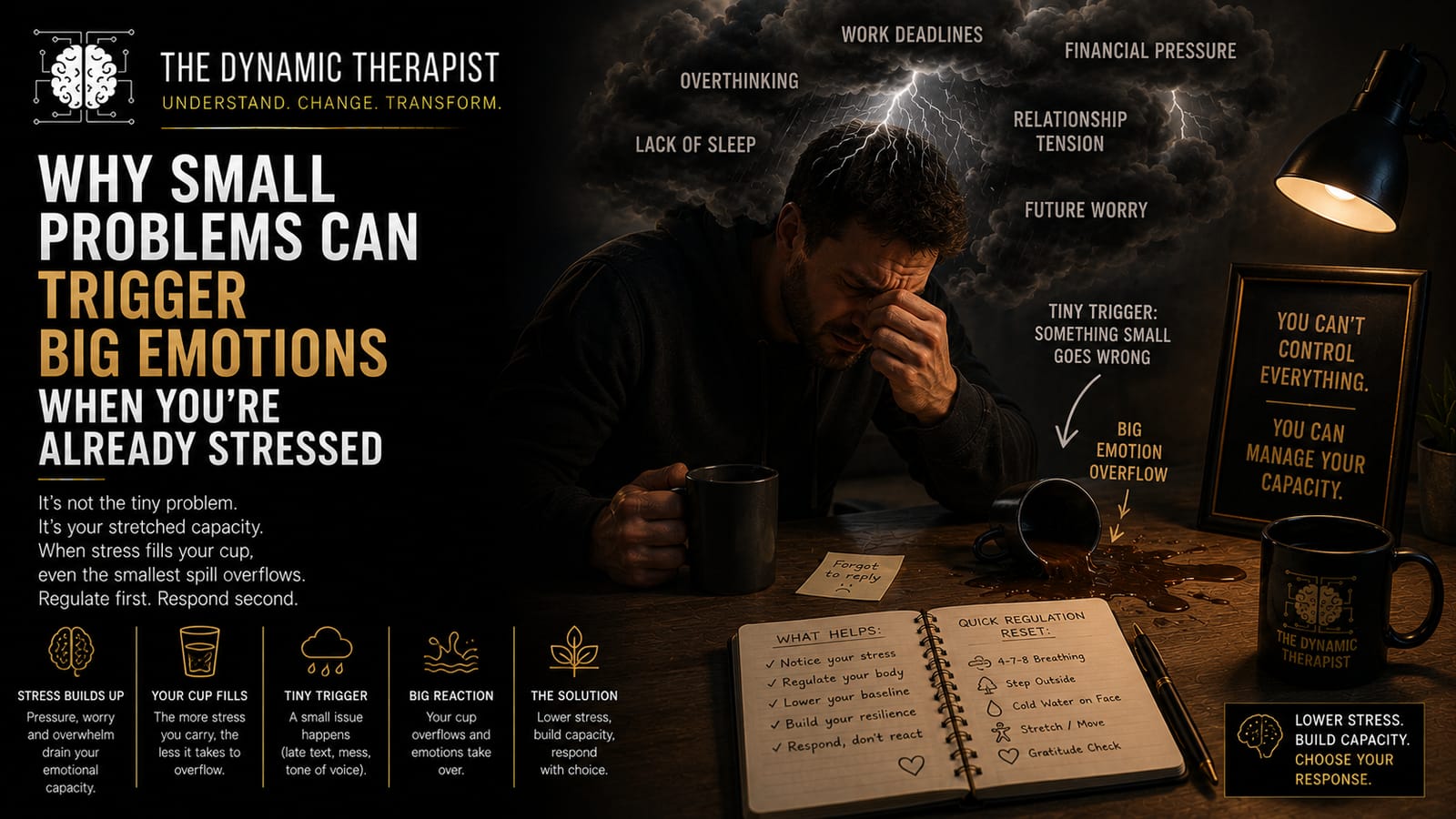
Why Small Problems Can Trigger Big Emotions When You’re Already Stressed
Have you ever snapped at something small — a noisy room, a message notification, a bit of mess — and then thought, “Why did I react like that?”
When you’re already stressed or overloaded, minor problems can feel like the final straw. That doesn’t mean you’re a bad person. It often means your emotional capacity is already depleted.
This post explains why small triggers can provoke big reactions, how to de-escalate in the moment, and how to identify what the Anger or overwhelm may be signalling — without excusing intimidating or abusive behaviour.
A clear boundary: Stress doesn’t excuse harmful behaviour
Feeling overwhelmed can explain why your system reacts strongly — but it doesn’t excuse shouting, intimidation, threats, or aggression. If your reactions are harming others or you feel out of control, it’s important to seek support and put safety first.
Why small problems feel bigger when you’re overloaded
1) Reduced emotional capacity (your “buffer” is smaller)
Think of emotional capacity like a battery. When it’s full, you can tolerate interruptions and annoyances. When it’s low, the same events feel unbearable. Your brain has less bandwidth for patience, perspective, and flexibility.
2) Accumulated frustration (the “final straw” effect)
Often the reaction isn’t really about the small thing. It’s about everything that came before it: weeks of pressure, unresolved conversations, too many demands, not enough recovery. The small trigger is simply where the build-up spills over.
3) Unmet needs (your system is asking for something)
Anger and irritability often show up when needs are unmet: rest, quiet, food, support, respect, autonomy, time, or fairness. If you’ve been pushing through and ignoring needs, your system may eventually force the issue.
4) Sensory overload (too much input)
Noise, bright lights, constant notifications, crowded spaces, and multitasking can overload the nervous system. When you’re already stressed, your tolerance for sensory input drops — so normal sounds or interruptions can feel like an attack.
5) Lack of sleep (less regulation, more reactivity)
Sleep is one of the biggest regulators. When you’re tired, your brain is more threat-sensitive and less able to inhibit impulses. That’s why you can feel “fine” one day and reactive the next after poor sleep.
6) Suppressed feelings (what you don’t feel doesn’t disappear)
If you’ve been swallowing sadness, fear, disappointment, or resentment, those feelings don’t vanish — they often leak out as irritability. Anger can be a secondary emotion that covers more vulnerable feelings underneath.
Relatable examples (why it happens in everyday life)
- Noise: the TV is on, someone is talking, your phone is buzzing — and you suddenly feel furious.
- Interruptions: you finally sit down to focus and someone asks “just one quick thing”.
- Traffic: you’re already late and one slow driver feels like a personal insult.
- Messages: you see a notification and feel instantly pressured or trapped.
- Household mess: one pile of clutter feels like proof you can’t cope.
In these moments, your reaction is often your nervous system saying: “I’m at capacity.”
Immediate de-escalation: the 90-second reset
When you feel the surge, your goal is to reduce escalation quickly — not to win an argument or solve everything.
- 1) Pause your mouth: stop talking for a moment (even one breath).
- 2) Drop tension: unclench jaw, lower shoulders, relax hands.
- 3) Slow the exhale: inhale gently for 3–4 seconds, exhale for 5–7 seconds (x6 breaths).
- 4) Orient outward: name 5 neutral objects you can see.
- 5) Choose a safe next move: step away, get water, or say “I need a minute — I’ll come back.”
This isn’t about suppressing emotion. It’s about preventing the nervous system from tipping into fight mode where you say or do things you regret.
Longer-term: what the Anger may be signalling
Once you’re calm enough, the useful question becomes: what is this reaction pointing to? Try this simple process:
Step 1: Identify the pattern
Ask: When does this happen most? (time of day, after work, around certain people, when hungry/tired, when overstimulated).
Step 2: Name the underlying need
Common needs under irritability include: rest, quiet, autonomy, fairness, support, appreciation, clarity, or time.
Step 3: Find the “leak”
Where are you swallowing feelings or saying yes when you mean no? Resentment often builds where boundaries are weak.
Step 4: Choose one change (small but real)
Examples:
- Reduce sensory load: notifications off for an hour, quieter environment, fewer tabs open.
- Protect sleep: consistent bedtime, wind-down routine, less late-night scrolling.
- Meet basic needs: food, hydration, movement, short breaks.
- Set one boundary: one “no”, one time limit, one delegated task.
- Have one honest conversation: “I’m overloaded and I need…”
What to do if you’ve already snapped
Repair matters. If you reacted in a way that hurt someone, take responsibility without self-attack:
- “I’m sorry I snapped. I was overloaded, but that’s not an excuse.”
- “I’m going to take a few minutes to calm down and then we can talk.”
- “Here’s what I need going forward…”
When support may be worthwhile
If you’re frequently reactive, overwhelmed, or stuck in a cycle of pressure → snapping → guilt, support can help you change the pattern underneath. Therapy can help with boundaries, nervous system regulation, emotional processing, and reducing the build-up that leads to blow-ups.
At The Dynamic Therapist, I use a blended approach — hypnotherapy, NLP and grounded coaching (and where appropriate, evidence-based tools such as CBT/DBT) — to help you build capacity and respond differently under Stress.
Key Takeaways
- Big reactions to small problems often signal reduced capacity and accumulated Stress.
- Sleep, sensory overload, unmet needs, and suppressed feelings can amplify reactivity.
- De-escalation is about slowing the nervous system before you act.
- Long-term change comes from identifying patterns, needs, and boundaries — not self-blame.
- Stress explains reactions, but it doesn’t excuse abusive or intimidating behaviour.
Final Call to Action
If you’re tired of feeling like you’re one small thing away from snapping, book a free 30-minute consultation. We’ll map what’s driving the overload and build a plan that helps you feel steadier day-to-day.
Book your free consultation: https://tidycal.com/fws-tdt/free-30-minute-consultation
If you’d like a practical, grounded read that supports mindset shifts and reduces self-doubt, you may also find my book useful:
The Little Book of Big Changes: https://amzn.eu/d/00gxh8X1