
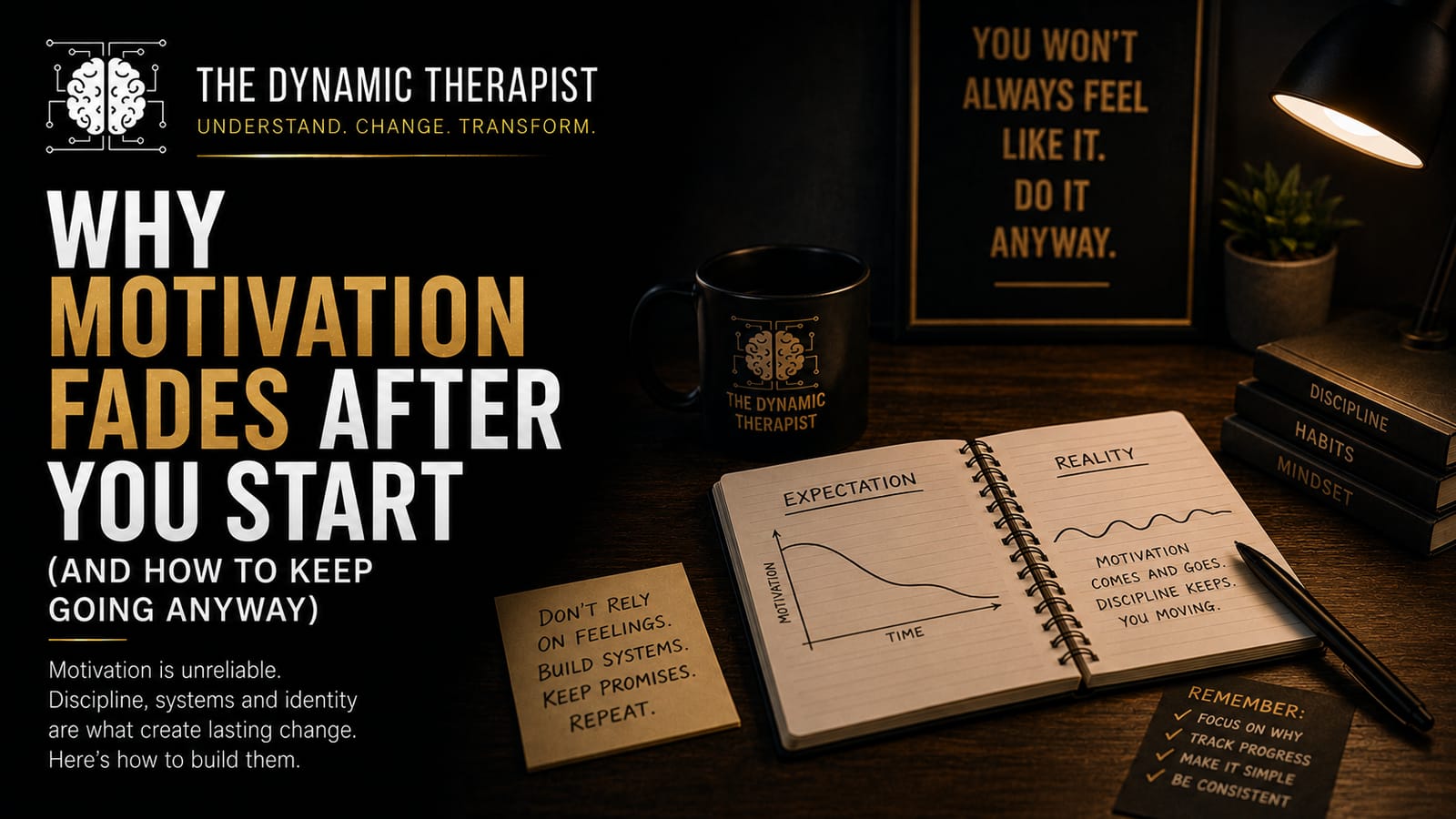
Why Motivation Fades After You Start (and How to Keep Going Anyway)
The beginning of a new goal often feels electric. You’re inspired. You make a plan. You imagine the future version of you. Then a week or two later, motivation fades — and you start wondering what’s wrong with you.
Usually, nothing is wrong with you. Motivation is a feeling, and feelings fluctuate. The real question is whether you have a system that can carry you when the excitement wears off.
This post explains why motivation often fades after the initial burst and gives you a simple, practical system for continuing during low-motivation periods — including minimum standards, environmental design, tracking, and restarting without shame.
Why motivation fades (common reasons)
Unrealistic plans
Many goals fail because the plan is built for your best day, not your real life. If your plan requires perfect energy, perfect time, and perfect mood, it won’t survive a normal week.
Novelty wears off
New goals come with novelty — and novelty is motivating. Once the newness fades, the goal becomes repetition. That’s where systems matter more than excitement.
Perfectionism
Perfectionism turns progress into a pass/fail test. If you miss one day, you feel like you’ve failed — so you stop. Perfectionism doesn’t create consistency; it destroys it.
Delayed rewards
Many goals have delayed payoff: fitness, business growth, learning, healing. Your brain prefers immediate rewards, so it naturally drifts toward what feels good now.
Identity conflicts
Sometimes the goal clashes with an old identity: “I’m not the kind of person who…” or “People like me don’t…” If success would change how you see yourself — or how others see you — your system may resist.
Emotional resistance
Goals often bring up emotion: fear of failure, fear of success, fear of judgement, fear of disappointment. Motivation fades when the goal starts touching the feelings underneath.
Relying on mood rather than structure
If your plan is “I’ll do it when I feel like it,” you’re outsourcing your future to your mood. Structure is what keeps you moving when mood is low.
A simple system for low-motivation periods
This system is designed to be boring in the best way: reliable. You don’t need to feel motivated. You need to reduce friction and keep the chain alive.
1) Set minimum standards (the “floor”, not the “ceiling”)
Minimum standards are what you do on your worst day — the smallest version that still counts.
Examples:
- Fitness goal: 10-minute walk (minimum) instead of a full workout.
- Business goal: 10 minutes of outreach or one post draft.
- Learning goal: 5 minutes of reading or one practice question.
- Mental health goal: 6 slow breaths + one journal line.
Minimum standards protect consistency. You can always do more — but you don’t have to.
2) Use environmental design (make the right thing easier)
Your environment is a silent coach. Reduce friction for the habit you want and increase friction for the habit you don’t.
- Put walking shoes by the door.
- Keep your journal open on the table.
- Remove distracting apps from your home screen.
- Prep tomorrow’s task the night before (one small step).
3) Track the process (not just outcomes)
Tracking isn’t about pressure — it’s about evidence. A simple tick-box calendar works. Track “did I show up?” not “did I do it perfectly?”
If you want a simple rule: never miss twice. Missing once is normal. Missing twice is a pattern.
4) Plan for the restart (without shame)
Everyone drops habits. The difference is whether you restart quickly or turn it into a story about failure.
Use this restart script:
- “I paused. That’s information.”
- “What made it hard?”
- “What’s the smallest step I can do today?”
Restarting is a skill. Shame makes it harder. Curiosity makes it easier.
A quick template you can copy
LOW-MOTIVATION PLAN My goal: ____ My minimum standard (5–10 min): ____ My environment tweak (make it easier): ____ My tracking method: ____ My restart rule: “If I miss, I will restart within ____ hours with ____.”
How this connects to The Little Book of Big Changes
The Little Book of Big Changes is built around practical change principles: small, repeatable actions that create momentum — especially when motivation is low. It’s not about hype. It’s about systems, identity shifts, and doing what works in real life.
If you’d like a practical resource to use alongside this system: The Little Book of Big Changes: https://amzn.eu/d/00gxh8X1
When support may help
If motivation fades because the goal triggers Anxiety, perfectionism, fear of judgement, or self-sabotage patterns, support can help you change what’s underneath — not just push harder.
At The Dynamic Therapist, I use a blended approach — hypnotherapy, NLP and grounded coaching (and where appropriate, evidence-based tools such as CBT/DBT) — to help you build sustainable change without relying on willpower.
Key Takeaways
- Motivation fades because novelty wears off, rewards are delayed, and real life is messy.
- Perfectionism and mood-based planning destroy consistency.
- A simple system (minimum standards + environment + tracking + restart) keeps you moving.
- Restarting without shame is part of the process — not proof you failed.
Final Call to Action
If you’re stuck in a cycle of starting strong and fading out, book a free 30-minute consultation. We’ll map what’s driving the drop-off and build a system that fits your life.
Book your free consultation: https://tidycal.com/fws-tdt/free-30-minute-consultation