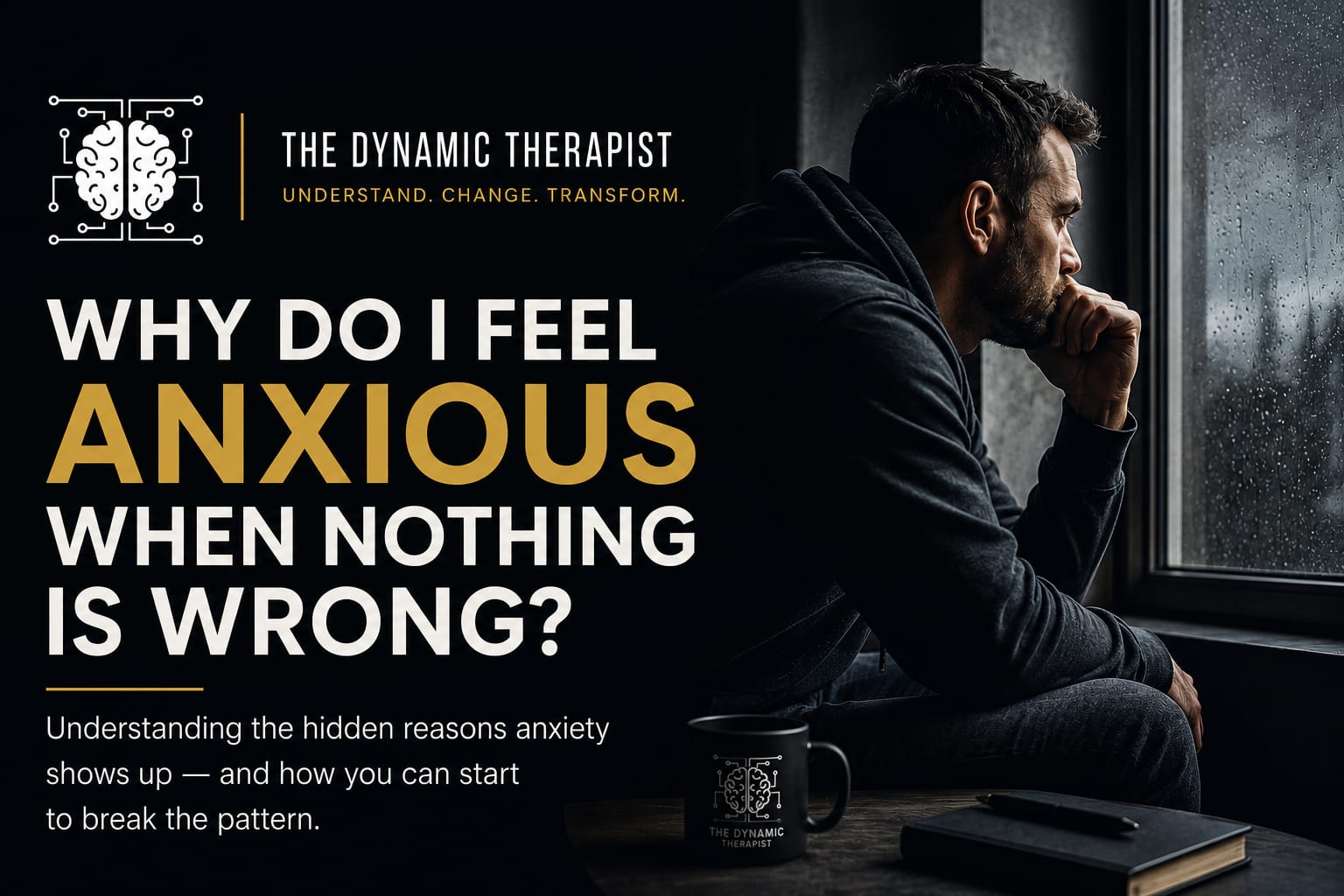
You can be having a perfectly ordinary day — nothing urgent, nothing obviously “wrong” — and still feel anxious. Your chest feels tight, your stomach flips, your mind starts scanning for problems, and you’re left thinking: “What is this about?”
If you relate to that, you’re not imagining it and you’re not weak. Anxiety can show up without an immediate threat because it isn’t only a reaction to what’s happening right now. It’s often a response to what your nervous system has learned to expect.
This article will help you understand why “no obvious reason” doesn’t necessarily mean “no reason at all”, and what to do first — without fighting, suppressing, or catastrophising the feeling.
Anxiety is often a nervous system state, not a logical conclusion
A lot of people try to solve Anxiety like it’s a thinking problem: “If I can work out what’s wrong, I’ll calm down.” Sometimes that helps. But often Anxiety is more like a setting your system has slipped into — a threat-ready state — and your mind then tries to explain it.
When your nervous system is on alert, your brain naturally looks for danger. That can create a strange experience: the body feels anxious first, and the mind starts searching for a story to match.
That’s why you can feel anxious while doing something objectively safe — sitting on the sofa, walking the dog, even lying in bed.
“No obvious reason” doesn’t mean “no reason at all”
If you wake up anxious, feel unsettled during quiet periods, or suddenly feel on edge while relaxing, it can be tempting to conclude that Anxiety is random. Usually it isn’t random — it’s just not obvious.
The trigger might be subtle, delayed, or outside conscious awareness. And sometimes the “reason” is simply accumulated load: stress that hasn’t had a chance to discharge.
Common reasons Anxiety appears when nothing is wrong
1) Accumulated Stress and delayed reactions
Many people hold it together during busy periods, then feel anxious when things finally slow down. Your system has been running on adrenaline and focus, and when you stop, the backlog catches up.
Example: You get through a demanding week at work. Saturday morning arrives, you finally sit down with a coffee — and your body starts buzzing. Your mind says, “Why now?” Your nervous system says, “Now I have space to feel what I couldn’t feel earlier.”
2) Learned associations (your brain linking safety with danger)
Your brain is a pattern-recognition machine. If you’ve had difficult experiences, it can link neutral situations with threat — even if you consciously know you’re safe.
Example: Quiet evenings might feel unsettling if, in the past, quiet meant tension at home. Or relaxing might trigger Anxiety if you learned that “letting your guard down” leads to something going wrong.
3) Unconscious triggers and micro-cues
Sometimes the trigger is a small cue you barely notice: a smell, a tone of voice, a certain time of day, a song, a type of lighting, even a body posture. Your system recognises it before your conscious mind does.
This can be especially true after Trauma. You don’t need to remember every detail for your nervous system to react to a familiar pattern.
4) Physical sensations that get misread as danger
Anxiety often involves physical sensations: a racing heart, breath changes, dizziness, nausea, tingling, tightness in the chest. If you’ve had panic before, those sensations can become a trigger in themselves.
You notice a flutter in your chest, then your mind goes: “Here we go again.” The fear of the sensation amplifies the sensation — and the loop builds.
If you have new, severe, or worrying physical symptoms, it’s important to speak to an appropriate healthcare professional to rule out medical causes.
5) Lifestyle factors that quietly push your system into alert
Sometimes Anxiety is being fuelled by everyday factors that don’t look dramatic but add up:
- poor sleep or irregular sleep patterns
- too much caffeine (or caffeine later in the day)
- skipping meals or blood sugar dips
- alcohol rebound Anxiety the next day
- constant scrolling and information overload
- lack of movement or time outdoors
None of these mean “it’s all lifestyle”. But they can raise the baseline level of tension in the system, making Anxiety more likely to appear “out of nowhere”.
6) Becoming frightened of Anxiety itself
One of the most common patterns I see is Anxiety about Anxiety. You’ve felt it before, you hated it, and now your system treats the first hint of it as a threat.
That creates a second layer: not just “I feel anxious”, but “What if this gets worse? What if I can’t cope? What if I lose control?”
This is where people often start fighting the feeling — trying to suppress it, distract from it, or mentally wrestle it into submission. Unfortunately, that struggle tends to signal danger to the nervous system, which keeps the loop going.
Relatable examples (and what they often mean)
Waking with Anxiety
Waking anxious can happen because cortisol naturally rises in the morning. If your system is already under strain, that normal rise can feel like alarm. It can also reflect unresolved Stress, anticipatory worry, or a nervous system that hasn’t fully downshifted overnight.
Feeling anxious during quiet periods
Quiet can remove distractions. If you’ve been running on “doing mode” for a long time, stillness can feel unfamiliar — and unfamiliar can feel unsafe to a threat-sensitive system.
Suddenly feeling unsettled while relaxing
If you’ve learned that relaxing equals vulnerability, your system may interpret rest as risk. The goal isn’t to force yourself to relax harder — it’s to teach your system that rest can be safe.
First steps: how to respond without fighting or catastrophising
You don’t need to “get rid of” Anxiety to handle it well. The first win is changing your response so the loop doesn’t escalate.
1) Name what’s happening, simply
Try: “My nervous system is activated.” Not “Something is wrong.” Not “I’m going to spiral.” Just a clean label.
2) Stop searching for a perfect explanation in the moment
When Anxiety is high, your mind will generate convincing stories. You can investigate later. For now, focus on stabilising.
3) Give your body a 60–90 second safety signal
A practical reset:
- Exhale slowly (make the out-breath longer than the in-breath).
- Drop your shoulders and unclench your jaw.
- Feel your feet on the floor and press them gently down.
- Look around and name five neutral objects in the room.
This isn’t about pretending everything is fine. It’s about telling your system: “Right now, in this moment, I’m safe enough.”
4) Reduce the secondary fear
If you notice “fear of fear”, try this reframe: “This feeling is uncomfortable, but it’s not dangerous.” You’re not arguing with the Anxiety — you’re removing the fuel.
5) Do one small grounding action
Anxiety pulls you into your head. Grounding brings you back into the present. Choose one:
- drink a glass of water slowly
- step outside for two minutes of daylight
- walk around the room and feel your legs working
- write down the next practical step for your day
How therapy can help (when Anxiety keeps returning)
If Anxiety keeps appearing “for no reason”, it’s often because the pattern underneath hasn’t been identified or updated yet. That’s not a life sentence — it’s a clue.
At The Dynamic Therapist, I use a blended approach — hypnotherapy, NLP and grounded coaching (and where appropriate, evidence-based methods such as CBT/DBT tools) — to help you understand what your system is doing and change the response at the root.
That might involve uncovering learned associations, reducing sensitivity to physical sensations, updating old threat rules, and building a calmer baseline so your mind doesn’t have to keep scanning.
Therapy isn’t about forcing you to be a different person. It’s about helping your system stop reacting as if you’re still in an old situation.
Key Takeaways
- Anxiety can show up without an immediate threat because it’s often a nervous system state.
- “No obvious reason” doesn’t mean “no reason at all” — triggers can be subtle, delayed, or unconscious.
- Accumulated Stress, learned associations, physical sensations, and lifestyle factors can all raise your baseline.
- Fear of Anxiety itself is a common driver of escalation.
- Responding with grounding and safety signals helps break the loop.
FAQ
Is it normal to feel anxious when life is calm?
Yes. Calm on the outside doesn’t always mean calm in the nervous system. If your baseline is elevated, Anxiety can appear during quiet moments.
Why do I feel anxious when I wake up?
Morning cortisol rises naturally. If you’re under strain, that rise can feel like alarm. Poor sleep, Stress, and anticipatory worry can also contribute.
Can Anxiety be caused by physical issues?
Sometimes. If symptoms are new, severe, or worrying, speak to a healthcare professional to rule out medical causes.
What if I’m anxious about being anxious?
That’s very common. The first step is reducing the secondary fear by treating the sensations as uncomfortable but not dangerous, then grounding your body.
How can therapy help if I don’t know the cause?
Therapy can help identify patterns you can’t easily see from inside the loop — and then change the automatic response so Anxiety stops being the default.
Final Call to Action
If you’re tired of Anxiety showing up when nothing is wrong, we can work on the pattern underneath it. Book a free 30-minute consultation and we’ll talk through what’s happening and what would help.
Book here: https://tidycal.com/fws-tdt/free-30-minute-consultation
If you’d like a practical, grounded read that supports mindset shifts and reduces self-doubt, you may also find my book useful:
The Little Book of Big Changes: https://amzn.eu/d/00gxh8X1