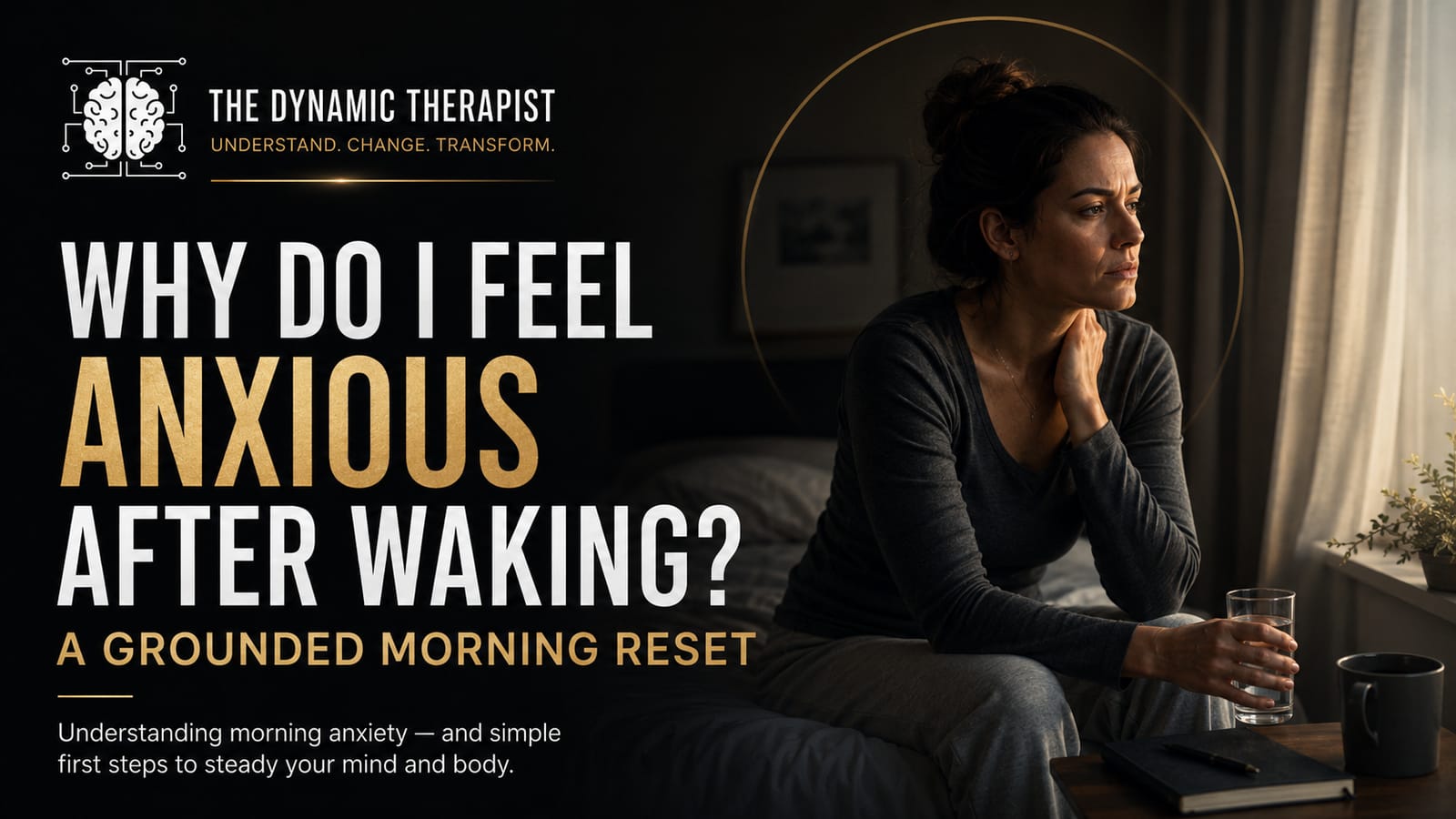
Why Do I Feel Anxious After Waking? A Grounded Morning Reset
For some people, the hardest part of the day is the first ten minutes. You open your eyes and your body is already tense: a tight chest, a fluttering stomach, a racing mind, a sense of dread that doesn’t seem to match anything happening in the room.
If that’s familiar, it can be confusing and frightening — especially if you went to bed feeling “fine”. The key point is this: waking Anxiety doesn’t always have one clear cause. It’s usually a mix of biology, habits, Stress load, and learned patterns.
This article explains common reasons Anxiety can spike shortly after waking, how to look for your own patterns, and a practical 20-minute morning reset routine that doesn’t require expensive equipment.
First: waking Anxiety doesn’t mean you’re broken
Morning Anxiety is often your nervous system switching on — sometimes a little too strongly. It can happen even when life is going reasonably well, and it can happen more during stressful seasons.
It’s also important to say this clearly: if symptoms are persistent, severe, new, or concerning — especially physical symptoms — it’s sensible to speak to an appropriate healthcare professional. Don’t automatically assume everything is Anxiety.
Why Anxiety can spike shortly after waking (common contributors)
Think of the morning as a “handover” between sleep physiology and daytime demands. Several factors can push that handover into an anxious state.
1) The body’s natural waking response (cortisol and activation)
Your body naturally increases cortisol in the morning to help you wake up. That’s normal. But if your baseline Stress is already high, that normal rise can feel like alarm — especially if you’re sensitive to physical sensations.
2) Anticipation of the day (even if you’re not consciously worrying)
Sometimes your mind is already running tomorrow’s script before you’ve even stood up. You might not be thinking “I’m worried”, but your system is preparing for pressure: meetings, responsibilities, conflict, uncertainty, or simply too much to do.
This can be subtle. You wake up and your brain starts scanning: “What have I forgotten? What’s coming? What if I can’t cope?”
3) Poor sleep and a nervous system that never fully downshifted
Broken sleep, late nights, alcohol, or inconsistent routines can leave your system more reactive. When you’re tired, your brain has less capacity to regulate Stress — so sensations feel bigger and thoughts feel more urgent.
4) Unresolved Stress (your system carrying yesterday into today)
Many people “hold it together” during the day and only feel the impact when things slow down. Sleep doesn’t always clear the backlog. If you’ve been running on adrenaline, your body may wake up still in threat mode.
5) Checking your phone immediately
If the first thing you do is check messages, news, or social media, you’re feeding your nervous system information before it’s stabilised. Even neutral content can trigger comparison, urgency, or mental overload.
6) Caffeine (especially early, strong, or on an empty stomach)
Caffeine can be a useful tool — and it can also mimic Anxiety sensations: faster heart rate, jitteriness, shallow breathing. If you’re already waking activated, caffeine can push you over the edge.
7) Blood-sugar fluctuations
If you wake up hungry, shaky, or nauseous, blood sugar may be part of the picture. Long gaps without food can trigger adrenaline, which can feel like Anxiety. This doesn’t mean you need a perfect diet — it means it’s worth noticing patterns.
8) Learned morning routines (your brain linking mornings with pressure)
If mornings have historically meant rushing, criticism, conflict, or pressure, your system can learn: “Morning = threat.” Even when life changes, the nervous system can keep running the old programme until it’s updated.
Avoid the trap: “I woke up anxious, so today will be awful”
One of the biggest amplifiers of morning Anxiety is the interpretation you attach to it. If you wake up tense and immediately think, “Here we go again,” your brain treats the sensation as proof of danger.
A more helpful stance is: “My system is activated. Let’s stabilise first.”
A practical 20-minute morning reset (no equipment needed)
This routine isn’t a magic fix. It’s a way to send your nervous system a clear message: “We’re safe enough to start the day.” Do what you can, not what’s perfect.
Minute 0–2: Hydration + a simple cue of safety
Drink a glass of water. While you do, drop your shoulders and unclench your jaw. If you can, sit upright with both feet on the floor.
Minute 2–6: Breathing that calms (not forced deep breaths)
Try this for four minutes:
- Inhale gently through the nose for 3–4 seconds.
- Exhale slowly for 5–7 seconds (longer out-breath than in-breath).
- Keep it comfortable — no gasping, no strain.
Longer exhalations help signal safety to the nervous system. If you feel light-headed, ease off and return to normal breathing.
Minute 6–10: Light exposure (even if it’s cloudy)
Get daylight into your eyes (not staring at the sun). Step outside, stand by an open window, or walk to the end of the street. Light helps regulate your body clock and can reduce grogginess and Stress reactivity.
Minute 10–15: Gentle movement to discharge activation
Choose something simple:
- a brisk 5-minute walk
- slow stair walking
- a few minutes of stretching (neck, shoulders, hips)
- 10 bodyweight squats at an easy pace
Movement tells your body: “We can handle energy.” It also reduces the urge to sit and ruminate.
Minute 15–20: Delay social media + choose one manageable priority
Before you open apps, choose one priority that is genuinely manageable. Not “fix my whole life”. One step.
Examples:
- Send one email you’ve been avoiding.
- Do a 10-minute admin task.
- Book the appointment you keep postponing.
- Prepare one meal or snack so blood sugar stays steadier.
This reduces the sense of chaos. Your brain likes traction. One clear step can calm the system more than an hour of thinking.
How to find your pattern (without obsessing over it)
Because there isn’t one universal cause, the most useful approach is gentle pattern-spotting. Over a week, notice:
- What time you went to bed and how broken your sleep was
- Whether you checked your phone immediately
- Caffeine timing and strength
- Whether you ate late, skipped dinner, or woke hungry
- What kind of day you had yesterday (Stress load)
- Whether mornings are rushed or calm
You’re not trying to control everything. You’re looking for leverage — the few factors that make the biggest difference for you.
When to seek medical advice
If morning Anxiety comes with symptoms that are persistent, severe, new, or concerning — especially chest pain, fainting, significant breathlessness, or anything that worries you — speak to an appropriate healthcare professional. It’s better to rule things out than to carry uncertainty.
How support can help
If waking Anxiety is frequent, it often means your nervous system is running an old programme: anticipating threat, scanning for danger, and bracing for the day. Therapy can help you uncover what’s driving that pattern and change it at the root.
At The Dynamic Therapist, I use a blended approach — hypnotherapy, NLP and grounded coaching (and where appropriate, evidence-based tools such as CBT/DBT) — to help you calm the baseline, reduce fear of sensations, and build a morning routine that supports you rather than pressures you.
Key Takeaways
- Morning Anxiety is often a mix of biology, Stress load, habits, and learned patterns.
- Cortisol, poor sleep, anticipation, caffeine, blood sugar and phone-checking can all contribute.
- A short reset routine can stabilise your system without needing perfect motivation.
- Look for patterns rather than a single universal cause.
- Seek medical advice if symptoms are persistent or concerning.
FAQ
Why do I wake up with a racing heart?
It can be linked with the natural waking response, Stress, poor sleep, caffeine, or blood sugar. If it’s new or worrying, get medical advice.
Does checking my phone really make it worse?
For many people, yes. It introduces urgency and stimulation before your system is stable. Delaying it even 20 minutes can help.
Should I stop caffeine completely?
Not necessarily. But if you wake anxious, try delaying caffeine, reducing strength, or having it after food and hydration.
What if the routine feels like another task?
Keep it simple. Even 5 minutes of hydration, slower exhalations, and daylight is a win. The goal is support, not perfection.
When should I get extra support?
If waking Anxiety is frequent, affecting your day, or leading to avoidance, support can help you change the underlying pattern rather than just manage symptoms.
Final Call to Action
If you’re waking anxious most days and you want to change the pattern underneath it, book a free 30-minute consultation. We’ll map what’s happening and what would help.
Book your free consultation: https://tidycal.com/fws-tdt/free-30-minute-consultation
If you’d like a practical, grounded read that supports mindset shifts and reduces self-doubt, you may also find my book useful:
The Little Book of Big Changes: https://amzn.eu/d/00gxh8X1