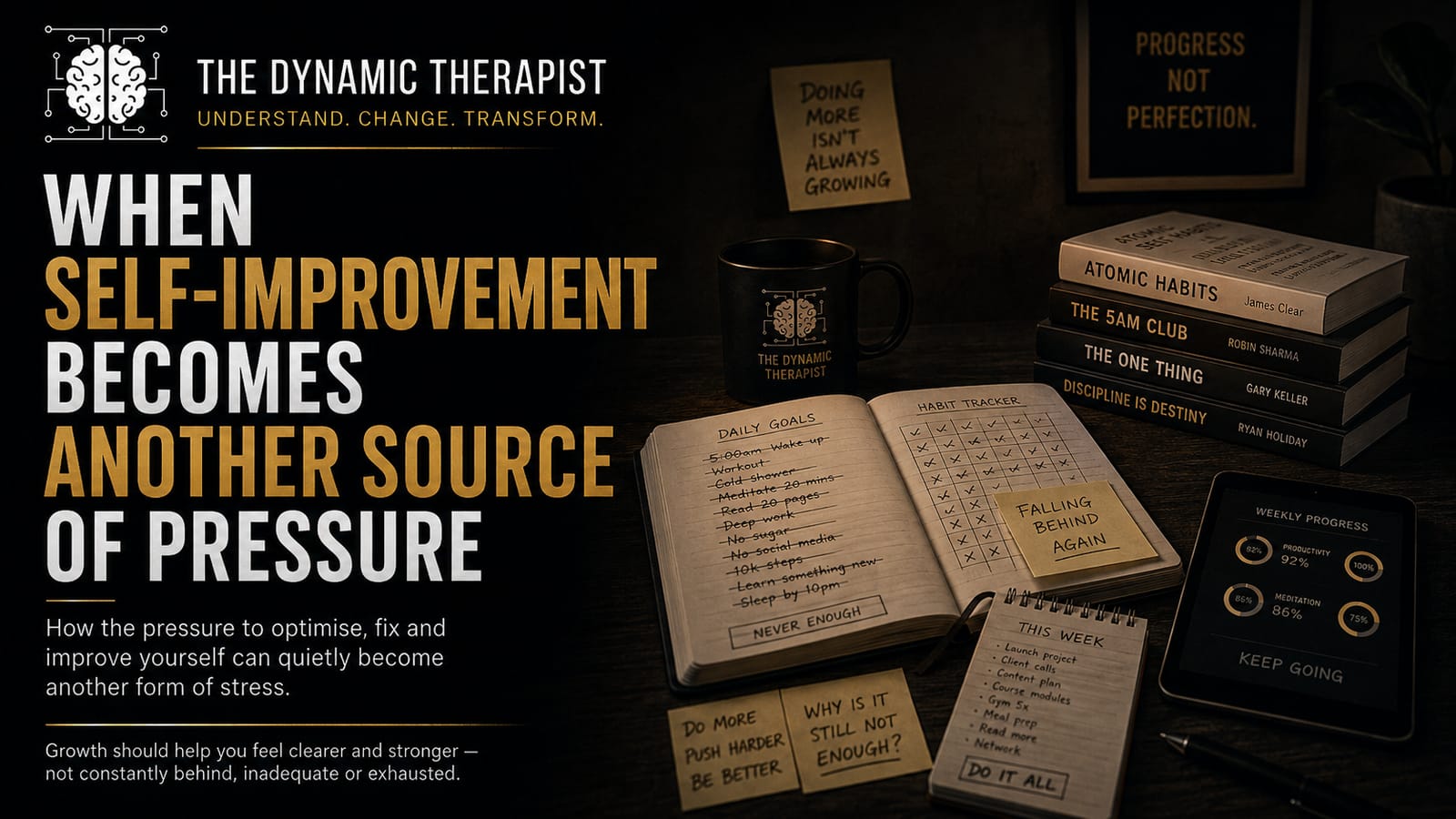
When Self-Improvement Becomes Another Source of Pressure
There's something quietly contradictory about the self-improvement industry. It exists to help people feel better — and for a significant number of people, it produces the opposite effect. The endless stream of content about optimising your morning, fixing your mindset, building better habits and becoming your best self creates its own particular kind of pressure. Self-improvement Anxiety is real, and it's worth examining.
How Improvement Becomes a Performance
Self-improvement starts as something genuinely useful: the desire to grow, to address what isn't working, to become more capable or more content. The problem comes when it shifts from something you do to something you are — when the state of self-improvement becomes an identity, and falling short of the improvement standard becomes another failure to add to the list.
At that point, you're not working on yourself. You're performing self-improvement, with all the Anxiety that any performance produces.
The Specific Pressures It Creates
The comparison problem is significant. Every book, podcast and social media account features someone who has apparently figured something out that you haven't. There's always a system more optimised, a habit more consistent, a mindset more evolved than yours. The standard keeps moving because there's always more improvement available.
The productivity-isation of rest is another problem. When rest, sleep, exercise and relationships become inputs to be optimised rather than parts of a life to be lived, even recovery becomes work. The constant self-monitoring required by intensive self-improvement approaches is itself cognitively and emotionally tiring.
And there's a deeper issue: for some people, self-improvement is a sophisticated form of the belief that they are not currently acceptable. The improvement project is an ongoing attempt to become good enough. It tends not to reach a conclusion, because the goalposts shift whenever the current level is reached.
What Genuine Growth Actually Looks Like
It tends to be slower, less dramatic and more specific than the self-improvement industry suggests. It's usually not about becoming a better version of yourself in general — it's about addressing something specific that isn't working, and making a sustainable change to it. That's a smaller, quieter, more honest project than the one being sold.
It also involves periods of consolidation — not working on yourself, not optimising anything, just living. These periods aren't failures. They're part of how change actually works.
A More Useful Frame
Rather than 'how do I become better', try 'what specifically isn't working right now, and what one thing could I do differently?' This is answerable. It's actionable. And it doesn't require you to remain in a permanent state of remediation.
What The Dynamic Therapist Offers
The Little Book of Big Changes is deliberately different from most self-improvement content. It's practical, specific and honest about what change actually involves — without the promise of transformation or the pressure of a programme to follow. For one-to-one work, a free 30-minute consultation is available to discuss what's actually going on and what would genuinely help.
Key Takeaways
Self-improvement can create its own pressure when it shifts from something you do to something you are. The comparison problem is structural — there's always more improvement available. For some people, self-improvement is an attempt to become acceptable rather than to address specific things. Genuine growth is slower and more specific than the industry suggests. Periods of not working on yourself are a normal and necessary part of change.
Tired of Trying to Fix Yourself? Let's Have an Honest Conversation.
Book a free 30-minute consultation with The Dynamic Therapist,
or get your copy of The Little Book of Big Changes for a more grounded approach to growth.