
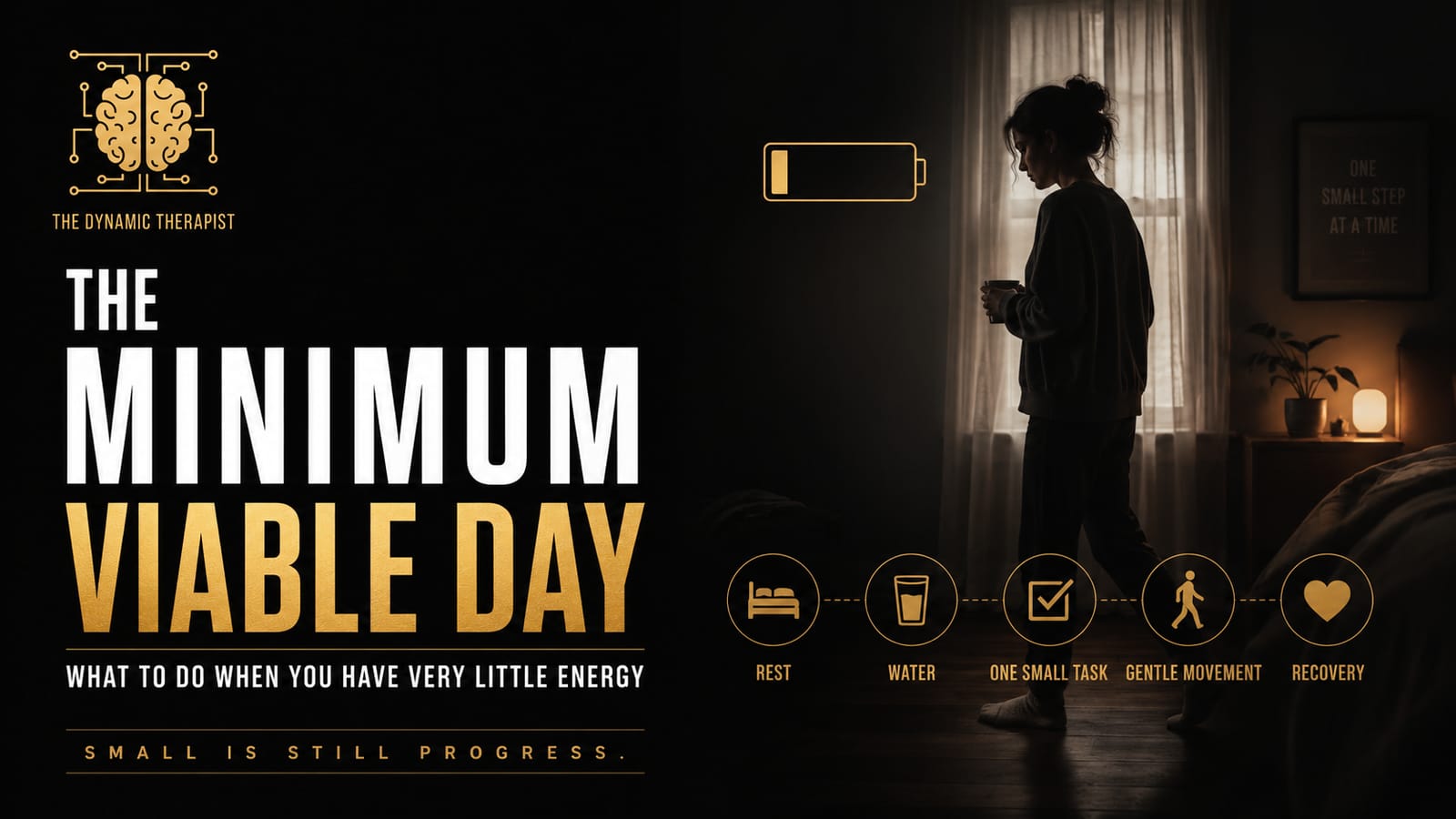
The Minimum Viable Day: What to Do When You Have Very Little Energy
When Getting Through Is the Goal
There are days when the plan collapses before it starts.
You wake up depleted, or something has happened, or the accumulated weight of a difficult week has finally landed and there is simply not the energy to execute the version of the day you intended.
Most people handle these days in one of two ways.
The first is to push through — to demand the same performance from a depleted system that the system cannot currently provide, which produces poor-quality work, increasing frustration and usually a worse crash afterwards.
The second is to abandon the day entirely — to decide that if you cannot do it properly, you will not do it at all, which leaves the day having produced nothing and often adds guilt to the existing depletion.
Both responses treat the day as binary: full performance or nothing. Neither is actually useful.
The minimum viable day is the third option.
It is a pre-defined set of actions — deliberately small, covering the essential domains — that constitute a good enough day when full performance is not available. Not the ideal day. The floor.
What a Minimum Viable Day Includes
The specifics are personal, but the categories are consistent across most people's lives.
Health: one non-negotiable physical action
Not a full workout.
A walk around the block.
Ten minutes of movement.
A single stretch.
Something physical that prevents the complete sedentary collapse that a genuinely difficult day can produce.
The point is not fitness.
The point is maintaining the physical baseline and the self-signal that you are looking after yourself even on a hard day.
Work: one meaningful output
On a minimum viable day, the standard is not productivity — it is continuity.
The single most important task, done to a standard that is functional rather than exceptional.
One email that needed to be sent.
One decision that needed to be made.
One thing that moves the most important project one step forward.
Not ten things.
One.
Relationships: one genuine point of contact
A short message to someone who matters. A brief conversation. Something that maintains the relational thread rather than disappearing into the difficult day without acknowledgement.
This is partly for the relationship and partly for you — social connection, however brief, tends to reduce the intensity of difficult days more than isolation does.
Self: one thing that is yours
Five minutes of something that is not output, not obligation, not for anyone else.
A cup of tea without a screen.
A few pages of a book. Five minutes outside. The smallest possible act of self-regard.
On a minimum viable day, this is easy to skip because it feels least essential. It is, in practice, one of the more important things on the list.
Why This Works
The minimum viable day works for three reasons. First, it redefines success for the day in a way that is actually achievable, which prevents the all-or-nothing collapse where falling short of the ideal leads to abandoning the basics.
Second, it keeps the essential habits and relationships alive on days when full investment is not available — which means recovery does not require rebuilding from scratch.
Third, it signals something important to yourself: that you showed up, even when showing up was hard.
That last thing matters more than it sounds.
The accumulation of showing up on difficult days — imperfectly, minimally, but genuinely — is part of what builds the sense of resilience and self-trust that makes the difficult days less destabilising over time.
Two Realistic Examples:
The parent who cannot think straight
Lucy has three young children. The week has involved illness, disrupted sleep and a difficult professional situation that has not been resolved.
By Thursday she has nothing left. Her minimum viable day: one school run completed without her phone in her hand.
One email sent that has been sitting in drafts. A ten-minute walk on her lunch break. A short message to her sister she has been meaning to send.
That is the whole thing. It takes less than thirty minutes of deliberate effort scattered across the day. It keeps everything from slipping and gives her a basis for Friday.
The professional after a significant setback
Ben has just received difficult feedback on work he was proud of. He is not in the space to produce anything significant.
His minimum viable day: read the feedback once more, slowly, without responding. Take a walk. Make one note about what he will do differently.
Tell one trusted person what happened.
Get eight hours' sleep.
He does not solve the problem today. He keeps the baseline steady so he can solve it tomorrow.
How to Define Yours
The minimum viable day is personal and needs to be defined in advance — not in the moment when the difficult day has already arrived, when your capacity to make good decisions is already compromised.
Ask yourself: if I could only do four things today, which four would ensure that nothing important slips, that I looked after myself minimally, and that I could face tomorrow from a defensible position?
Write them down. Keep the list somewhere accessible. The only rule is that everything on the list must be genuinely achievable on your worst days, not your average ones.
What the Minimum Viable Day Is Not
It is not an excuse to underperform on ordinary days. It is not a replacement for the better day when the better day is available.
It is not a standard to aspire to — it is a floor. On most days, you should be well above it.
The value of having defined it is precisely that it provides something clear and achievable to fall back to when the better day is not possible.
Three Reflection Questions
- On your last genuinely difficult day, what was the first non-essential thing you abandoned — and did abandoning it make the day better or worse?
- What four things, if you did nothing else, would constitute a defensible minimum for your day?
- What usually happens the day after a day when you abandoned everything? And the day after a day when you held the minimum?
Key Takeaways
- On low-energy days, the choice is not full performance or nothing — it is full performance or the minimum viable alternative.
- A minimum viable day covers four domains: one physical action, one work output, one relational touchpoint, one thing that is yours.
- Keeping the basics alive on difficult days prevents rebuilding from scratch on recovery days.
- Define the minimum in advance — not during the difficult day, when decision-making is already impaired.
- Showing up minimally on hard days builds the self-trust that makes hard days less destabilising over time.
Frequently Asked Questions:
What if even the minimum feels too much?
Then the minimum is too high.
Make it smaller.
The principle is that it should be achievable on your worst days.
If it is not, reduce it until it is. There is no virtue in a minimum that cannot be met.
How do I avoid the minimum becoming the new normal?
By being honest with yourself about when a minimum viable day is genuinely warranted versus when it is being chosen for convenience.
The minimum is for genuine low-capacity days, not as an escape from ordinary discomfort.
What if my difficult days are most days?
Then the question is not what your minimum viable day should look like. It is what is generating sustained depletion and whether that can be addressed.
Minimum viable days are a floor for bad days, not a chronic operating mode.
Should I tell people I am having a minimum viable day?
In close relationships and with trusted colleagues, transparency about capacity can be useful — it sets realistic expectations and invites appropriate support.
It is not generally necessary to announce it broadly.
Is this related to Burnout?
Yes. For people in or recovering from Burnout, the minimum viable day is not a temporary measure — it is a genuine recalibration of what sustainable daily output looks like.
It should not gradually expand to pre-Burnout levels without addressing the structural conditions that produced the Burnout.
Hold the Line on Hard Days
You do not have to be excellent today.
You have to be present, minimal, and functional.
That is enough. It keeps tomorrow accessible.
Define your minimum before you need it. Use it without guilt when you do.
Simon Taylor supports people who are trying to find a sustainable way to operate — through difficult periods and beyond. A free 30-minute consultation is a good place to explore what that might look like.