The Intelligence Myth
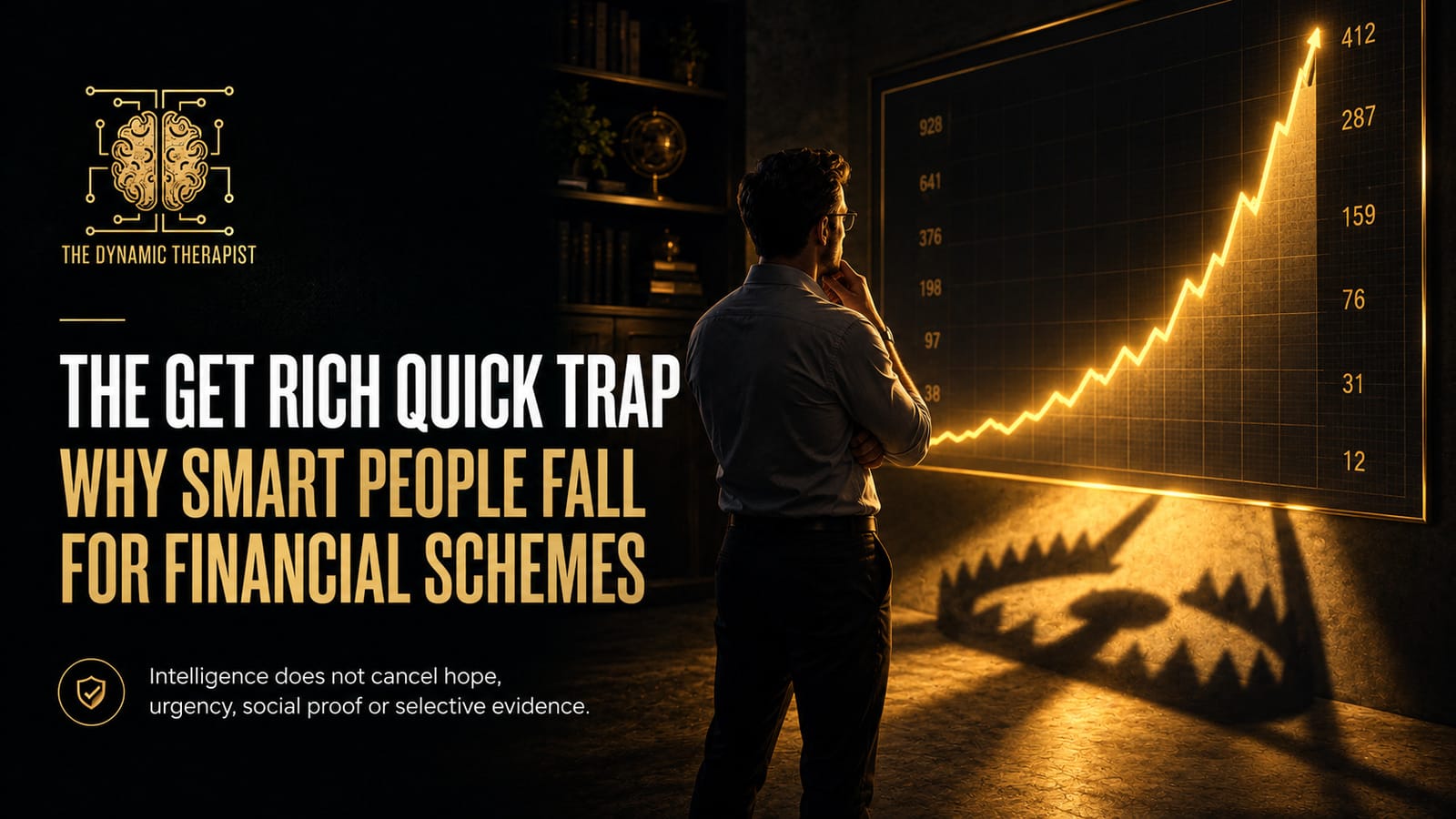
The persistent belief that financial fraud primarily affects people with poor financial literacy or limited intelligence is both inaccurate and harmful. Inaccurate because the research on fraud victims consistently documents high representation of educated, financially literate and professionally successful people. Harmful because it produces the specific vulnerability of assuming it cannot happen to you.
Sophisticated financial fraud is not designed to exploit ignorance. It is designed to exploit the specific psychological states — financial Anxiety, the desire for security, the fear of missing out, the aspiration for a different financial position — that exist across the intelligence spectrum. The mechanism is emotional, not cognitive. Intelligence does not protect you from emotional manipulation; in some cases it increases your susceptibility because it provides the capacity to construct elaborate rationalisations for decisions that feel right but are not.
The Psychological Profile of Financial Fraud Victims
Research by the Financial Conduct Authority and consumer protection organisations documents a consistent profile of people who are most susceptible to financial fraud. It is not who most people expect.
Over-Confidence in financial knowledge is a significant risk factor — people who consider themselves financially sophisticated are more likely to engage with complex-sounding investment propositions and less likely to seek independent verification. The belief that they would recognise a scam if they encountered one prevents the caution that would otherwise apply.
Recent financial change — redundancy, inheritance, divorce settlement, pension access — creates a combination of available capital and unfamiliar decision-making context that is specifically targeted. The person who has just accessed a pension lump sum and is making significant financial decisions for the first time is in a specific state of vulnerability regardless of their general intelligence.
Social isolation and loneliness, as covered in the 17 November post, remove the external check that trusted people provide — the friend or family member who would ask the questions the target is too emotionally engaged to ask.
Why Critical Thinking Fails
Emotional commitment precedes financial commitment
By the time money is involved in a financial scheme, the target has typically already made a significant emotional investment. The relationship with the person who introduced the opportunity has been cultivated. The vision of the financial future has been elaborated. The community of people who are already benefiting has been introduced. The emotional commitment makes the financial commitment feel like following through on a decision already made, rather than a new decision that deserves fresh evaluation.
The sunk cost dynamic
Early investments, particularly those that appear to perform well in the initial period — a feature of many Ponzi and pyramid structures — create a sunk cost that is psychologically difficult to abandon. The person who has invested and seen apparent returns is not evaluating the scheme fresh. They are evaluating whether to continue with something that appears to be working, which is a very different psychological task.
Social proof within the scheme
Sophisticated financial schemes invest significantly in social proof — testimonials, community groups, events, visible success stories. The target is embedded in a social environment in which the scheme appears legitimate and normal. Dissenting voices are absent or marginalised. The social environment within the scheme actively counteracts the critical thinking that might otherwise operate.
Two Examples
The investment group
Michael, a successful professional in his fifties, was introduced to an investment group through a trusted contact. The initial meetings were impressive — well-presented, attended by apparently successful people, featuring credible-seeming financial documentation. He invested a significant portion of his pension. The returns appeared strong for eighteen months. Then the scheme collapsed. The documentation had been fabricated. The other apparently successful people had been in the same position as Michael — convinced by the same presentation, by the same social proof, with the same inability to see clearly from inside the environment that had been constructed around them.
The cryptocurrency opportunity
Sarah was introduced through social media to a cryptocurrency trading platform promising exceptional returns. The interface was professional. The initial returns were real — a standard feature of schemes designed to build trust before the larger extraction. By the time she tried to withdraw a significant sum, the withdrawal was blocked on technical grounds that kept shifting. She eventually lost most of what she had invested. She is highly educated and had researched the opportunity extensively before investing. The research had been directed at confirming what she hoped rather than finding what would disconfirm it.
Three Reflection Questions
- Is there a financial opportunity you are currently considering that you have not yet sought independent, professional verification of?
- Can you identify the emotional component of any significant financial decision you are currently making — and is the emotional commitment preceding the rational evaluation?
- Who would you consult before making a significant financial decision — and is that person genuinely independent of the opportunity being considered?
Key Takeaways
- Intelligence does not protect against financial fraud — the mechanism is emotional, not cognitive.
- Over-Confidence in financial knowledge, recent financial change and social isolation are significant risk factors.
- Critical thinking fails because emotional commitment precedes financial commitment, sunk costs create bias, and social proof within the scheme normalises the opportunity.
- Independent verification — from a regulated financial adviser with no connection to the opportunity — is the most reliable protection.
- Any legitimate investment opportunity can withstand independent scrutiny and does not require rapid decision-making.
Frequently Asked Questions
How do I check if a financial opportunity is legitimate?
Check the Financial Conduct Authority register (register.fca.org.uk) to verify that any firm offering investments is authorised. Use the FCA's ScamSmart tool to check specific opportunities. Seek advice from an independent regulated financial adviser before committing significant funds.
What are the warning signs?
Guaranteed returns, returns significantly above market rates, pressure to decide quickly, complexity that cannot be clearly explained, reluctance to provide documentation for independent review, and requests for secrecy about the investment are all significant warning signs individually and very significant in combination.
What if I am already in a scheme I am now uncertain about?
Do not invest more money. Seek independent financial advice immediately. Contact Action Fraud (0300 123 2040). Document everything — communications, contracts, transaction records.
Can I get my money back?
Potentially, depending on how the investment was made and when. Contact your bank immediately if you transferred money recently. The Financial Services Compensation Scheme provides protection for certain regulated investments. Independent legal advice is worth seeking for significant losses.
Can working with Simon help with the emotional aftermath of financial fraud?
Yes. Financial fraud produces significant psychological consequences — shame, self-blame, Anxiety, damaged trust — alongside the financial consequences. The therapeutic work addresses these directly.
The Smartest Thing You Can Do Is Ask Someone Independent
Not someone inside the opportunity. Not someone who introduced you to it. Someone who has no stake in whether you proceed and every interest in giving you an honest assessment. That person is the most reliable protection available.
Simon Taylor works with people dealing with the psychological impact of financial fraud and the underlying vulnerabilities that enabled it. A Free 30-Minute Consultation is a good place to start.
Book Your Free 30-Minute Consultation | Get The Little Book of Big Changes