If you’ve ever thought, “I’m not even scared of the situation — I’m scared of feeling anxious,” you’re describing one of the most common Anxiety patterns I see. It’s not weakness. It’s a learning loop.
Anxiety often starts as a normal body response. But when the sensations are interpreted as dangerous, the fear of Anxiety itself becomes the fuel. The result is a cycle that can keep running even when you’re trying your best to cope.
In this article, I’ll break down the Anxiety cycle in plain English, show you how it reinforces itself, and give you practical ways to interrupt it — without forcing positivity or pretending it’s “nothing”.
What the Anxiety cycle is (and why it feels so convincing)
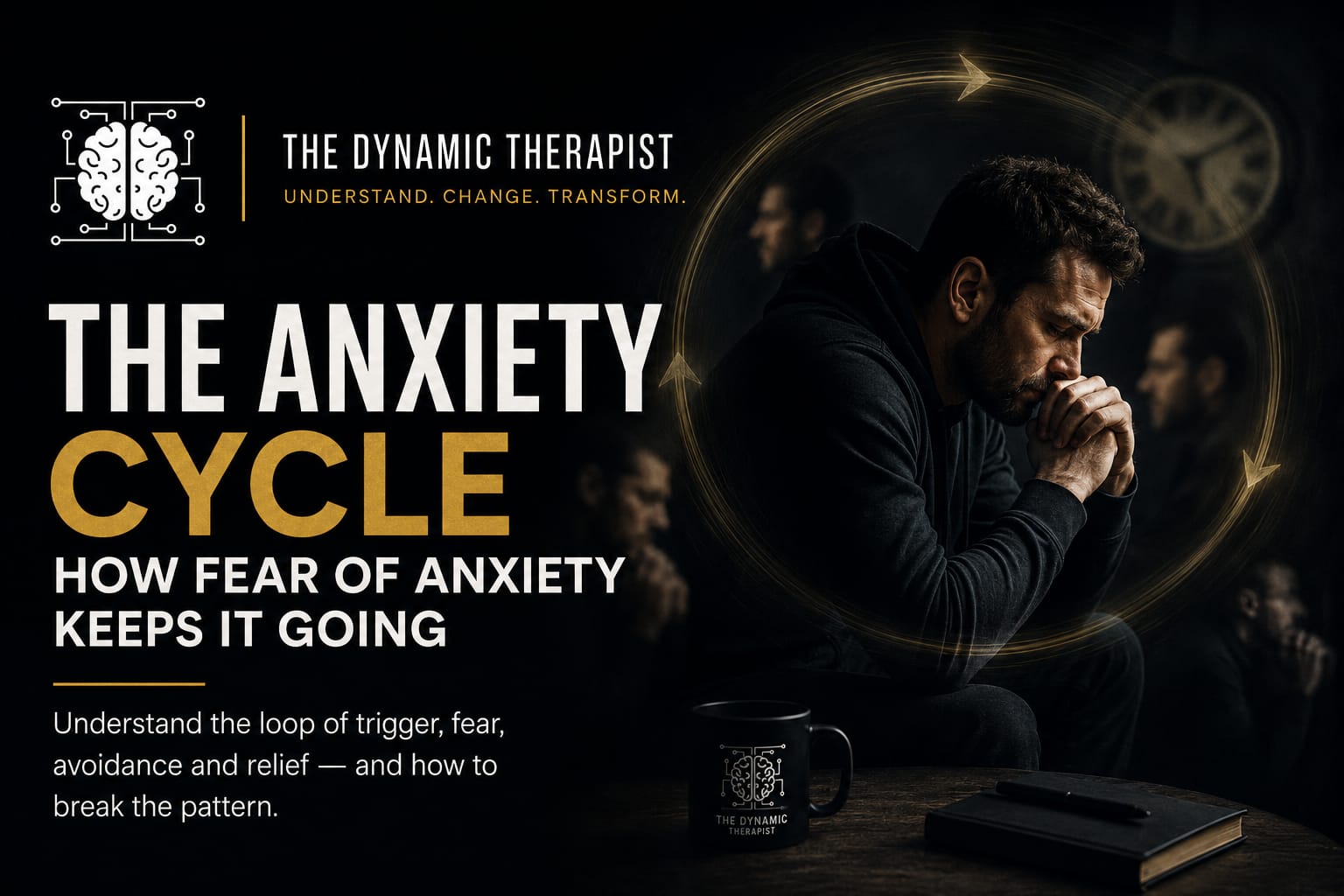
The Anxiety cycle is a predictable sequence. Once you can see the stages, you stop treating Anxiety like a mysterious enemy and start treating it like a pattern — something that can be changed.
No obvious danger doesn’t mean your system is calm. It means your system is reacting to something it has learned to treat as a threat.
The stages of the Anxiety cycle
1) Trigger
A trigger can be external (a crowded place, a conversation, a deadline) or internal (a sensation, a thought, a memory, tiredness). Sometimes it’s obvious. Sometimes it’s subtle.
2) Physical sensation
Your nervous system shifts into alert. You might notice a faster heartbeat, shallow breathing, light-headedness, nausea, heat, tingling, or a tight chest. These sensations are common in Anxiety — and they’re also common in everyday life.
3) Frightening interpretation
This is the turning point. The sensation gets labelled as danger: “I’m going to panic.” “I’m going to collapse.” “I’m losing control.” “People will notice.”
The interpretation matters because your nervous system responds to meaning. If your brain decides the sensation is a threat, it increases the alarm.
4) Increased fear (the escalation)
Fear adds more adrenaline. More adrenaline intensifies the sensations. The sensations then feel like proof that something is wrong — which increases fear again. That’s how a spiral builds.
5) Avoidance or reassurance-seeking (safety behaviours)
To get relief, people naturally do things that feel protective in the moment. These are often called safety behaviours. They can include leaving, sitting near exits, checking your pulse, constantly scanning your body, calling someone for reassurance, or avoiding certain places altogether.
6) Temporary relief
Avoidance and reassurance often work short-term. Your Anxiety drops, and your brain learns: “Good — we escaped.”
7) Reinforcement of the pattern
Here’s the catch: the relief teaches your brain that the situation (or sensation) really was dangerous — and that you only stayed safe because you avoided it or used a safety behaviour. That makes the fear stronger next time.
A realistic example: the supermarket spiral
Imagine you’re in a supermarket. It’s warm, busy, and you’ve had a stressful week. Halfway down an aisle you notice your heart beating faster.
- Trigger: crowded aisle, heat, Stress, maybe low blood sugar.
- Physical sensation: heart rate increases, breath feels tight.
- Frightening interpretation: “What if I panic or collapse?”
- Increased fear: adrenaline rises, dizziness increases, legs feel shaky.
- Safety behaviour: you abandon the basket and rush outside, or call someone to talk you down.
- Temporary relief: once outside, your heart settles.
- Reinforcement: your brain concludes, “Supermarkets are dangerous. Leaving saved me.”
Next time you go back, your system remembers. You’re more alert before you even reach the entrance. You scan your body for signs. That scanning increases sensations — and the cycle starts earlier.
Why avoidance feels helpful — and why it strengthens Anxiety over time
Avoidance isn’t “bad”. It’s understandable. It’s your nervous system trying to protect you.
But avoidance has a hidden cost: it prevents your brain from learning the most important update — that you can feel anxious and still be safe.
Over time, the “safe zone” shrinks. You avoid more places, more situations, more sensations. Confidence drops, not because you’re incapable, but because you’re not getting the experiences that rebuild trust.
Practical ways to interrupt the cycle
You don’t need to be fearless. You need a different response at one or two key points in the loop.
1) Change the interpretation (without arguing with yourself)
Instead of “This means I’m in danger,” try a more accurate label:
- “This is adrenaline.”
- “My nervous system is activated.”
- “This is uncomfortable, not dangerous.”
You’re not trying to force calm. You’re removing the catastrophic meaning that tells your body to escalate.
2) Reduce safety behaviours (gradually, not brutally)
Pick one small safety behaviour to soften. For example:
- If you always stand near the exit, try moving one aisle further in.
- If you constantly check your pulse, practise delaying the check by 60 seconds.
- If you always call someone, try one minute of grounding first.
The aim is to teach your brain: “I can stay present and nothing terrible happens.” That’s how Confidence returns.
3) Calm the nervous system in the moment (60–90 seconds)
A simple reset that works well in public:
- Exhale slowly (longer out-breath than in-breath).
- Drop your shoulders and soften your belly.
- Press your feet into the floor and feel the contact points.
- Look around and name five neutral objects (colours, shapes, signs).
This signals safety to the body. It doesn’t erase Anxiety instantly, but it stops the spiral from accelerating.
4) Rebuild Confidence through graded exposure
Confidence is built through evidence, not pep talks. Graded exposure means practising the situation in manageable steps, long enough for your system to learn it can settle.
For the supermarket example, that might start with a short visit at a quieter time, staying until the Anxiety peaks and begins to drop — rather than leaving at the first surge.
5) Address the baseline (sleep, caffeine, food, Stress load)
If your baseline is already high, your system will trigger more easily. Small adjustments can make the cycle easier to interrupt:
- steady meals (avoid long gaps that spike adrenaline)
- reduce caffeine, especially later in the day
- prioritise sleep consistency where possible
- daily movement and daylight, even brief
Reassurance that doesn’t dismiss you
If you’ve been stuck in this cycle, it can feel like your body is betraying you. It isn’t. It’s doing what it learned to do: detect threat and push you to safety.
The work is helping your system update — so it stops treating sensations and situations as emergencies.
If you have new, severe, or worrying physical symptoms (for example chest pain, fainting, or symptoms that could have a medical cause), speak to an appropriate healthcare professional.
How therapy can help change the pattern underneath
When fear of Anxiety is driving the loop, therapy can help you change the meaning your brain attaches to sensations and situations — and reduce the automatic alarm response.
At The Dynamic Therapist, I use a blended approach (hypnotherapy, NLP and grounded coaching, alongside evidence-based tools where appropriate) to help you understand your pattern, interrupt it, and rebuild Confidence step by step.
Key Takeaways
- The Anxiety cycle is: trigger → sensation → frightening interpretation → increased fear → safety behaviours → relief → reinforcement.
- Fear of Anxiety can become the main driver of Anxiety.
- Avoidance brings short-term comfort but teaches the brain the fear is justified.
- Interrupting the cycle involves changing interpretations, reducing safety behaviours, calming the nervous system, and rebuilding Confidence gradually.
FAQ
Why does my Anxiety spike when I notice my heartbeat?
Because your brain may have learned to treat that sensation as a warning sign. The fear response then increases adrenaline, which makes the heartbeat feel even stronger.
Is avoidance always bad?
No — it’s understandable. But if it becomes the main strategy, it can strengthen the fear over time by preventing your brain from learning you can cope.
What are “safety behaviours”?
They’re actions used to reduce Anxiety in the moment — like leaving, checking, seeking reassurance, or staying near exits. Helpful short-term, but they can keep the cycle going.
How long does it take to break the cycle?
It varies. Many people notice progress once they consistently change their response at key points in the loop and rebuild Confidence through small, repeated experiences.
When should I speak to a healthcare professional?
If symptoms are new, severe, or worrying, or you’re unsure whether they could be medical, it’s sensible to get checked.
Final Call to Action
If you recognise this cycle and you’re ready to change it, book a free 30-minute consultation. We’ll map your pattern clearly and talk through what would help.
If you’d like a practical, grounded read that supports mindset shifts and reduces self-doubt, you may also find my book useful:
The Little Book of Big Changes: