
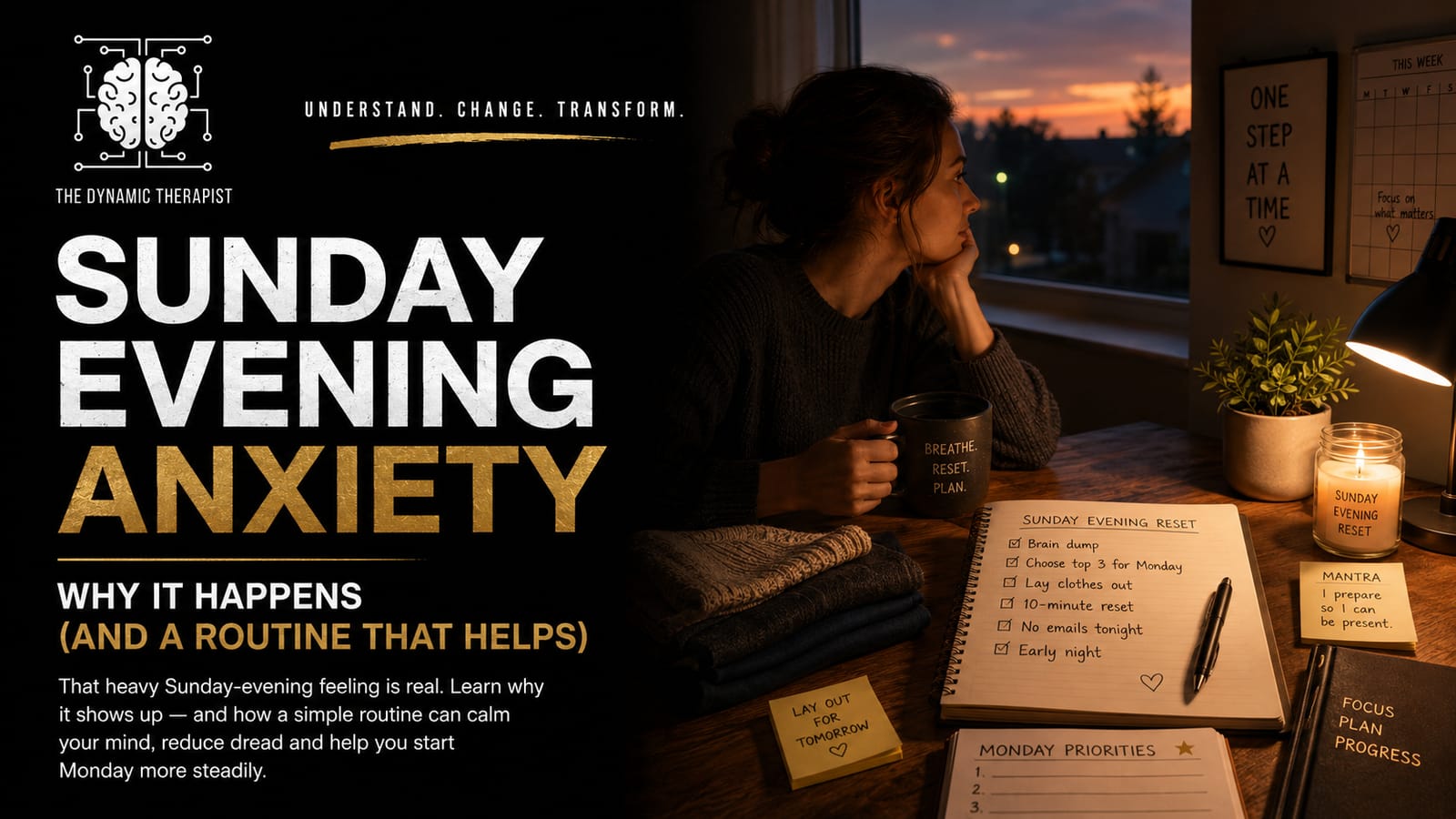
Sunday Evening Anxiety: Why It Happens (and a Routine That Helps)
If you feel a wave of dread on Sunday evening, you’re not alone. Many people describe a shift around late afternoon: the weekend feels like it’s disappearing, Monday feels heavy, and your mind starts running through everything that could go wrong.
Sometimes it’s mild and manageable. Sometimes it’s a sign that work is costing you more than you realise. This post explores why Sunday-evening Anxiety happens and gives you a practical Sunday routine that prepares you without letting work consume the whole day.
Why Sunday-evening Anxiety happens
Uncertainty (your mind tries to predict Monday)
Anxiety often spikes when you don’t know what’s coming. If Monday feels unpredictable — emails, meetings, demands, conflict — your brain tries to create safety by rehearsing and scanning.
Unfinished tasks (open loops)
If you end the week with loose ends, your mind keeps them “open” in the background. Sunday evening becomes the moment those open loops come back online.
Difficult workplaces
If your workplace involves criticism, unclear expectations, conflict, bullying, or constant pressure, Sunday dread can be a realistic response — not a mindset problem.
Loss of control
Weekends often include more choice: when you wake, what you do, who you see. Monday can feel like a sudden return to external control — schedules, demands, and other people’s priorities.
Poor boundaries (work leaking into rest)
If you check emails on weekends, mentally rehearse Monday, or feel “on call”, your nervous system never fully downshifts. Sunday evening Anxiety is often the cost of never truly switching off.
The sudden transition from freedom to obligation
Even in a good job, the transition can feel abrupt. Your nervous system shifts from flexible time to structured time — and that shift can trigger resistance, sadness, or Anxiety.
A practical Sunday routine (prepare without losing the day)
This routine is designed to reduce uncertainty and open loops — while protecting your Sunday. Adjust the times to fit your life.
Step 1 (10 minutes): A “Monday map” — not a full work session
Set a timer for 10 minutes. Write:
- Top 3 priorities for Monday (realistic, not everything).
- Any fixed commitments (meetings, deadlines).
- One small first task to start the day (a quick win).
Stop when the timer ends. The goal is clarity, not productivity.
Step 2 (5 minutes): Close one open loop
Choose one small thing that will reduce mental load:
- send one email you’ve been avoiding
- write a short note to yourself about where to pick up a task
- set one reminder
- prepare one item you’ll need (lunch, clothes, bag)
Step 3 (15 minutes): Nervous system downshift
Do something that signals safety to your body:
- a short walk
- a warm shower
- gentle stretching
- 6–10 slow breaths with a longer exhale
- a calming audio track
Step 4 (the rest of the evening): Protect your Sunday
Choose one genuinely restorative activity (not scrolling as avoidance): a meal, a film, reading, time with someone safe, a hobby, or early night. The point is to remind your system: life isn’t only work.
What not to do (if you want Sunday to feel better)
- Don’t spend hours “getting ahead” — it teaches your brain that rest is unsafe.
- Don’t repeatedly check work messages “just in case”.
- Don’t rehearse every possible Monday scenario.
- Don’t treat dread as proof you’re weak — treat it as information.
Is this a manageable habit — or a sign something needs to change?
Sunday Anxiety can be a normal response to transition. But it can also be a signal that something in your working life is unsustainable.
More likely manageable when:
- it reduces once you start work and get into the day
- it improves when you plan lightly and protect boundaries
- your workplace is generally safe and expectations are reasonable
- you still have energy for life outside work most weeks
More likely a sign something significant needs to change when:
- you feel dread most weeks and it’s getting worse
- you feel unsafe at work (bullying, criticism, hostility, chronic conflict)
- you can’t mentally disconnect even on holiday
- sleep is consistently disrupted and recovery never feels enough
- you’re experiencing persistent Anxiety symptoms, panic, or Burnout signs
- your values are repeatedly compromised (you’re asked to do things that feel wrong)
- your life is shrinking around work
If the second list fits, the answer may not be “better Sunday routines”. It may be boundaries, workload changes, support, or a bigger decision about your working life.
When support may help
If Sunday dread is persistent, affecting sleep, or linked with Burnout, therapy can help you understand what’s driving it and change the pattern underneath — including boundaries, fear of conflict, perfectionism, and nervous system overload.
At The Dynamic Therapist, I use a blended approach — hypnotherapy, NLP and grounded coaching (and where appropriate, evidence-based tools such as CBT/DBT) — to help you reduce anticipatory Anxiety and build a working life that doesn’t cost you your wellbeing.
Key Takeaways
- Sunday-evening Anxiety is often driven by uncertainty, open loops, loss of control, and poor boundaries.
- A short planning window can reduce dread without turning Sunday into a workday.
- Protecting rest is part of the solution — not a luxury.
- Persistent dread can be a signal that something bigger needs to change.
Final Call to Action
If Sunday dread is becoming a weekly pattern and you want to change what’s driving it, book a free 30-minute consultation. We’ll map your pattern and talk through the most effective next step.
Book your free consultation: https://tidycal.com/fws-tdt/free-30-minute-consultation
If you’d like a practical, grounded read that supports mindset shifts and reduces self-doubt,
you may also find my book useful:
The Little Book of Big Changes: https://amzn.eu/d/00gxh8X1