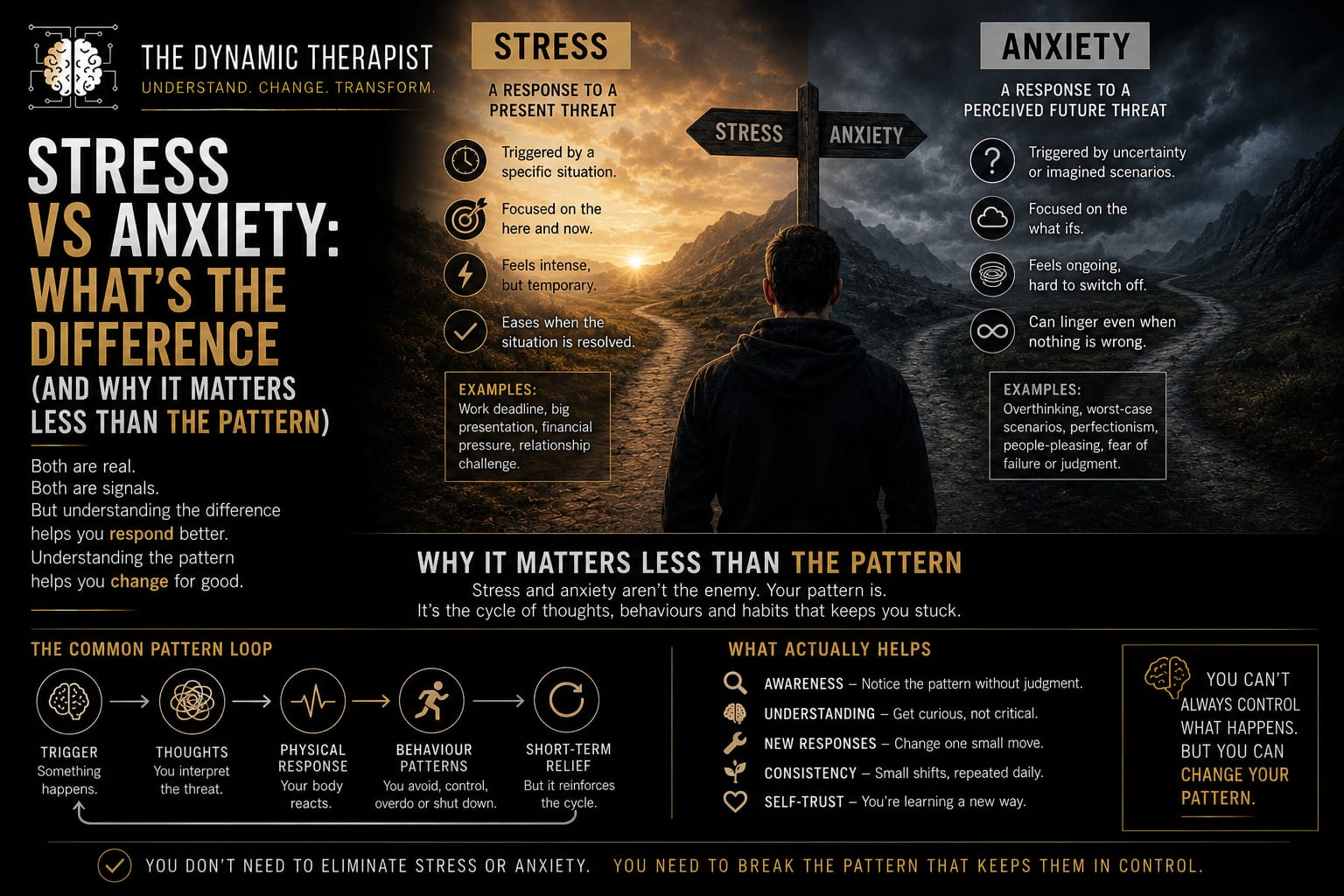
Stress vs Anxiety: What’s the Difference (and Why It Matters Less Than the Pattern)
People often use “Stress” and “Anxiety” interchangeably — and there’s a reason for that: they overlap. Both can involve tension, worry, sleep disruption, irritability, and physical symptoms.
But there are also useful differences. Understanding them can help you respond more effectively — not by obsessing over labels, but by noticing the pattern your mind and body are running.
Stress in straightforward language
Stress is often a response to identifiable demands. There’s usually something you can point to: a deadline, a workload spike, a financial pressure, a difficult conversation, a health appointment.
Stress can be uncomfortable, but it often makes sense in context: “I have a lot on.”
Anxiety in straightforward language
Anxiety can also be triggered by real demands — but it often continues after the immediate demand has passed, or it focuses on anticipated threats: what might happen, what could go wrong, what you might not cope with.
Anxiety is frequently driven by uncertainty. The mind tries to create safety by predicting and preparing — which can turn into Overthinking, checking, reassurance-seeking, or avoidance.
Where Stress and Anxiety overlap
Stress can become Anxiety when the nervous system stays activated and the mind keeps scanning for danger. Anxiety can feel like Stress when there are clear pressures in your life.
Both involve the nervous system shifting into alert mode. The difference is often the focus:
- Stress: “This is a lot right now.”
- Anxiety: “What if this means something worse?”
Comparison table: Stress vs Anxiety
| Feature | Stress | Anxiety |
| Trigger | Often identifiable demand | May be vague, future-focused, or persist after demand |
| Time pattern | Often reduces when the situation resolves | Can continue even when things are “fine” |
| Mind focus | Problem + workload management | Threat prediction, uncertainty, “what if” |
| Body response | Tension, fatigue, irritability | Similar symptoms + more fear of symptoms |
| Common behaviours | Working harder, pushing through | Checking, reassurance-seeking, avoidance, rumination |
| Helpful response | Prioritise, plan, reduce load, recover | Reduce catastrophic meaning, build tolerance of uncertainty, calm the nervous system |
Examples (work, money, relationships, health)
Work deadlines
Stress example: You have a deadline on Friday. You feel pressure, you plan your tasks, you work late, and once it’s submitted you feel relief.
Anxiety example: The deadline passes, but your mind keeps replaying: “What if it wasn’t good enough?” “What if they think I’m incompetent?” You keep checking emails, rehearsing explanations, and scanning for criticism.
Money worries
Stress example: You have a specific bill due. You feel tense, you adjust your budget, you make a plan.
Anxiety example: Even when the bill is paid, your mind keeps projecting: “What if something happens?” “What if I can’t cope?” You repeatedly check your bank balance or avoid looking at it entirely.
Relationships
Stress example: You’re having a difficult week with your partner. You feel on edge and want to resolve it.
Anxiety example: You start mind-reading and predicting: “What if they leave?” “What if I said the wrong thing?” You replay conversations, rehearse future arguments, and feel unable to relax even when things are calm.
Health worries
Stress example: You have a symptom and you book an appointment. You feel worried but you’re taking a clear step.
Anxiety example: You repeatedly search symptoms, check your body, and catastrophise. Reassurance helps briefly, then the fear returns. (If symptoms are new, severe, or concerning, medical assessment is important — Anxiety and medical issues can overlap.)
Why labels matter less than understanding the pattern
Whether you call it Stress or Anxiety, the most useful question is: what keeps it going?
- Is it an overload problem (too much demand, not enough recovery)?
- Is it a threat-interpretation problem (catastrophic meaning, fear of sensations)?
- Is it an uncertainty problem (needing guarantees before you can relax)?
- Is it a habit loop (checking, rumination, avoidance)?
The goal isn’t the perfect label. The goal is the right response.
When additional support may be worthwhile
Support can be helpful if:
- your Stress/Anxiety is persistent and not settling with rest
- sleep is regularly disrupted
- you’re avoiding situations or shrinking your life
- you’re stuck in rumination, checking, or reassurance loops
- you feel constantly on edge or overwhelmed
- physical symptoms are frequent or frightening
If symptoms are new, severe, unusual, or concerning — especially physical symptoms — it’s sensible to seek medical advice. If Anxiety is part of the picture, therapy can help you change the pattern underneath rather than just cope day-to-day.
How therapy can help
At The Dynamic Therapist, I use a blended approach — hypnotherapy, NLP and grounded coaching (and where appropriate, evidence-based tools such as CBT/DBT) — to help you understand your pattern, calm the nervous system, and change the beliefs and behaviours that keep Stress and Anxiety running.
Key Takeaways
- Stress often relates to identifiable demands; Anxiety often persists or focuses on anticipated threats.
- They overlap — both involve nervous system activation.
- Labels matter less than understanding what keeps the pattern going.
- Support is worthwhile when symptoms persist, disrupt life, or lead to avoidance.
FAQ
Can Stress turn into Anxiety?
Yes. When the nervous system stays activated and the mind keeps scanning for threat, Stress can become a more persistent Anxiety pattern.
Can Anxiety exist without Stress?
Yes. Anxiety can show up even when nothing obvious is wrong, especially if your baseline is high or you’ve learned to anticipate threat.
What’s the best first step?
Identify whether you need load reduction (rest, boundaries, planning) or pattern change (reducing rumination/checking, changing interpretations, building tolerance of uncertainty).
When should I seek medical advice?
If symptoms are new, severe, unusual, persistent, or concerning — especially physical symptoms — speak to an appropriate healthcare professional.
Final Call to Action
If you want help understanding your pattern and changing it — whether you call it Stress, Anxiety, or overwhelm — book a free 30-minute consultation.
Book your free consultation: https://tidycal.com/fws-tdt/free-30-minute-consultation
If you’d like a practical, grounded read that supports mindset shifts and reduces self-doubt, you may also find my book useful:
The Little Book of Big Changes: https://amzn.eu/d/00gxh8X1