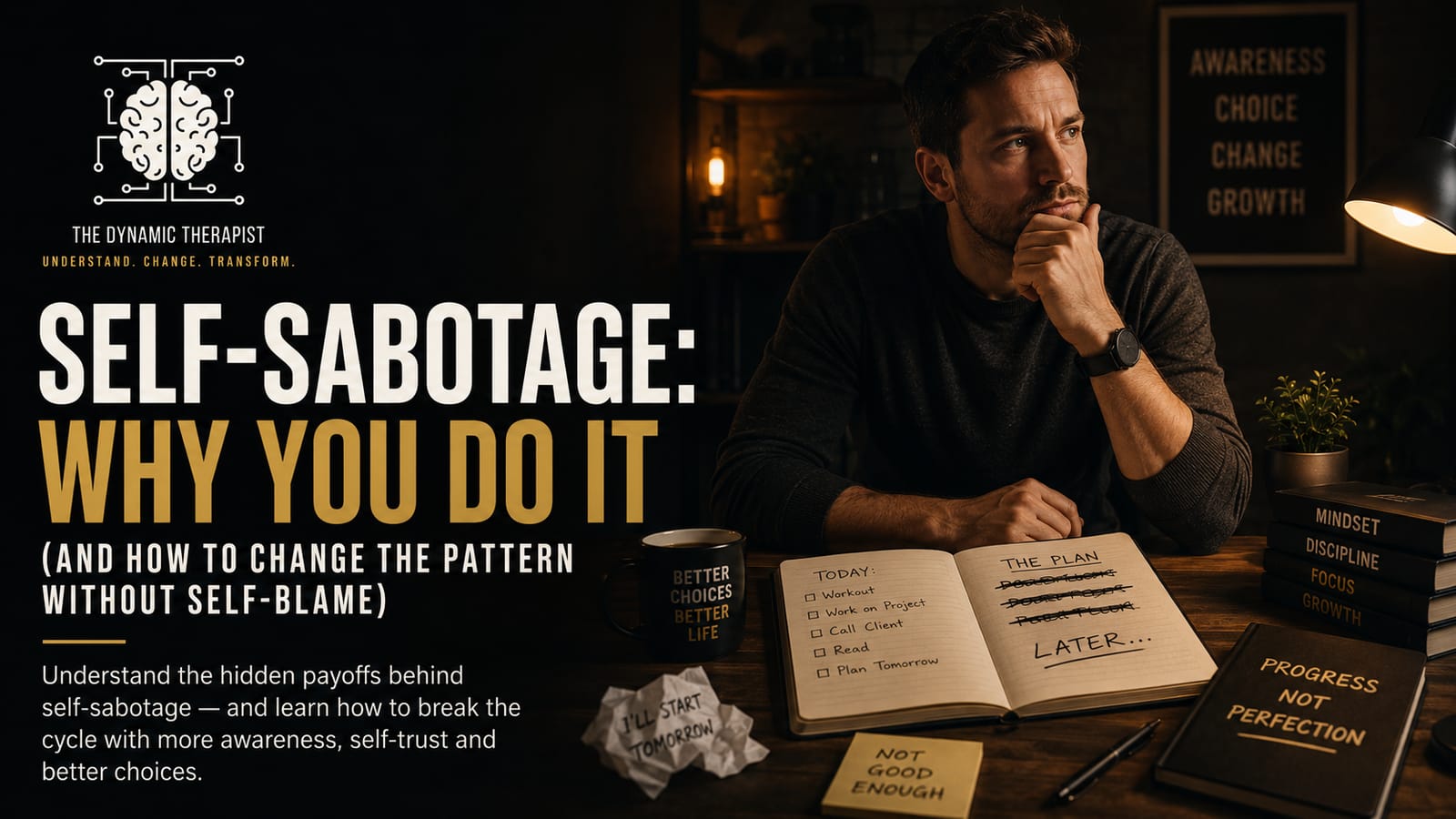
Self-Sabotage: Why You Do It (and How to Change the Pattern Without Self-Blame)
“Why do I keep getting in my own way?” is one of the most painful questions people ask themselves. You set a goal, you mean it, and then something happens: you procrastinate, you pick a fight, you overspend, you stop showing up, you abandon the plan right before it starts working.
It’s tempting to label that as laziness or weakness. But self-sabotage is usually neither. It’s often a protection strategy — a pattern your nervous system learned to reduce emotional risk in the short term.
This post explains self-sabotage in a compassionate, grounded way: why it happens, what it’s protecting you from, the hidden benefit an unhelpful behaviour may be providing, and a four-step exercise to create a healthier replacement response.
What self-sabotage actually is
Self-sabotage is when your behaviour undermines what you say you want — often at the exact moment it matters. It’s not because you don’t care. It’s often because caring makes the stakes feel high.
In many cases, the “sabotage” behaviour is doing something useful in the short term: reducing Anxiety, avoiding disappointment, protecting identity, or keeping you in familiar territory.
Why self-sabotage happens (common drivers)
Fear of failure
If you try fully and fail, it can feel like a verdict on you. Self-sabotage creates a different story: “I didn’t really try.” That can feel safer than “I tried and I wasn’t enough.”
Fear of success
Success can bring visibility, responsibility, expectations, and change. If success means being judged more, losing freedom, or outgrowing familiar relationships, your system may resist it.
Familiarity (the nervous system prefers the known)
Even when something is painful, it can be familiar. The nervous system often prefers familiar discomfort over unfamiliar possibility. Change can feel unsafe simply because it’s new.
Identity (“Who am I if I change?”)
If you’ve built an identity around being the struggling one, the helper, the responsible one, the one who never needs anything — change can threaten that identity. Self-sabotage can keep you aligned with an old role.
Protection from disappointment
If you don’t hope too much, you can’t be crushed. Self-sabotage can be a way of keeping expectations low so disappointment hurts less.
Perfectionism
Perfectionism often looks like high standards, but it can function as avoidance: if you can’t do it perfectly, you don’t start — or you quit early. That protects you from being seen trying.
Short-term emotional relief
Many self-sabotage behaviours provide immediate relief: scrolling instead of working, eating or drinking to numb, spending to soothe, picking a fight to discharge tension, avoiding a conversation to escape discomfort. The relief is real — and it’s why the pattern repeats.
The hidden benefit: what the unhelpful behaviour is doing for you
A useful way to understand self-sabotage is to ask: what is this behaviour protecting me from right now?
Examples of hidden benefits:
- Avoiding rejection: “If I don’t put myself out there, I can’t be rejected.”
- Avoiding shame: “If I don’t try fully, I can’t be exposed.”
- Avoiding responsibility: “If I succeed, people will expect more.”
- Avoiding Grief: “If I slow down, I’ll feel what I’ve been carrying.”
- Maintaining belonging: “If I change, I might not fit with my people.”
Self-sabotage is often your system choosing short-term safety over long-term satisfaction.
Relatable examples (relationships, health, business, money, goals)
Relationships
You want closeness, but when someone gets close you withdraw, become critical, or start an argument. Hidden benefit: protection from vulnerability or rejection (“If I push them away first, it won’t hurt as much”).
Health
You plan to exercise or eat steadily, then abandon it after a few days. Hidden benefit: relief from pressure, avoiding the discomfort of change, or avoiding the fear of “What if I try and it still doesn’t work?”
Business
You want to grow, but you delay launching, avoid marketing, or keep “tweaking” forever. Hidden benefit: avoiding visibility, judgement, or the risk of failure.
Money
You want stability, but you overspend when stressed or avoid looking at finances. Hidden benefit: short-term soothing or avoiding Anxiety and shame.
Personal goals
You set a goal, then quit when you’re 70% of the way there. Hidden benefit: avoiding the moment where you have to find out what happens if you actually succeed.
The four-step exercise: Interrupt the pattern
Use this exercise when you notice a repeating pattern. Keep it simple and honest — no self-attack.
Step 1: Identify the behaviour
What do you do that undermines what you want? Be specific.
- “I scroll for two hours instead of doing the task.”
- “I cancel plans last minute.”
- “I pick fights when I feel insecure.”
- “I avoid sending the invoice.”
Step 2: Identify the trigger
What happens right before the behaviour? Look for:
- a feeling (Anxiety, shame, pressure, loneliness)
- a situation (deadline, conflict, being seen)
- a thought (“What if I fail?” “They’ll judge me.”)
Step 3: Uncover the short-term payoff
Ask: what does this behaviour do for me in the moment?
- reduces Anxiety
- avoids vulnerability
- creates a sense of control
- numbs discomfort
- protects me from disappointment
Step 4: Create a healthier replacement response
You’re not trying to remove the need — you’re meeting it differently. Choose a replacement that provides a similar benefit with less cost.
Examples:
- If the payoff is relief: do a 10-minute “starter step” instead of quitting (tiny action reduces pressure).
- If the payoff is avoiding judgement: share a draft with one safe person instead of hiding completely.
- If the payoff is soothing: use a short grounding routine (slow exhale + external focus) before you decide.
- If the payoff is control: write a simple plan (3 bullets) rather than spiralling or avoiding.
Then practise it repeatedly. Your nervous system learns through repetition, not insight alone.
A compassionate truth: you can change without shaming yourself
Self-blame often keeps self-sabotage going because it increases Stress — and Stress increases the urge for short-term relief. A more effective stance is curiosity:
“What is this protecting me from — and how can I meet that need in a healthier way?”
When support may help
If self-sabotage is persistent, linked with Anxiety, Trauma responses, perfectionism, or relationship patterns, support can help you change the underlying drivers — not just the surface behaviour.
At The Dynamic Therapist, I use a blended approach — hypnotherapy, NLP and grounded coaching (and where appropriate, evidence-based tools such as CBT/DBT) — to help you update old protection strategies and build new responses that actually serve you.
Key Takeaways
- Self-sabotage is often a protection strategy, not laziness or weakness.
- It can be driven by fear of failure, fear of success, familiarity, identity, perfectionism, and short-term relief.
- Unhelpful behaviours often provide a hidden benefit in the moment.
- Use the four-step exercise to identify the pattern and build a healthier replacement response.
Final Call to Action
If you’re tired of repeating the same pattern and want help changing it without self-blame, book a free 30-minute consultation. We’ll map what’s driving the sabotage and build a plan that fits your life.
Book your free consultation: https://tidycal.com/fws-tdt/free-30-minute-consultation
If you’d like a practical, grounded read that supports mindset shifts and everyday change, you may also find my book useful:
The Little Book of Big Changes: https://amzn.eu/d/00gxh8X1