
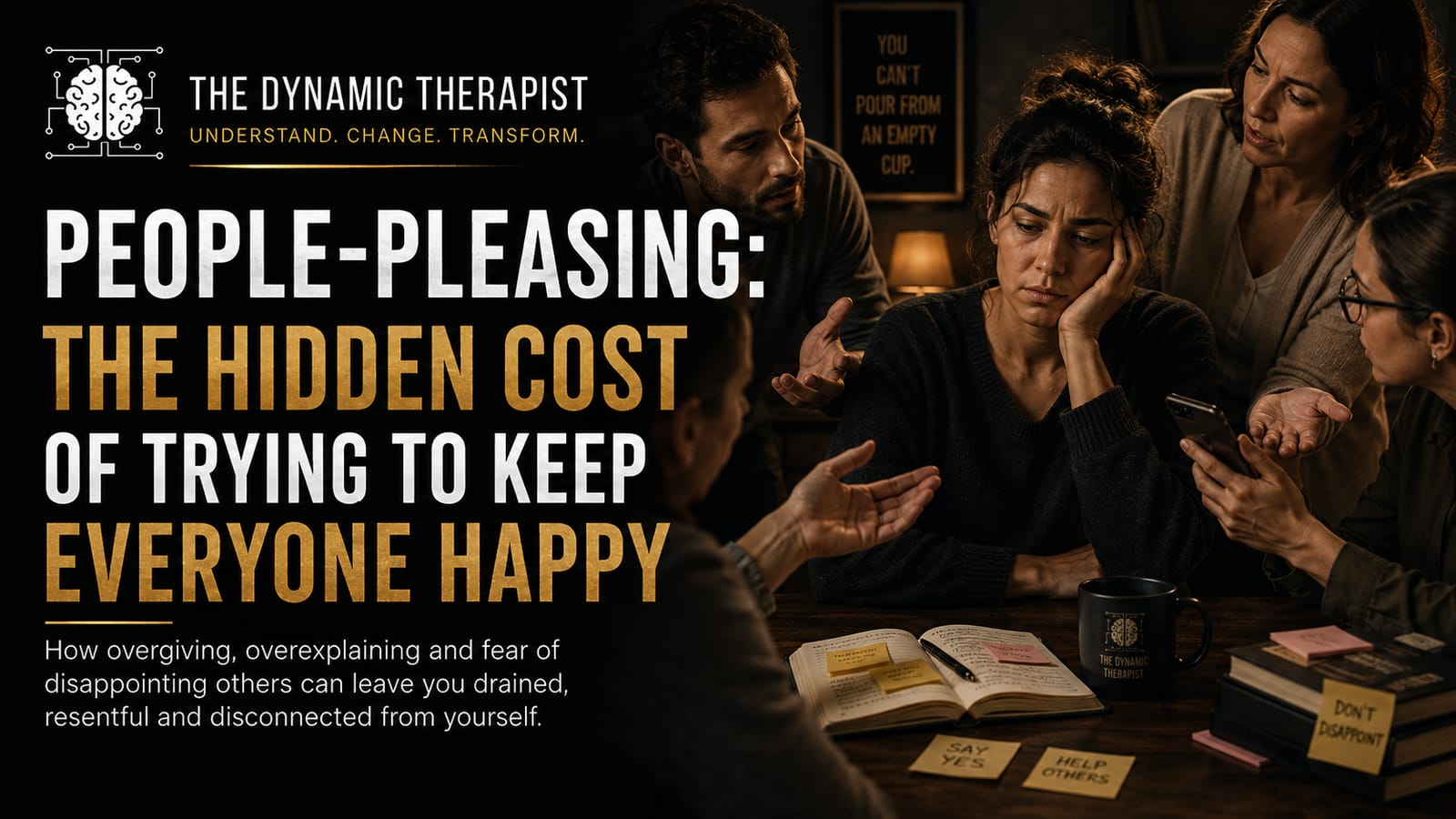
People-Pleasing: The Hidden Cost of Trying to Keep Everyone Happy
People-pleasing often looks like kindness. You’re helpful, agreeable, reliable, easy to be around. But inside, it can feel like pressure: constantly scanning for what others need, avoiding conflict, and trying to prevent disappointment at all costs.
If you recognise yourself in that, you’re not alone — and you’re not “weak”. People-pleasing is usually a safety strategy. It’s a way the nervous system learned to reduce risk: conflict, rejection, disapproval, or being seen as selfish.
This post explores why people-pleasing happens, the emotional cost over time, and practical ways to set polite but firm boundaries — including a seven-day boundary challenge.
What people-pleasing really is
People-pleasing is the habit of prioritising other people’s comfort, approval, or needs over your own — often automatically. It can include saying yes when you mean no, softening your opinions, over-explaining, apologising for existing, or taking responsibility for other people’s emotions.
Why people-pleasing happens (fear-based drivers)
People-pleasing is often driven by fear — not because you’re dramatic, but because your system learned that certain outcomes were unsafe.
- Fear of conflict: “If I disagree, it will escalate.”
- Fear of rejection: “If I say no, they’ll leave.”
- Fear of disapproval: “If they’re unhappy, I’ve failed.”
- Fear of being seen as selfish: “My needs are too much.”
Sometimes these fears come from childhood messages, unpredictable relationships, criticism, or environments where keeping the peace felt necessary.
The emotional cost of constantly trying to keep everyone happy
1) Resentment
When you repeatedly abandon your own needs, resentment builds — even if you don’t want it to. You may feel angry at others, then guilty for feeling angry.
2) Exhaustion
People-pleasing is work. It’s emotional labour: monitoring tone, anticipating reactions, managing other people’s comfort, and staying “nice” even when you’re depleted.
3) Unclear relationships
If people only know the version of you that agrees, they don’t know the real you. Relationships can become unclear because your yes doesn’t always mean yes — it means “I’m scared to say no.”
4) Loss of identity
Over time, you may lose touch with what you actually want, like, or believe. Your identity becomes shaped around being acceptable rather than being authentic.
A key shift: other people’s disappointment is not proof you did something wrong
One of the hardest parts of changing people-pleasing is learning to tolerate someone else’s disappointment without rushing to fix it.
Disappointment is a normal human emotion. It doesn’t automatically mean you’ve harmed someone.
If you’ve been trained to treat discomfort as danger, another person’s unhappy reaction can feel like an emergency. But you can learn to stay steady.
Polite but firm boundary examples (scripts you can actually use)
Boundaries don’t need to be aggressive. They need to be clear. Here are examples you can adapt:
- “I can’t do that, but I hope it goes well.”
- “I’m not available for that.”
- “I can help for 20 minutes, then I need to stop.”
- “I need to think about it — I’ll get back to you tomorrow.”
- “That doesn’t work for me.”
- “I’m not able to take that on right now.”
- “I hear you. My answer is still no.”
- “I’m happy to talk, but not if we’re shouting.”
Notice what’s missing: long explanations, apologies for having needs, and over-justifying. You can be kind without negotiating your boundary away.
How to tolerate disappointment without self-blame
Try this three-step process when someone reacts badly:
- 1) Name what’s happening: “They’re disappointed.” (Not: “I’m bad.”)
- 2) Regulate your body: drop shoulders, slow the exhale, feel your feet on the floor.
- 3) Hold the boundary: repeat your line once, then stop explaining.
A helpful internal line is: “I can be a good person and still say no.”
A practical seven-day boundary challenge
This is designed to build Confidence gradually. Keep it small and doable. The goal is practice, not perfection.
Day 1: Notice your automatic yes
Today, don’t change anything yet. Just notice: where do you say yes out of fear? What do you feel in your body when you want to say no?
Day 2: Use the pause phrase
Practise: “Let me think about it and get back to you.” Use it once today. This breaks the reflex to agree.
Day 3: One small no
Say no to something low-stakes. Keep it short. No long explanation.
Day 4: Set a time boundary
Choose one limit: “I can stay for an hour.” “I can talk for 10 minutes.” Then follow through.
Day 5: Stop one unnecessary apology
Notice where you apologise for having needs (“Sorry, I can’t…”). Replace with: “I can’t.”
Day 6: Hold steady through discomfort
If someone is disappointed, practise not fixing it. Slow your exhale. Repeat your boundary once. Let the feeling pass.
Day 7: Review and choose one boundary to keep
What was hardest? What helped? Choose one boundary habit to keep for the next week (pause phrase, time limit, one no per week, etc.).
When support can help
If people-pleasing is deeply wired — especially if it’s linked with Anxiety, Trauma responses, or fear of rejection — support can help you change the pattern underneath, not just practise scripts.
At The Dynamic Therapist, I use a blended approach — hypnotherapy, NLP and grounded coaching (and where appropriate, evidence-based tools such as CBT/DBT) — to help you feel safer setting boundaries, reduce guilt, and build relationships that are clearer and more sustainable.
Key Takeaways
- People-pleasing is often a safety strategy driven by fear of conflict, rejection, or disapproval.
- Over time it can create resentment, exhaustion, unclear relationships, and loss of identity.
- Boundaries can be polite and firm — clarity is kinder than over-explaining.
- You can tolerate someone’s disappointment without assuming you’ve done something wrong.
- A seven-day challenge builds Confidence through small, repeatable practice.
Final Call to Action
If you’re tired of carrying everyone else’s comfort and want to build boundaries without guilt, book a free 30-minute consultation. We’ll map your pattern and create a plan that fits your life.
Book your free consultation: https://tidycal.com/fws-tdt/free-30-minute-consultation
If you’d like a practical, grounded read that supports mindset shifts and reduces self-doubt, you may also find my book useful:
The Little Book of Big Changes: https://amzn.eu/d/00gxh8X1