
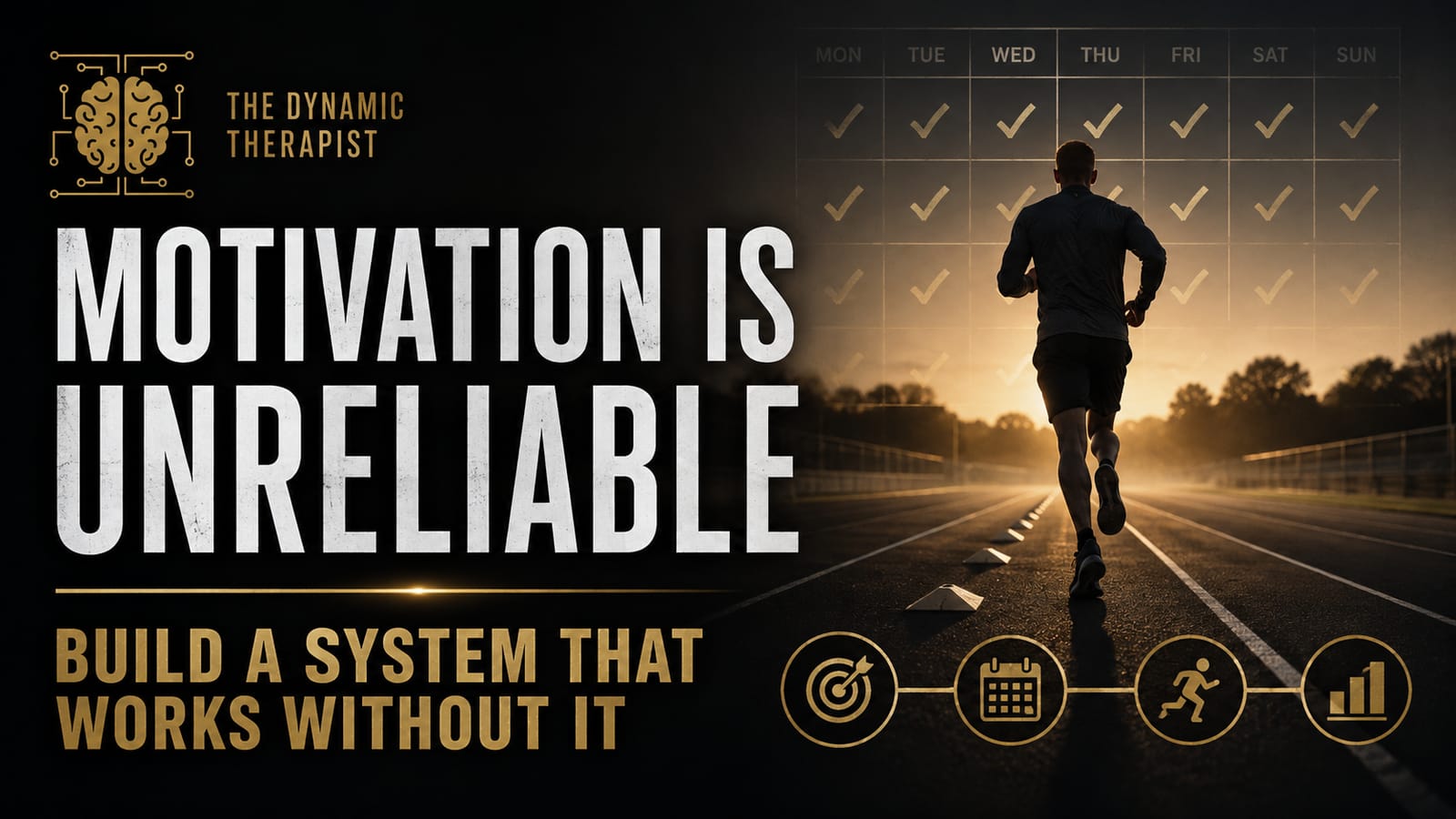
Motivation Is Unreliable: Build a System That Works Without It
The Problem With Waiting to Feel Motivated
Motivation is the thing most people are trying to find, maintain or recover when they want to be more consistent. If only I were more motivated.
If only I could get that feeling back. If only something would light me up enough to keep going.
The difficulty is that motivation is an emotional state, and emotional states fluctuate. They are influenced by sleep, Stress, the weather, a difficult conversation, a disappointing outcome, a poor night's rest.
The person who is highly motivated on Monday is often the same person who cannot face the task on Thursday — not because the goal has changed, but because the feeling has.
Relying on motivation to sustain consistent behaviour is a structurally unstable strategy.
Not because you are weak or uncommitted, but because it places a cognitive and emotional demand at the point of action — requiring you to feel a particular way before you can do the thing — and that demand will not always be met.
The alternative is a system. A set of structural conditions that make the behaviour easier to do than not to do, regardless of how motivated you feel when the moment arrives.
What a System Actually Is
A system is not a plan, though it can include one.
It is the arrangement of your environment, your time, your commitments and your defaults so that the behaviour you want is the path of least resistance rather than the one requiring the most willpower.
Systems work because they reduce the decision load at the point of action. If you have to decide every morning whether to exercise, you will often decide not to — particularly on the mornings when you are tired or stressed or rushed.
If your trainers are by the door, your kit is already out, and the walk has a fixed time in the diary, the decision has already been made.
You are no longer choosing whether to go. You are simply going.
The Four Components of a Reliable System
1. Environment design
The environment you inhabit shapes your behaviour far more than most people realise.
The food that is on the counter gets eaten. The phone that is in the bedroom gets checked at 2am. The book that is on the bedside table gets read.
The running shoes that are beside the bed get used more than the ones in the cupboard.
Environment design means arranging the physical and digital spaces around you so that the behaviours you want are easy and visible, and the behaviours you want to reduce are inconvenient or invisible.
This is not about willpower — it is about not using willpower where it can be conserved.
2. Minimum standards
Most systems collapse because the standard set was too high for difficult days.
You committed to one hour at the gym, and on the day when you have forty minutes you decide not to go at all.
You committed to writing a thousand words, and when you sit down with only twenty minutes you do not start.
A minimum standard is the floor — the version of the behaviour so small that there is almost no valid reason to skip it.
Ten minutes of movement. One paragraph. Five minutes of the difficult task.
The minimum standard keeps the habit alive on hard days, which means you do not have to rebuild from scratch when the difficult week passes.
3. Fixed routines
Behaviour that is attached to a consistent time or trigger requires less decision-making than behaviour that floats. 'I exercise at 7am on Monday, Wednesday and Friday' requires one decision — the original commitment.
'I exercise when I have time and feel like it' requires a new decision every day, and that daily decision is subject to the same motivational fluctuation the system is designed to avoid.
Fixed routines also benefit from the associative learning that underpins habit formation: the consistent time and context become cues that prime the behaviour, so over time the behaviour begins to feel more automatic and less effortful.
4. A reliable restart
Every system breaks down. The week gets disrupted, the illness arrives, the project derails the routine.
The system that survives is not the one that never breaks — it is the one that has a clear protocol for restarting after it does.
What is your first action when you miss three days?
What is the minimum you need to do to re-establish the pattern?
Having this decided in advance removes the paralysis that often follows a breakdown and makes it much more likely that the interruption stays an interruption rather than becoming an abandonment.
Two Grounded Examples
The person who could not make exercise stick
Diane had tried to establish a consistent exercise habit four times in three years.
Each attempt followed the same arc: high motivation, high commitment, a disruption, collapse.
On the fifth attempt she changed the approach.
She moved her trainers next to the front door.
She booked three specific classes per week rather than 'going when she could.'
She defined the minimum standard as attending two of the three even in a bad week, and one in a very bad week. Eight months later, she has not missed a week.
Not because her motivation is higher, but because the structure does not depend on it.
The professional who could not protect deep work
James's job requires concentrated thinking, but his diary is full of meetings and interruptions.
He kept planning to do deep work 'when he had time' and consistently not finding any.
The system change: he blocked 7–9am every weekday as non-negotiable in his diary, positioned as existing commitments, with his phone in a different room and his email closed.
In those two hours, nothing is allowed in.
He produces more useful work in those two hours than in the rest of the day combined, and it does not require motivation. It requires the protected time.
What Tracking Actually Does
Visual tracking — a calendar on the wall, a streak app, a tick in a notebook — works not because the streak itself is the goal but because it externalises progress and makes the behaviour feel real.
It also creates what some researchers call 'loss aversion' around the streak: once you have ten consecutive days, missing day eleven feels like losing something, which increases the pull to continue.
Keep the tracking simple. Complex systems for tracking become a project in themselves and often outlast the behaviour they are meant to support.
Three Reflection Questions
- Which behaviour have you been trying to sustain through motivation alone — and how is that working?
- What is the minimum standard version of your most important habit that you could almost always achieve?
- What one environmental change could you make this week to reduce the friction between you and the behaviour you want?
Key Takeaways
- Motivation fluctuates. A system does not depend on it.
- Environment design reduces the decision load at the point of action — make the wanted behaviour the path of least resistance.
- Minimum standards keep habits alive on hard days and prevent rebuilds from scratch.
- Fixed routines reduce the daily decision load and build associative cues over time.
- A reliable restart protocol is as important as the original system — every system will break down.
Frequently Asked Questions:
Does this mean motivation does not matter at all?
Motivation matters at the start — it provides the initial energy to set the system up.
The problem is using it as the ongoing fuel.
Use motivation to build the structure. Use the structure to run the behaviour.
What if I set up a system and still do not follow it?
Look at where it is breaking down. Is the standard too high?
Is the environment not actually arranged to support the behaviour?
Is there something running underneath the avoidance that the system cannot reach?
Systems solve structural problems.
They do not solve deeper resistance.
How many habits can I build a system for simultaneously?
One at a time is still the most reliable approach.
Build one system until it is solid, then add the next.
Multiple simultaneous system-builds compete for the same setup energy and tend to produce the same collapse as multiple simultaneous habit attempts.
What is the fastest way to make a new behaviour feel automatic?
Consistency of time and context.
The same action, at the same time, in the same place, connected to the same trigger.
Research suggests automaticity develops at around 66 days on average, with significant individual variation.
It is slower than most people expect and faster than it feels during the early weeks.
Can coaching or therapeutic work help with building systems?
Yes — particularly when the failure to follow through is connected to something more than structural problems.
If you consistently set systems up and consistently abandon them, the abandonment pattern is worth understanding directly.
Build the Structure. Trust the Structure.
You do not need to feel motivated to act. You need conditions in which acting is the natural thing to do.
That is what a system provides — and it is considerably more reliable than waiting for a feeling that may or may not show up when you need it.
Simon Taylor helps people understand what is actually preventing them from following through — and what kind of change would make the difference. A free 30-minute consultation is a practical first step.
Book Your Free 30-Minute Consultation | Get The Little Book of Big Changes