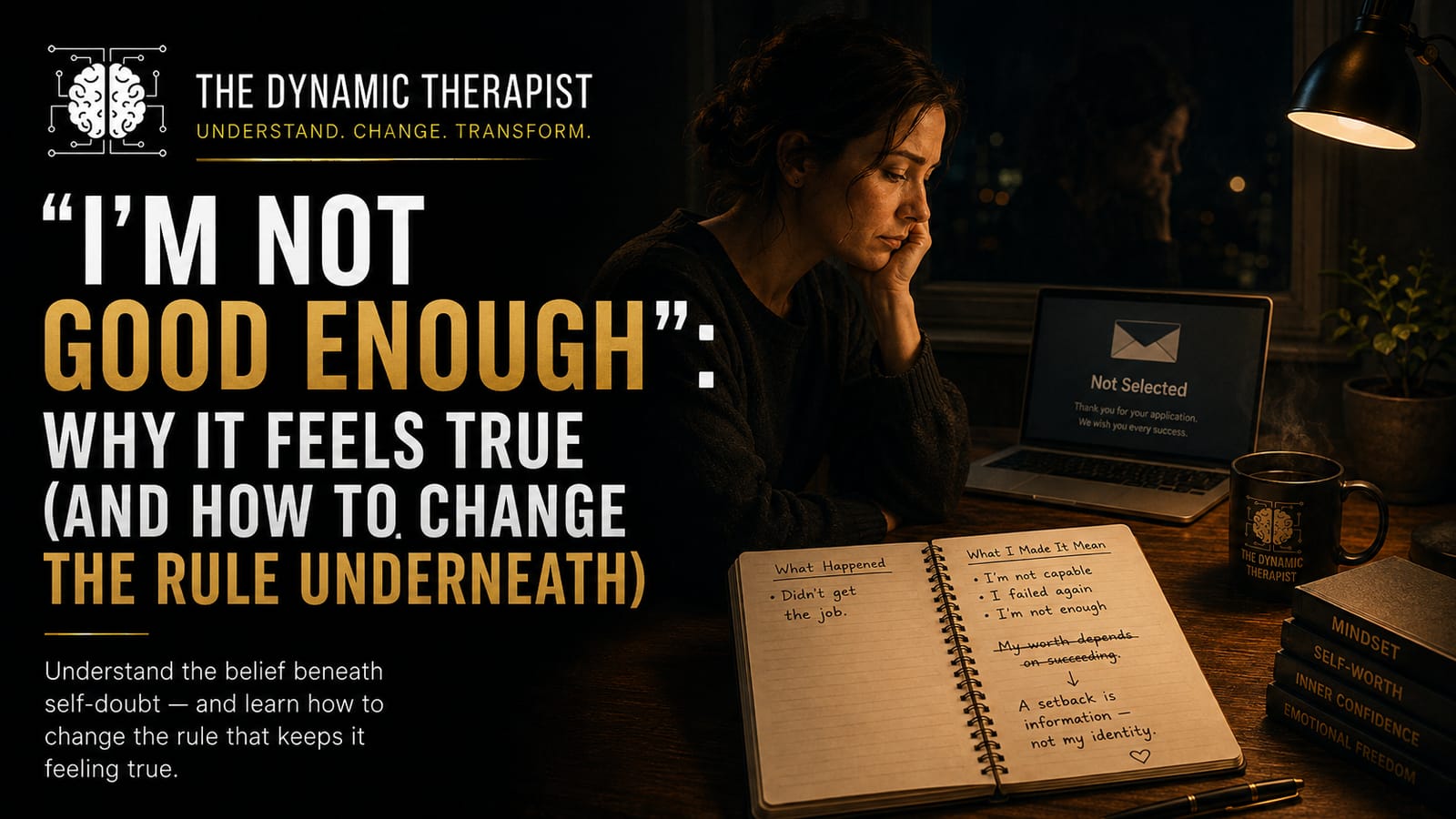
“I’m Not Good Enough”: Why It Feels True (and How to Change the Rule Underneath)
“I’m not good enough” is one of the most common and painful beliefs people carry. It can sit quietly in the background or show up loudly after a mistake, a rejection, or a moment of comparison. It can drive perfectionism, people-pleasing, overworking, and constant self-monitoring — and still never feel satisfied.
This post is compassionate but direct: that belief may feel true, but feeling true is not the same as being objectively true. We’ll explore where the belief often comes from and practical ways to challenge the underlying rule — without relying on empty positive affirmations.
Where the “not good enough” belief often comes from
This belief rarely appears out of nowhere. It’s usually learned — through experiences that taught your nervous system that approval, safety, or belonging were conditional.
Comparison
Comparison is a fast route to inadequacy because it’s selective. You compare your behind-the-scenes to someone else’s highlight reel. Your brain then treats the gap as evidence that you’re lacking — rather than evidence that you’re human.
Criticism (especially repeated or harsh)
If you were criticised often — or criticised for things you couldn’t control — your brain may have learned: “I’m wrong” or “I’m not enough” as a default. Even as an adult, feedback can trigger that old alarm.
Conditional approval
Some people learned that love and approval came when they performed: achieved, behaved, helped, stayed quiet, stayed useful. The message becomes: “I’m acceptable when I earn it.”
Past rejection
Rejection hurts — and the mind often tries to make sense of it by turning it into a personal verdict: “It happened because I’m not good enough.” That explanation feels certain, but it’s not necessarily accurate.
Perfectionism
Perfectionism is often a coping strategy for this belief. If you can do everything perfectly, you can avoid criticism, rejection, or shame. The problem is that perfection is impossible — so the belief never gets disproved.
Interpreting mistakes as evidence of inadequacy
Mistakes are normal. But if you carry the “not good enough” rule, mistakes don’t feel like information — they feel like exposure. One error becomes “proof” that you are fundamentally lacking.
A key distinction: a thought can feel true without being true
Thoughts feel true when they’re familiar, emotionally charged, and repeated. Your nervous system recognises the pattern and treats it as reality.
Feeling true = “my system believes this.” Objectively true = “this is a fact that holds up under evidence.”
The goal isn’t to argue with your mind all day. The goal is to reduce the authority you give the thought — and change the rule underneath it.
Why positive affirmations often don’t work (and what to do instead)
If you deeply believe “I’m not good enough,” repeating “I am amazing” can feel fake — and your brain rejects it. That doesn’t mean change is impossible. It means you need grounded exercises that target the underlying rule and build believable evidence.
Practical exercises (challenge the rule, not just the mood)
Exercise 1: Identify the hidden rule
Complete this sentence honestly:
- “I’m good enough when…”
- “If I make a mistake, it means…”
- “If someone is disappointed in me, it means…”
This reveals the rule your nervous system is living by.
Exercise 2: Separate behaviour from identity
Write two columns:
- Column A: “What happened” (facts only).
- Column B: “What I made it mean about me.”
Example: Fact: “I forgot to reply.” Meaning: “I’m unreliable.” Then ask: is that meaning the only possible interpretation?
Exercise 3: Build a believable alternative statement
Instead of a big affirmation, use a statement your brain can accept:
- “I’m learning.”
- “I can be imperfect and still be worthy.”
- “One mistake is information, not a verdict.”
- “I don’t need to be exceptional to be enough.”
Exercise 4: The evidence audit (balanced, not biased)
Your brain collects evidence for “not good enough” and ignores the rest. Do a 3-minute audit:
- List 3 examples from the last month that show competence, effort, or integrity.
- List 1 example where you struggled (keep it factual).
- Write one sentence that holds both: “I struggled with X, and I also did Y.”
Exercise 5: Behavioural experiment (prove the rule wrong gently)
Pick one small action that challenges the rule “I must be perfect to be okay.” For example:
- Send the email after one review instead of five.
- Say “I’ll get back to you” instead of overexplaining.
- Do one task at 80% and notice what actually happens.
Your nervous system learns through experience, not logic alone.
What to do when the thought shows up in real time
Try this short sequence:
- 1) Label it: “That’s the not-good-enough story.”
- 2) Ground outward: name 5 objects you can see.
- 3) Choose one next step: “What would I do if I didn’t believe this thought?”
How The Little Book of Big Changes fits in
Changing a belief like “I’m not good enough” isn’t usually one breakthrough — it’s a series of small, repeatable shifts in how you respond to yourself day-to-day.
The Little Book of Big Changes is designed as a practical resource for exactly that: changing limiting beliefs and everyday patterns with grounded prompts and actions you can actually use.
If you’d like to use it alongside these exercises: The Little Book of Big Changes: https://amzn.eu/d/00gxh8X1
When support may help
If this belief is persistent, affecting relationships, work, Confidence, or leading to Anxiety and perfectionism, support can help you change the pattern at the root.
At The Dynamic Therapist, I use a blended approach — hypnotherapy, NLP and grounded coaching (and where appropriate, evidence-based tools such as CBT/DBT) — to help people update old rules about worth and safety and build a steadier internal baseline.
Key Takeaways
- “I’m not good enough” is often a learned rule, not an objective fact.
- Comparison, criticism, conditional approval, rejection, and perfectionism can reinforce it.
- A thought feeling true is not the same as it being true.
- Grounded exercises work better than empty affirmations because they target the underlying rule.
- Small behavioural experiments help your nervous system learn safety without perfection.
Final Call to Action
If you’re tired of living under the pressure of “not good enough,” book a free 30-minute consultation. We’ll map what’s driving the belief and what would help you change it.
Book your free consultation: https://tidycal.com/fws-tdt/free-30-minute-consultation