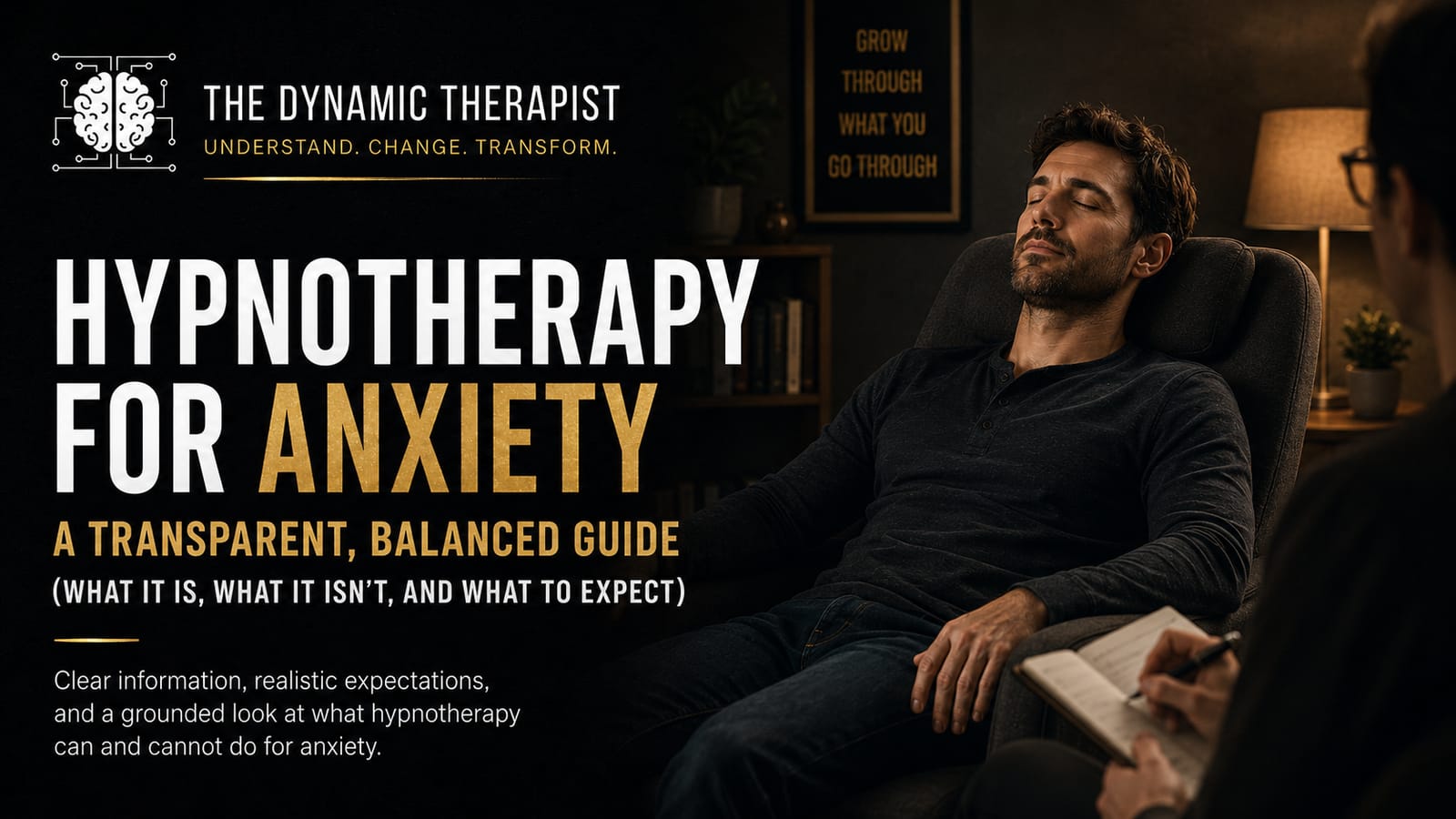
Hypnotherapy for Anxiety: A Transparent, Balanced Guide (What It Is, What It Isn’t, and What to Expect)
Hypnotherapy is often surrounded by myths — stage shows, swinging watches, and the idea that you’ll “lose control”. If you’re considering hypnotherapy for Anxiety, it’s reasonable to want a clear, grounded explanation of what it is, how it may help, and what a real session looks like.
This article is intentionally transparent and balanced. It doesn’t promise miracles. It explains hypnosis as a focused, absorbed state (not sleep or unconsciousness), addresses common fears, and outlines how hypnotherapy can be used alongside coaching, NLP-informed methods and other therapeutic approaches to work with thoughts, emotional associations and automatic responses.
What hypnosis is (in straightforward language)
Hypnosis is usually described as a focused, absorbed state of attention. It’s similar to the kind of absorption you might experience when you’re deeply engaged in a film, a book, driving a familiar route, or daydreaming — where your attention narrows and your mind becomes more responsive to suggestion and imagery.
In hypnotherapy, that focused state is used deliberately to support change: calming the nervous system, shifting unhelpful associations, and practising new responses.
What hypnosis is not
- Not sleep: you’re not “knocked out”. Many people are aware of what’s happening throughout.
- Not unconsciousness: you don’t disappear or lose your mind.
- Not mind control: you can’t be made to do something against your values.
- Not a truth serum: you’re not forced to reveal secrets.
- Not a trap: you don’t get stuck in hypnosis.
In a therapeutic setting, hypnosis is collaborative. You’re participating — not being controlled.
Common myths (and the reality)
Myth: “I’ll lose control.”
Reality: Hypnotherapy is not about taking control away. It’s about helping you access a calmer, more focused state where you can practise new responses. You can speak, move, and stop at any time.
Myth: “I’ll reveal secrets.”
Reality: Hypnosis isn’t a truth serum. In therapy, you share what you choose to share. The process is guided, but you remain a person with agency.
Myth: “I might get stuck in hypnosis.”
Reality: People naturally come out of hypnosis. Even if someone stopped guiding you, you would return to a normal state of awareness.
Myth: “If it doesn’t work instantly, it’s pointless.”
Reality: Some people notice shifts quickly; others need repetition and integration. Anxiety patterns are often learned over time, and change can be gradual. A responsible approach avoids guarantees and focuses on measurable progress.
How hypnotherapy may help with Anxiety (without overpromising)
Anxiety often involves automatic responses: threat scanning, catastrophic interpretations, body alarm sensations, avoidance, and learned associations (“this sensation means danger”, “this situation isn’t safe”).
Hypnotherapy may be used to:
- support relaxation and downshifting (helping the nervous system settle)
- work with emotional associations (reducing the intensity of triggers)
- rehearse new responses (Confidence, calm, boundaries, coping)
- reduce unhelpful automatic patterns (Overthinking, panic spirals, avoidance)
- strengthen self-trust and internal safety
It’s important to be honest: results vary. Hypnotherapy isn’t a guarantee, and it’s not the only effective approach. For many people, it works best as part of a broader plan.
How hypnotherapy fits alongside coaching, NLP-informed methods and other approaches
Anxiety is rarely just one thing. It can involve thoughts, body sensations, habits, beliefs, and relationship patterns. That’s why a blended approach can be useful.
In practice, this can look like:
- Coaching: clarifying goals, building routines, taking action, and creating accountability.
- NLP-informed methods: noticing patterns in language, meaning, and internal responses, and practising alternative responses.
- Evidence-based tools (where appropriate): practical strategies for Anxiety, boundaries, and behaviour change.
- Hypnotherapy: focused change work with the nervous system and emotional associations, plus rehearsal of new responses.
The aim is not to “pick one magic technique”. The aim is to use the right tool for the pattern you’re experiencing.
What a first session with The Dynamic Therapist may involve
Every client is different, but a first session typically includes:
- A clear conversation about what’s been happening and what you want to change.
- Mapping your Anxiety pattern: triggers, thoughts, body sensations, behaviours, and what keeps it going.
- Agreeing a realistic goal and what progress would look like.
- Explaining the process so you know what to expect (and can ask questions).
- A guided hypnotherapy experience if appropriate — focused on calming, safety, and beginning to shift the pattern.
- Practical next steps: a simple plan for between sessions (grounding, routines, or small exposure steps).
You won’t be pushed into anything you’re not ready for. The work is collaborative and paced.
Who should obtain appropriate medical or specialist advice before proceeding
Hypnotherapy can be supportive for many people, but it’s not a substitute for medical care. It’s sensible to seek appropriate medical or specialist advice before proceeding if:
- you have significant respiratory, cardiac, neurological, or other medical conditions and Anxiety symptoms overlap with physical symptoms
- you have symptoms that are new, severe, unusual, or worsening
- you are experiencing severe dissociation, psychosis, mania, or are under specialist psychiatric care (specialist guidance is important)
- you have complex Trauma symptoms and feel easily overwhelmed (supported, paced work is recommended)
- you are pregnant or have other health considerations where you want medical reassurance
If you’re unsure, it’s always okay to ask questions and make an informed decision.
A final note on safety and expectations
A good hypnotherapy experience should feel safe, respectful, and collaborative. You should feel informed about what’s happening and able to pause at any time.
If you’re looking for support with Anxiety, the most important thing is not the label of the method — it’s whether the approach fits your needs and helps you build real change over time.
Key Takeaways
- Hypnosis is a focused, absorbed state — not sleep, unconsciousness, or loss of control.
- You can’t be forced to reveal secrets or get stuck in hypnosis.
- Hypnotherapy may help with Anxiety by working with nervous system activation, emotional associations, and automatic responses.
- Results vary; a responsible approach avoids guarantees and uses hypnotherapy as part of a broader plan when helpful.
- Seek appropriate medical or specialist advice when symptoms are complex, severe, or medically relevant.
Final Call to Action
If you’re considering hypnotherapy for Anxiety and want to explore whether it’s a good fit, book a free 30-minute consultation. We’ll talk through what’s happening and what approach would be most helpful for you.
Book your free consultation: https://tidycal.com/fws-tdt/free-30-minute-consultation