How Your Environment Quietly Shapes Your Behaviour
The Invisible Architecture of Your Choices
Most people explain their behaviour in terms of character.
I am disciplined, or I am lazy. I have willpower, or I do not. I am the kind of person who exercises, or I am the kind of person who struggles to.
The internal attribution is so automatic that it rarely occurs to anyone to look at the external conditions that shape behaviour just as powerfully — and often more so.
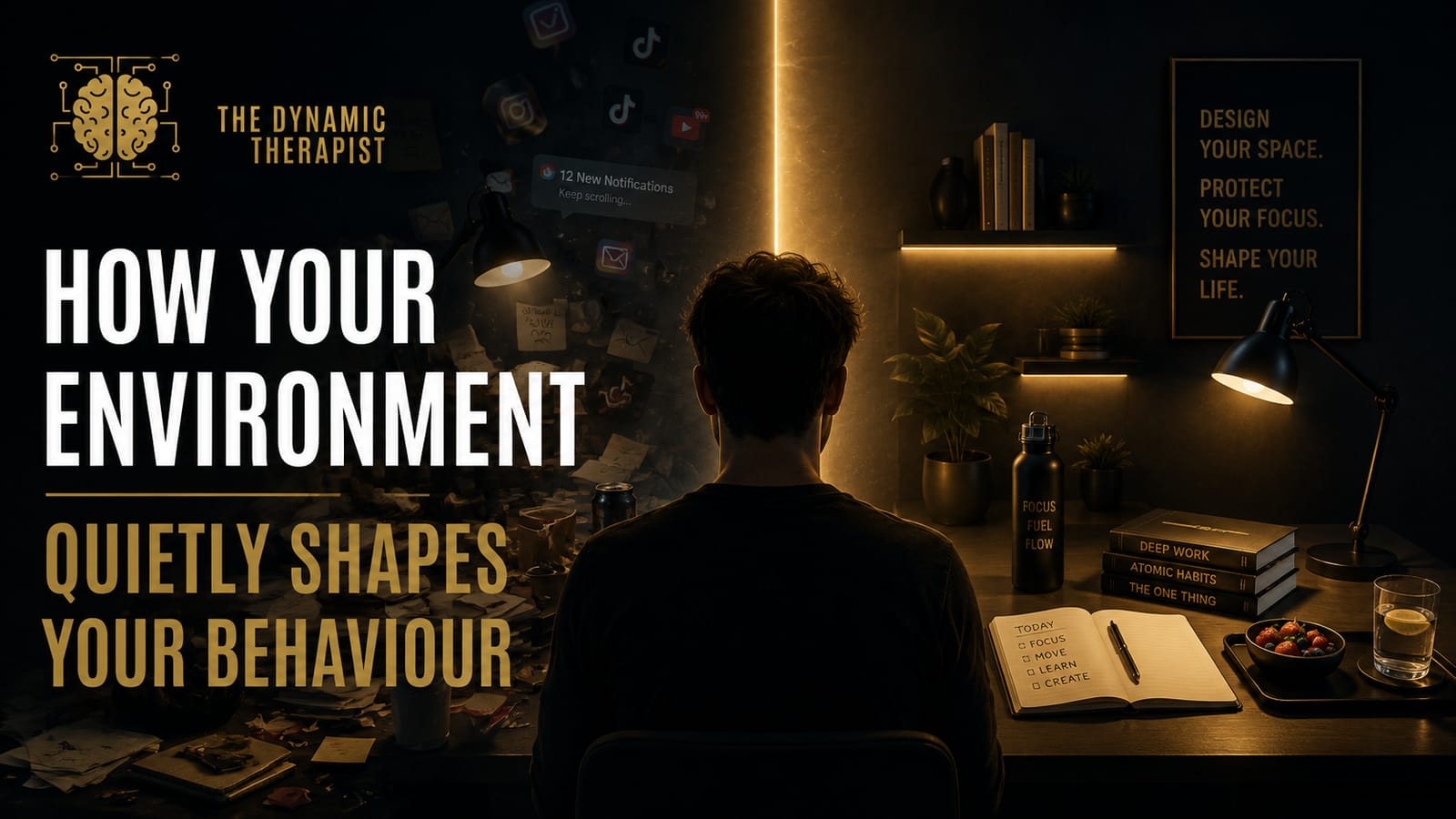
Your environment — the physical spaces you inhabit, the social contexts you move through, the digital architecture of your devices, the friction or ease of various actions — influences a remarkable proportion of what you do each day.
Not by forcing you, but by making certain behaviours more or less available, more or less visible, more or less effortful than others.
This is not a new observation.
Behavioural economics, social psychology and public health research have all documented the same finding: change the environment, and behaviour changes — often without any corresponding change in motivation, values or willpower.
How Environment Shapes Behaviour: The Key Mechanisms
Availability and visibility
What is present and visible gets used.
Food left on the counter gets eaten; food at the back of the fridge gets ignored. The book on the bedside table gets read; the book on the shelf does not.
The trainers by the door get worn; the ones in the cupboard stay there.
This is not weakness — it is how human attention and decision-making actually work.
We move towards what is immediately available and ignore what is not.
Friction
Friction is the resistance between an intention and an action. Even small amounts of friction — having to find equipment, sign in to an app, leave a room — reduce the frequency of a behaviour significantly.
Conversely, reducing friction makes behaviours markedly more likely, even without any change in motivation.
The evidence from supermarket research, for example, shows that moving a product from eye level to a lower shelf reduces sales significantly — purely through the addition of minimal physical effort.
Social norms
The behaviour of the people around you — what is normal, what is expected, what others are seen to be doing — is one of the most powerful environmental influences on your own behaviour.
People who want to reduce their alcohol consumption find it significantly easier in social environments where low or no alcohol is normal.
People trying to establish exercise habits find it significantly easier in peer groups where exercise is the default. The environment sets a social reference point that shapes what feels natural.
Default settings
In many areas of life, the default option — the one that happens if you do not actively choose otherwise — determines what most people do.
Pension contribution rates, organ donation, food portions, screen time notifications.
The default is powerful not because people choose it actively but because overriding it requires effort, and most of the time that effort is not expended.
Designing your own defaults — the things that happen unless you actively change them — is one of the more effective forms of self-management available.
Two Grounded Examples:
The phone that was charging in the bedroom
Mark wanted to reduce his phone use in the evenings.
He had tried apps, reminders and willpower.
None of it lasted.
The change that worked: he moved the charger to the kitchen and bought an old-fashioned alarm clock for the bedside table.
He no longer had to resist the phone in the bedroom.
It simply was not there.
His evening screen time halved within two weeks without any change to his motivation or character.
The environment did what his willpower could not.
The office that made movement impossible
Sarah's office is designed for sedentary work. Meetings happen in the meeting room directly opposite her desk.
The kitchen is four steps away.
She intended to walk more during the day but kept not doing it.
The environmental change: she moved her water bottle to a shelf at the far end of the building.
She started taking the stairs by default rather than the lift because she changed which entrance she used each morning.
Neither change required willpower.
Both produced daily movement that had previously been absent.
Designing Your Environment Intentionally:
Make desired behaviours visible and convenient
]
Whatever you want to do more of should be the easiest thing in your environment.
Healthy food at eye level.
Exercise equipment in the first room you enter.
The book where the remote control was. The journal open on the desk rather than in the drawer.
Make undesired behaviours inconvenient
You do not need to eliminate things.
You need to add enough friction that the unconscious default no longer applies. Log out of social media apps so signing in requires effort.
Put your phone in a different room during focused work.
Move the biscuits behind the vegetables.
The friction does not need to be large to be effective.
Choose your social environment deliberately
The people you spend the most time with set the ambient standard for your behaviour.
This is not about replacing your friends — it is about being deliberate about the additional contexts you inhabit.
Joining a running group, a book club, a professional community where the behaviour you are trying to establish is simply what people do.
Set your own defaults
Decide what happens unless you actively choose otherwise.
If the default is that you walk at lunch, you will walk at lunch unless something specific intervenes. If the default is that you check your phone first thing in the morning, you will check it every morning unless you actively remember not to.
Defaults are set by habit or by design. Setting them by design is considerably more effective.
Three Reflection Questions
- What behaviour have you been trying to change through willpower that might respond better to an environmental change?
- What is currently visible and convenient in your home or workplace that you would be better off making less accessible?
- What social environments are you regularly in — and do they support or subtly undermine the standards you are trying to maintain?
Key Takeaways
- Environment shapes behaviour through availability, friction, social norms and default settings — often more powerfully than willpower.
- Making desired behaviours visible and convenient increases their frequency without requiring motivation.
- Adding friction to undesired behaviours reduces them without requiring restriction or white-knuckling.
- Social norms are one of the most powerful behavioural influences available — choose your contexts deliberately.
- Default settings determine most behaviour. Setting them by design rather than habit is a significant lever.
Frequently Asked Questions:
Does this mean willpower is not important?
Willpower matters — particularly for single, high-stakes decisions.
But it is a limited resource, subject to depletion across the day, and a poor foundation for sustained behaviour change.
Environment design reduces the number of decisions that require willpower, preserving it for where it is actually needed.
Is this manipulation?
Designing your own environment to support your own goals is self-directed.
The same principles applied by others to your environment — through advertising, product placement, interface design — are worth being aware of, because they are not designed in your interest.
What if I cannot change my environment significantly?
Even small changes matter.
The position of one item.
The route you take.
Which app is on your home screen.
The principles apply at very small scale as well as large.
Can environment design replace therapeutic work?
For some surface-level behaviour patterns, environment design alone is sufficient.
For deeper patterns — particularly those driven by emotional states, ingrained beliefs or past experience — it addresses the structural layer but not the psychological one.
Both are usually relevant.
How quickly do environmental changes produce results?
Often quickly.
Many environmental changes produce immediate or near-immediate behavioural shifts — because the behaviour was never driven primarily by motivation, and removing the friction or the availability removes the primary obstacle.
Design the Conditions, Not Just the Intentions
You can have the right values, the right goals and the right intentions, and still find that your environment is quietly working against all of them.
The most effective change often starts not with deciding to be different, but with designing conditions in which being different is the path of least resistance.
Simon Taylor helps people understand the full picture of what is driving their behaviour — structural, environmental and psychological. A free 30-minute consultation is a good place to start looking at that.
Book Your Free 30-Minute Consultation | Get The Little Book of Big Changes