
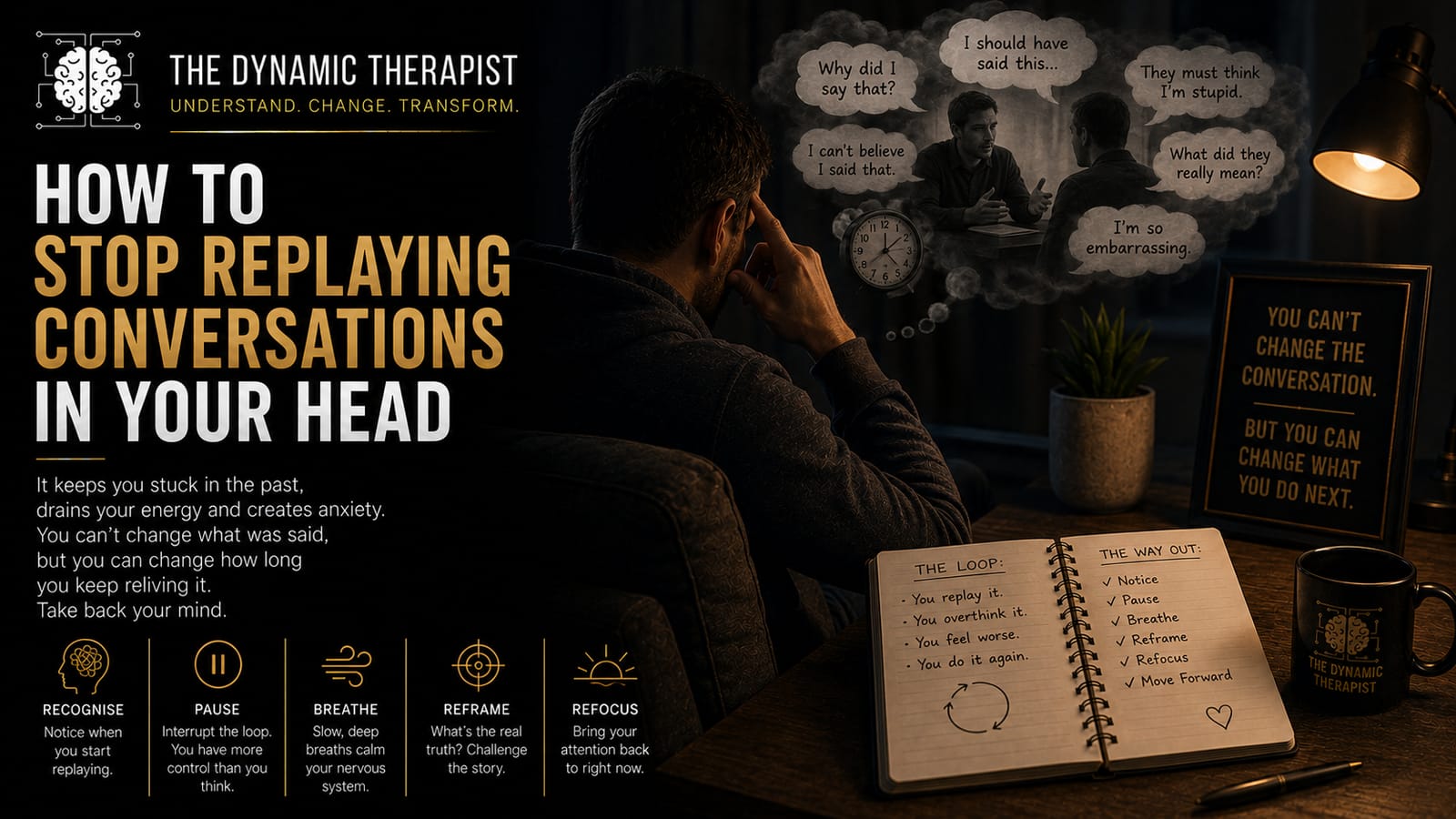
How to Stop Replaying Conversations in Your Head
The conversation ended hours ago. Maybe days ago. But it's still running — replaying the moment you said that thing, wondering what they meant by that look, wishing you'd responded differently, constructing the version where everything went better. Replaying conversations Anxiety is one of the most common and quietly exhausting features of social Anxiety, and it tends to be misunderstood as Overthinking rather than recognised as a specific pattern worth addressing.
Why the Mind Replays Conversations
The replay has a function. The mind is trying to process a social experience that felt uncertain or threatening — trying to work out whether you said something wrong, whether you've damaged the relationship, whether people think less of you now. It's doing a kind of damage assessment.
The problem is that the assessment is based entirely on imagination. You don't have access to what the other person was actually thinking. So the mind fills the gap with its best guess — and for anxious minds, the best guess tends toward the most threatening interpretation.
The Role of Imagined Judgement
Social Anxiety is fundamentally about anticipated evaluation by others. The replay is an attempt to predict that evaluation after the fact — to work out whether you came across well, whether you were judged negatively, whether something needs to be repaired.
This search for certainty about others' impressions is similar to the reassurance-seeking pattern: it provides brief relief (if the replay produces a benign conclusion) but more often generates its own Anxiety as the mind generates increasingly unflattering interpretations.
What the Replay Is Actually Looking For..
Most replays are searching for one of three things: confirmation that you didn't embarrass yourself, an explanation for something that felt ambiguous, or the perfect thing you should have said. None of these is reliably found through rumination — but the mind keeps searching.
What Helps..
Challenge the evidence
What do you actually know about how the other person received the conversation?
Separate concrete evidence from anxious interpretation.
Usually the evidence is far more ambiguous than the replay suggests.
Consider the other person's perspective realistically
People are considerably less focused on your performance than Anxiety predicts.
They're usually thinking about their own experience of the conversation, their own day, their own concerns.
The scrutiny the anxious mind imagines is rarely as intense as it feels.
Set a time limit on the replay
Allowing unlimited replay time produces more replay. Acknowledging 'I'm doing this, I'll give it five minutes and then stop' is more effective than trying to suppress it entirely.
Address the underlying social Anxiety
Replaying conversations is a symptom rather than the root cause.
The root is usually a fear of negative evaluation or a fragile sense of social acceptability. Working on those underlying patterns tends to reduce the replaying behaviour.
For Deeper Work
If social replaying is a persistent and distressing pattern, working with The Dynamic Therapist on the Anxiety underneath it is likely to be more effective than strategies aimed at the symptom alone.
A free 30-minute consultation is available.
Key Takeaways
Conversation replaying is the mind's attempt to assess social threat after the fact. It's based on imagination rather than evidence. The scrutiny imagined is almost always more intense than what's real. Setting a time limit is more effective than trying to suppress the replay. The underlying social Anxiety is usually worth addressing directly.
Tired of Living in Yesterday's Conversations? Let's Talk.
Book a free 30-minute consultation with The Dynamic Therapist to explore what's driving this pattern and what would actually help shift it.