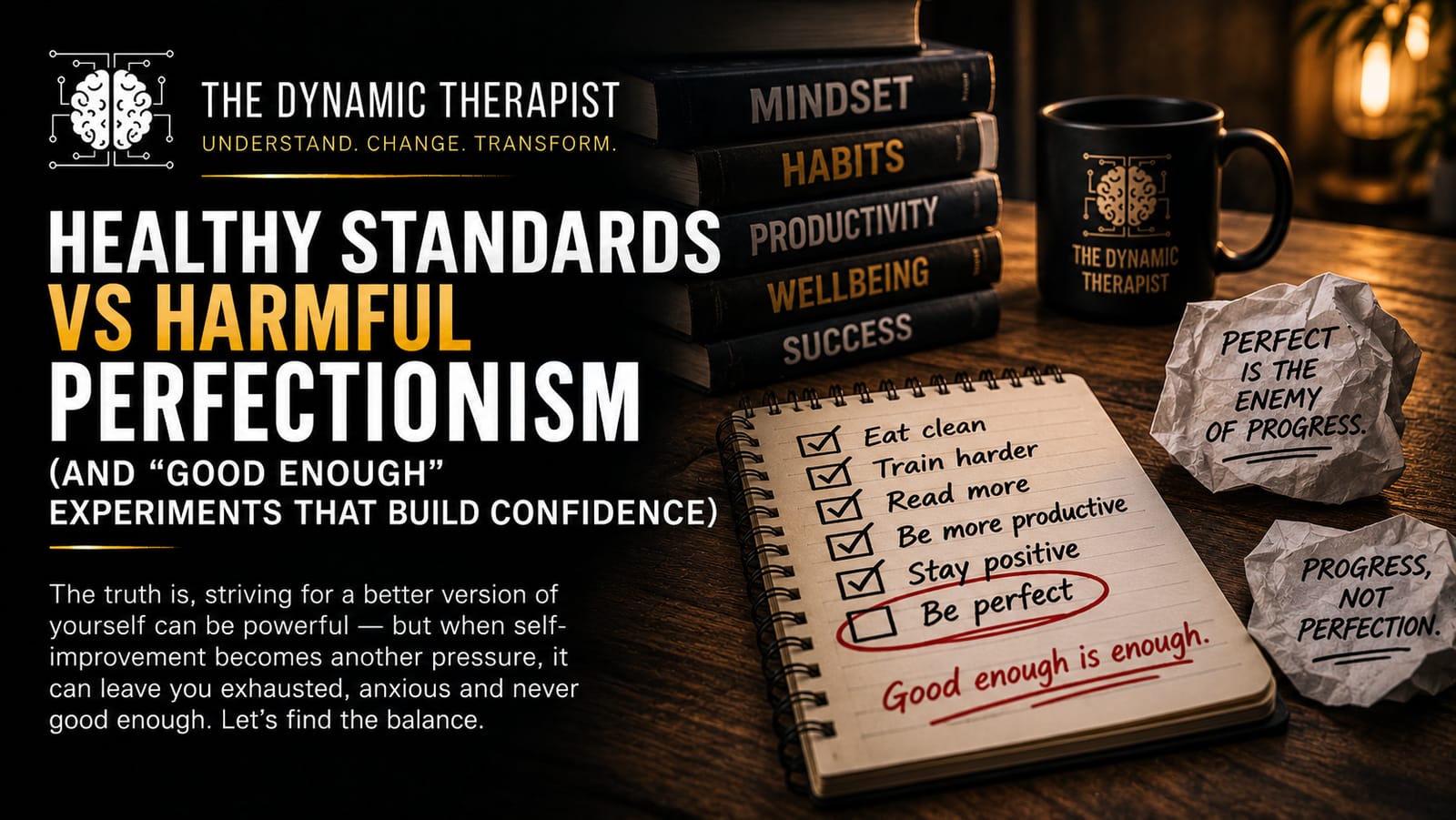
Healthy Standards vs Harmful Perfectionism (and “Good Enough” Experiments That Build Confidence)
Having standards can be a strength. It can mean you care, you’re conscientious, and you want to do things well. But perfectionism is different. Perfectionism isn’t just “high standards” — it’s often fear in a productive outfit.
It can look like discipline and ambition while quietly creating procrastination, overchecking, avoidance of visibility, difficulty finishing, and harsh self-criticism. Over time, it restricts growth because it makes learning feel unsafe.
This post differentiates healthy standards from harmful perfectionism and gives practical “good enough” experiments you can try in low-risk situations to retrain the pattern.
Healthy standards vs perfectionism (a clear comparison)
| Healthy standards | Harmful perfectionism |
| Aim for quality and learning | Aim for certainty and zero mistakes |
| Mistakes = information | Mistakes = personal inadequacy |
| Can finish and iterate | Struggles to finish; keeps tweaking |
| Effort is proportionate | Overchecking and overworking |
| Self-talk is firm but fair | Self-talk is harsh and shaming |
| Growth comes from practice | Growth is restricted by fear of being seen |
How perfectionism shows up (even when it looks productive)
Procrastination
Perfectionism often causes procrastination because starting means risking imperfection. If you don’t start, you can’t fail — and you can’t be judged.
Overchecking
You reread the email five times. You rework the design endlessly. You keep “just making it better”. Overchecking is often reassurance-seeking: trying to eliminate uncertainty.
Avoiding visibility
You avoid posting, presenting, applying, launching, or sharing your work because visibility increases the risk of judgement. Perfectionism often hides as “I’m just not ready yet.”
Difficulty finishing
Finishing means the work becomes real — and therefore judgeable. So perfectionism keeps you in the safer zone of “almost done”.
Harsh self-criticism
Perfectionism often uses criticism as a control strategy: “If I’m hard on myself, I’ll do better.” In reality, shame usually reduces creativity, risk-taking, and resilience.
Believing mistakes reduce personal worth
This is the core rule underneath many perfectionism patterns: “If I make a mistake, it means I’m not good enough.” That rule turns normal learning into a threat.
Why perfectionism restricts growth
Perfectionism can look like productivity because you’re busy — but the busyness often goes into control rather than progress.
Growth requires:
- trying things before you feel ready
- being seen while imperfect
- learning from feedback
- iterating over time
Perfectionism blocks those steps by making imperfection feel unsafe. It keeps you in preparation instead of practice.
Practical “good enough” experiments (low-risk, high learning)
These are behavioural experiments — small actions that teach your nervous system that “good enough” is safe. Choose one and try it for a week.
Experiment 1: The 80% send
Send an email or message after one review instead of five. Notice what happens. Most of the time, nothing catastrophic happens — and you gain time and Confidence.
Experiment 2: Time-boxed work
Set a timer (20–40 minutes). When it ends, stop. This breaks the “I must keep tweaking until it feels perfect” loop.
Experiment 3: Publish a draft
Share something small publicly that isn’t perfect: a short post, a simple update, a rough idea. The goal is to practise being visible without overpolishing.
Experiment 4: Deliberate minor imperfection
In a low-stakes situation, allow a tiny imperfection (a slightly messy drawer, a non-perfect outfit, a small typo you don’t fix). Then practise not correcting it. This is exposure training for uncertainty.
Experiment 5: “Done is data” review
Finish something and treat it as data, not a verdict. Ask:
- What worked?
- What would I improve next time?
- What did I learn?
Perfectionism in business, relationships, and appearance
Business
Perfectionism in business often looks like endless preparation: tweaking branding, rewriting copy, delaying launches, avoiding sales conversations, or waiting for the “perfect” offer. The cost is momentum. Businesses grow through iteration and feedback — not perfection.
Relationships
In relationships, perfectionism can show up as fear of saying the wrong thing, Overthinking texts, people-pleasing, or trying to be “easy” so you’re not rejected. It can also show up as unrealistic standards for others — because imperfection feels unsafe.
Appearance
Appearance perfectionism can create constant checking, comparison, and self-criticism. It can also shrink your life: avoiding photos, events, or intimacy until you feel “better”. The goal isn’t to stop caring about appearance — it’s to stop treating appearance as a measure of worth.
How to be firm without being cruel to yourself
Healthy standards include accountability. The difference is tone. Try swapping harsh self-talk for firm, fair language:
- Harsh: “This is pathetic.” → Firm: “This is hard, and I’m doing it anyway.”
- Harsh: “I can’t mess this up.” → Firm: “I can handle mistakes and adjust.”
- Harsh: “It has to be perfect.” → Firm: “It has to be done.”
When support may help
If perfectionism is driving Anxiety, avoidance, Burnout, or constant self-criticism, support can help you change the underlying rule — not just manage symptoms.
At The Dynamic Therapist, I use a blended approach — hypnotherapy, NLP and grounded coaching (and where appropriate, evidence-based tools such as CBT/DBT) — to help you build safety around imperfection and take action without needing certainty.
Key Takeaways
- Healthy standards support learning and completion; perfectionism seeks certainty and zero mistakes.
- Perfectionism can look productive while restricting growth through avoidance and overchecking.
- “Good enough” experiments build evidence that imperfection is safe.
- Perfectionism often shows up in business, relationships, and appearance — and can shrink your life if left unchecked.
Final Call to Action
If perfectionism is keeping you stuck — procrastinating, overchecking, or avoiding visibility — book a free 30-minute consultation. We’ll map the pattern and build a plan that helps you move forward without needing perfect Confidence first.
Book your free consultation: https://tidycal.com/fws-tdt/free-30-minute-consultation
If you’d like a practical, grounded read that supports mindset shifts and reduces self-doubt, you may also find my book useful:
The Little Book of Big Changes: https://amzn.eu/d/00gxh8X1