Guilt Around Resting: Why It Happens (and How to Make Rest Feel Safer)
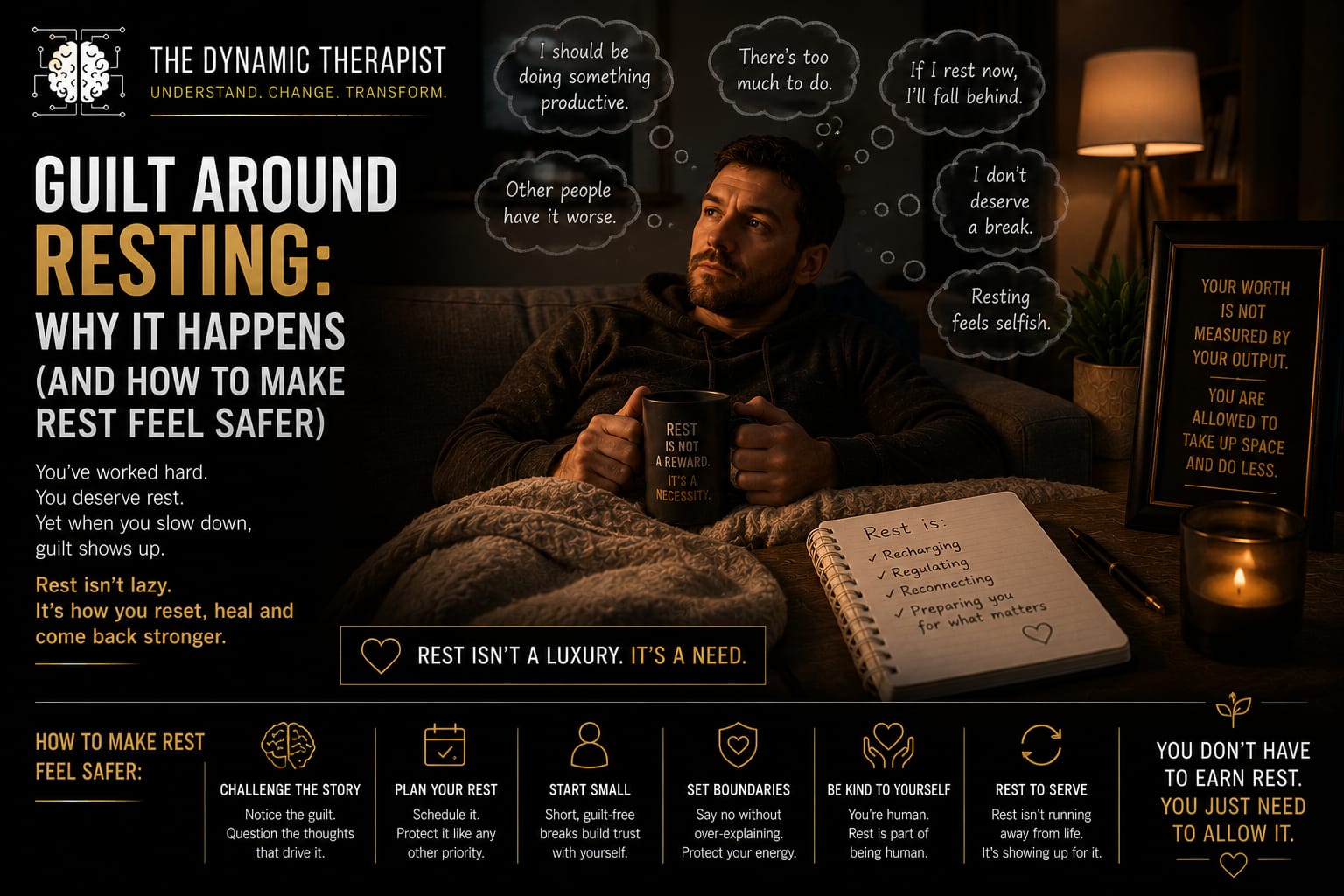
For some people, rest isn’t relaxing — it’s uncomfortable. You sit down and your mind starts listing what you “should” be doing. You try to switch off and feel guilty, restless, or even anxious.
If that’s familiar, it doesn’t mean you’re lazy or broken. It often means your nervous system has learned a rule: productivity equals safety, worth, or control.
This post explores why guilt around resting happens, how to tell restorative rest from avoidance, and practical ways to make rest feel safer — without turning it into another productivity task.
Why guilt around rest happens
Guilt is often a signal that you’re breaking an internal rule. Many people carry rules like:
- “I have to earn rest.”
- “If I slow down, I’ll fall behind.”
- “If I’m not productive, I’m not valuable.”
- “Rest is for people who have everything under control.”
Those rules don’t appear out of nowhere. They’re usually learned — and reinforced.
Beliefs connecting worth with productivity
If you’ve been praised mainly for achievement, reliability, or being “the strong one”, your brain may link output with approval. Rest can then feel like risk: “What if I’m not enough without doing?”
Childhood messages (spoken or unspoken)
Some people grew up with messages like “Don’t be lazy”, “There’s always something to do”, or “You have to work hard to deserve things”. Others learned it indirectly by watching stressed adults who never stopped.
Fear of falling behind
If your life has been shaped by pressure — deadlines, caregiving, responsibility, or high expectations — slowing down can trigger fear. Your system may interpret rest as losing control.
Comparison culture
Social media can make it feel like everyone else is achieving more, doing more, optimising more. That comparison can turn rest into self-judgement: “I should be using this time better.”
Financial pressure
For many people, guilt around rest isn’t just mindset — it’s reality. If money is tight, rest can feel unsafe. The goal isn’t to pretend pressure doesn’t exist; it’s to find sustainable ways to recover so you can function long-term.
The discomfort that surfaces when you finally slow down
When you stop, you may feel what you’ve been outrunning: sadness, Anger, Grief, loneliness, fear, or exhaustion. Rest can feel uncomfortable because it removes distraction — not because rest is wrong.
Restorative rest vs avoidance (a useful distinction)
Not all “rest” is restorative. Sometimes what looks like rest is actually avoidance — and it leaves you more drained.
Restorative rest tends to:
- leave you a little more resourced afterwards
- reduce tension or mental noise over time
- support recovery (sleep, nervous system, mood)
- feel aligned with your values (even if it’s unfamiliar)
Avoidance tends to:
- help you escape a task or emotion temporarily
- leave you more anxious afterwards (because the problem grows)
- come with a “stuck” feeling rather than recovery
- often involve numbing (endless scrolling, bingeing, zoning out)
This isn’t about judging yourself. It’s about choosing rest that actually helps.
How to make rest feel safer (without turning it into another task)
If rest triggers guilt, you don’t need to force yourself into hours of stillness. Start with small, safe doses and a clearer frame.
1) Use “minimum effective rest”
Try 5–10 minutes. A short pause is often easier for the nervous system to tolerate than a whole afternoon.
2) Give rest a simple purpose (not a productivity KPI)
Purpose doesn’t mean optimisation. It means a gentle frame like: “This is recovery so I can live my life.”
3) Pair rest with external grounding
If your mind spirals when you stop, keep rest lightly anchored in the environment:
- sit by a window and notice light and colour
- drink a warm drink slowly
- take a short walk without a goal
- listen to calming audio while you breathe gently
4) Practise “rest without earning it” (in tiny steps)
If rest only happens after everything is done, rest never happens. Choose one small rest moment that isn’t a reward — it’s maintenance.
5) Create a boundary around rest
Rest feels safer when it’s protected. Examples:
- a set stop time for work
- no emails after a certain hour
- a “phone in another room” window
- one evening a week that isn’t booked
6) Expect discomfort — and don’t treat it as failure
If guilt shows up, it doesn’t mean rest is wrong. It often means you’re changing an old rule. You can acknowledge it: “This is guilt. I’m allowed to recover.”
Reflection questions (where did my rules come from?)
Use these to identify the beliefs underneath the guilt:
- What did I learn about rest growing up?
- Who benefited when I was always productive or “easy”?
- What do I fear would happen if I slowed down?
- What do I believe rest says about me?
- When do I feel most guilty — and what does that reveal about my rules?
- What would I say to someone I love who needed rest?
- If my worth wasn’t tied to productivity, what would change this week?
When support may help
If guilt around rest is persistent, linked with Anxiety, Burnout, or perfectionism, support can help you change the underlying pattern — not just push through it.
At The Dynamic Therapist, I use a blended approach — hypnotherapy, NLP and grounded coaching (and where appropriate, evidence-based tools such as CBT/DBT) — to help people update old rules about worth, safety, and control so rest becomes possible again.
Key Takeaways
- Guilt around rest often comes from learned rules linking worth with productivity.
- Rest can feel unsafe when you fear falling behind, face financial pressure, or finally feel what you’ve been carrying.
- Restorative rest supports recovery; avoidance often leaves you more drained.
- Small, purposeful (not optimised) rest moments build safety over time.
- Reflection helps you identify and update the rules underneath the guilt.
Final Call to Action
If you’re stuck in a cycle of pressure, guilt, and exhaustion, book a free 30-minute consultation. We’ll map what’s happening and talk through what would help you recover without losing yourself to productivity.
Book your free consultation: https://tidycal.com/fws-tdt/free-30-minute-consultation
If you’d like a practical, grounded read that supports mindset shifts and reduces self-doubt, you may also find my book useful:
The Little Book of Big Changes: https://amzn.eu/d/00gxh8X1