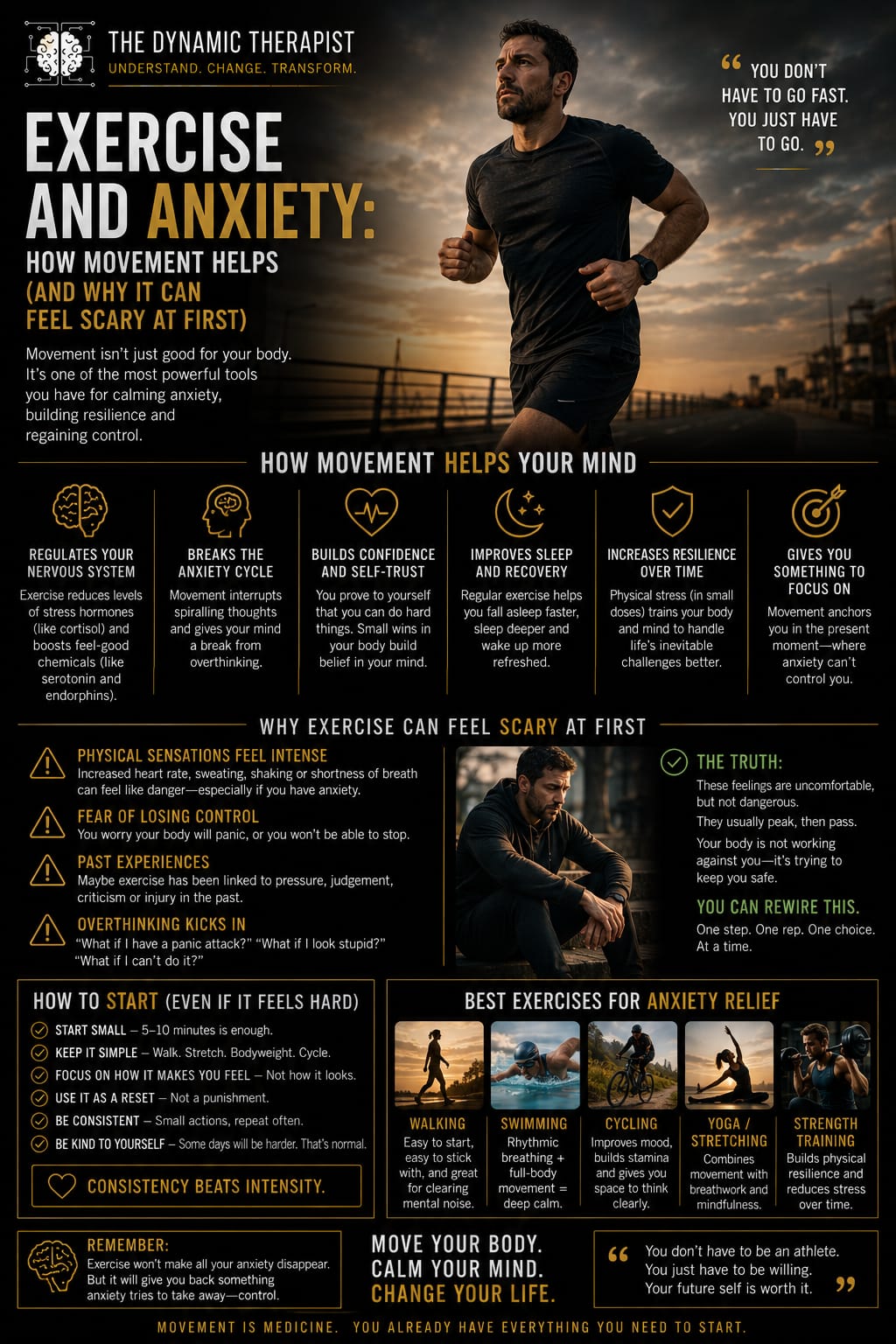
Exercise and Anxiety: How Movement Helps (and Why It Can Feel Scary at First)
Exercise is often recommended for Anxiety — and for good reason. Movement can support mood, sleep, Confidence, and Stress recovery. But if you’re someone who fears bodily sensations, exercise can also feel intimidating. A faster heart rate, sweating, or breathlessness can resemble panic symptoms and trigger worry.
This post is a balanced guide: the potential benefits of exercise for Anxiety, why it can initially feel frightening, and how to start in a way that builds Confidence rather than pressure. It also includes a simple beginner weekly movement plan focused on consistency — not punishment or extreme fitness.
How exercise can support Anxiety (realistic benefits)
Exercise isn’t a cure-all, and it won’t remove every anxious thought. But it can support your system in several practical ways:
- Mood support: movement can improve mood and reduce Stress reactivity over time.
- Improved sleep: regular activity often helps sleep quality and sleep drive.
- Greater physical Confidence: learning “my body can handle this” reduces fear of sensations.
- Routine and predictability: scheduled movement creates anchors in the week.
- A healthy outlet for Stress: movement helps your body process Stress chemistry rather than storing it as tension.
For many people, the biggest benefit is not “feeling calm” — it’s feeling more capable. Anxiety often shrinks your world. Movement can expand it again.
Why exercise can feel scary if you fear bodily sensations
If you’ve experienced panic, health Anxiety, or strong Anxiety symptoms, your brain may have learned to treat certain sensations as danger signals. Exercise naturally creates some of those sensations:
- increased heart rate
- faster breathing
- sweating and heat
- muscle fatigue
- light-headedness if you push too hard or breathe too fast
If your mind interprets these as “something is wrong”, it can trigger a fear response — which increases adrenaline and makes the sensations feel even stronger. That’s not weakness. It’s a learned association.
A key goal is to teach your nervous system: “These sensations can mean effort — not danger.”
Choosing the right type of movement
Different types of exercise feel different in the body. If you’re rebuilding Confidence, start with what feels doable and gradually expand.
Walking
Walking is one of the best starting points: low barrier, easy to scale, and naturally regulating. It also supports light exposure and routine.
Cycling
Cycling can be great if you enjoy it, but it can raise heart rate quickly. Start gently and choose routes where you feel safe to slow down or stop.
Swimming
Swimming can feel calming for some people because of the water and rhythm. For others, breath control can feel triggering. Start with short, easy sessions and plenty of breaks.
Strength training
Strength work can build Confidence quickly because it teaches “I can do hard things safely.” It doesn’t have to be heavy. Bodyweight exercises and light weights count.
Gentle movement (stretching, yoga, mobility)
Gentle movement can reduce muscle tension and help you reconnect with your body without a big adrenaline surge. It’s especially useful on high-Stress days or as a wind-down.
How to start without triggering panic
- Start below your “panic threshold”: choose an intensity where you can still speak in full sentences.
- Warm up slowly: sudden intensity spikes can feel like panic.
- Focus on the exhale: avoid gulping huge breaths; keep breathing gentle and steady.
- Expect some discomfort: effort sensations are normal. The goal is to tolerate them safely, not eliminate them.
- Progress gradually: add time or intensity in small steps, not big leaps.
If you have respiratory, cardiac, neurological, or other medical conditions — or symptoms are new, unusual, or severe — follow guidance from an appropriate healthcare professional.
A simple beginner weekly movement plan (consistency over punishment)
This plan is designed to be realistic. It’s not a bootcamp. It’s a Confidence-building routine. Adjust times to your level.
Week plan (repeat weekly)
- Mon: 15–20 min walk (easy pace) + 2 min stretch (neck/shoulders).
- Tue: 10–15 min gentle movement (mobility/yoga/stretching).
- Wed: 15–25 min walk OR easy cycle (keep it conversational).
- Thu: 15 min beginner strength (bodyweight): 2 rounds of 8–10 squats, wall push-ups, glute bridges, and a 30-sec plank (rest as needed).
- Fri: 15–20 min walk (or swim if you prefer) + 1 minute of slow exhale breathing.
- Sat: “Choice day” — do something enjoyable: longer walk, light hike, cycle, swim, or a class (keep it moderate).
- Sun: Recovery day — 10 min gentle stretch + a short outdoor stroll if possible.
If you’re starting from zero, begin with 10 minutes and build. The win is showing up, not smashing it.
How to know you’re progressing
Progress isn’t only fitness. For Anxiety, progress often looks like:
- you recover faster after your heart rate rises
- you stop interpreting normal effort sensations as danger
- you feel more confident leaving the house or doing activities
- you sleep a little better
- you feel less “stuck” in your head
When to get extra support
If fear of bodily sensations is stopping you from exercising — or if exercise reliably triggers panic — support can help. Therapy can reduce fear of sensations, change catastrophic interpretations, and retrain the nervous system so movement feels safer again.
At The Dynamic Therapist, I use a blended approach — hypnotherapy, NLP and grounded coaching (and where appropriate, evidence-based tools such as CBT/DBT) — to help you rebuild Confidence in your body and reduce Anxiety loops.
Key Takeaways
- Exercise can support mood, sleep, routine, and Stress recovery — but it’s not a cure-all.
- If you fear bodily sensations, exercise can feel scary because it mimics panic sensations.
- Start gently, progress gradually, and focus on Confidence-building rather than intensity.
- Seek appropriate medical guidance if symptoms are new, unusual, severe, or you have underlying conditions.
FAQ
What if my heart rate triggers panic?
Start with lower intensity (walking) and practise staying with mild increases while using gentle breathing and external focus. Gradual exposure builds Confidence.
Is gentle movement “enough”?
Yes. Gentle movement supports regulation and consistency. You can build intensity later if you want.
How often should I exercise for Anxiety?
Consistency matters more than perfection. A few short sessions per week can help, especially when paired with sleep and boundaries.
When should I speak to a healthcare professional?
If you have underlying medical conditions, or symptoms are new, unusual, severe, or concerning, seek appropriate medical advice.
Final Call to Action
If Anxiety is keeping you stuck — especially fear of bodily sensations — book a free 30-minute consultation. We’ll map what’s happening and build a plan that helps you move forward safely.
Book your free consultation: https://tidycal.com/fws-tdt/free-30-minute-consultation
If you’d like a practical, grounded read that supports mindset shifts and reduces self-doubt, you may also find my book useful:
The Little Book of Big Changes: https://amzn.eu/d/00gxh8X1