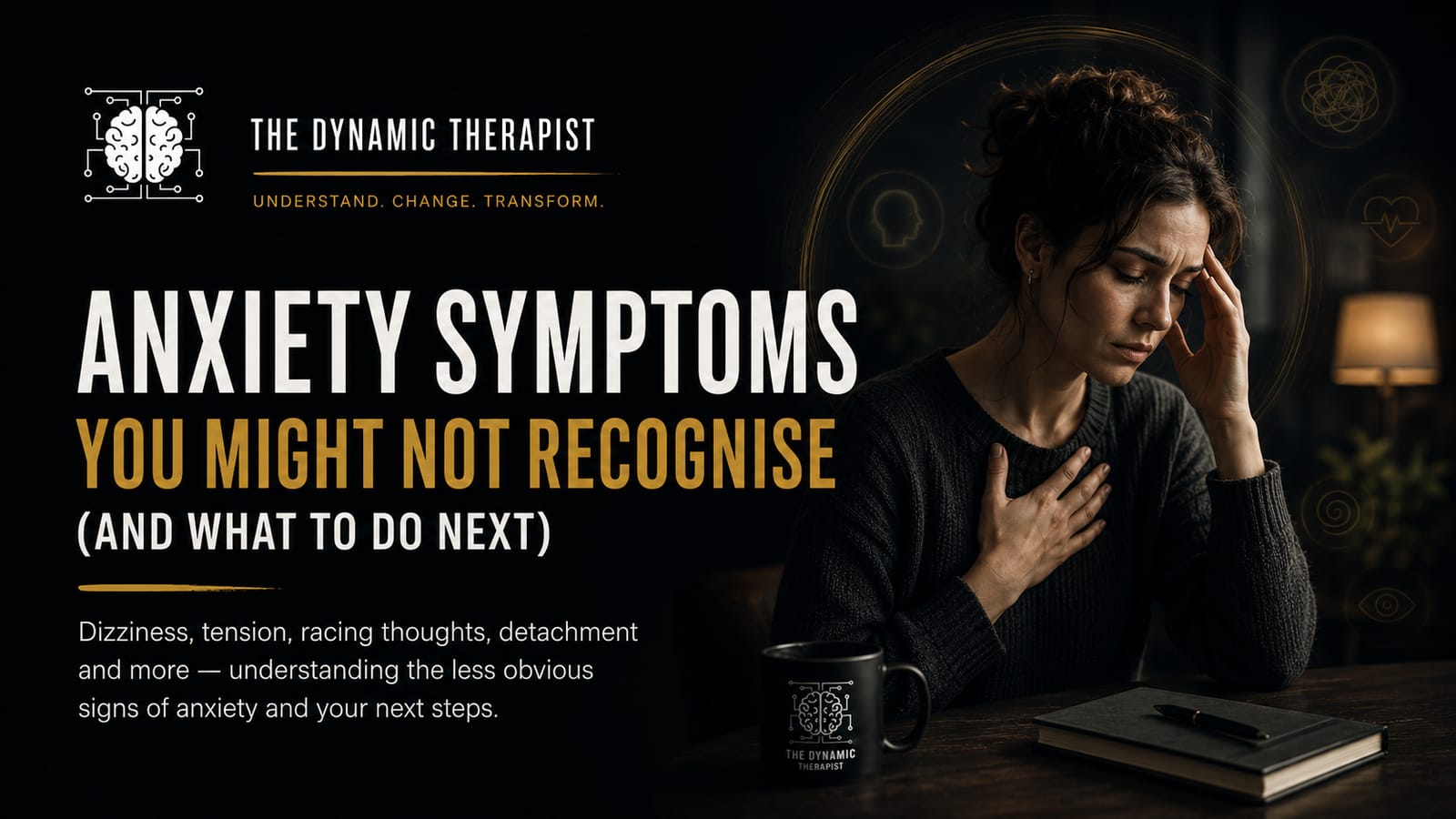
Anxiety Symptoms You Might Not Recognise (And What To Do Next)
When people think of Anxiety, they often picture racing thoughts, worry, or a pounding heart. But Anxiety doesn’t always announce itself that clearly. For many people it shows up as physical sensations, fogginess, irritability, or a strange sense of detachment — and that can be frightening, especially when you don’t connect it to Stress.
This article covers common and less obvious Anxiety symptoms, why nervous-system activation can create very real physical sensations, and how to respond in a grounded way. It also includes an important caveat: new, severe, or unexplained symptoms should be medically assessed rather than automatically assumed to be Anxiety.
A quick, grounded framework: Stress changes the body
Anxiety is not “all in your head”. It’s a whole-body state. When your nervous system shifts into threat mode, your body prioritises survival: blood flow changes, breathing patterns shift, muscles brace, digestion slows, and your senses become more alert.
Those changes can create sensations that feel alarming — especially if you’re the type of person who monitors your body closely or has had a panic episode before.
The sensations are real. The question is what they mean — and what your brain decides they mean.
Less obvious Anxiety symptoms people often miss
Below are experiences that are commonly linked with Stress and nervous-system activation. You don’t need to have all of them. And having them doesn’t automatically mean “it’s Anxiety”. It means they’re worth understanding in context.
Dizziness or light-headedness
Dizziness can come from changes in breathing (especially subtle over-breathing), muscle tension in the neck and shoulders, dehydration, low blood sugar, or adrenaline. When you notice it and panic, the fear response can intensify it.
Digestive discomfort
Stress can affect digestion quickly. You might notice nausea, a tight stomach, bloating, reflux, cramps, or urgent bowel movements. In threat mode, the body diverts energy away from digestion — which can make your gut feel unsettled.
Tingling, numbness, or “pins and needles”
Tingling can be linked with adrenaline and breathing changes, as well as muscle tension and posture. It’s common in Anxiety, and it’s also a symptom that should be checked if it’s new, one-sided, severe, or persistent.
Derealisation or feeling detached
Some people describe feeling “not quite here”, as if the world looks slightly unreal, distant, or too bright. Others feel emotionally numb or detached from themselves. This can be a protective response when the system is overwhelmed — like your brain turning down intensity.
It can be unsettling, but it’s a known Stress response. The fear of it often keeps it going.
Ringing ears or sound sensitivity
When you’re stressed, your senses can become more vigilant. Some people notice ringing, buzzing, or a heightened sensitivity to noise. If ringing is new or worsening, it’s worth discussing with a healthcare professional.
Muscle tension and jaw clenching
An anxious system braces. That can show up as tight shoulders, a clenched jaw, headaches, a sore neck, or a feeling of being “wired”. Over time, chronic tension can create its own discomfort — which then becomes another trigger.
Visual sensitivity and feeling overstimulated
Bright lights, busy environments, and screens can feel harsher when your system is on alert. Some people notice visual “shimmering”, difficulty focusing, or feeling overwhelmed in supermarkets and shopping centres.
Brain fog and difficulty thinking clearly
In threat mode, the brain prioritises scanning and reacting over deep thinking. That can feel like fog, forgetfulness, or struggling to find words. It’s frustrating — and it often improves when the system settles.
Irritability and a short fuse
Irritability is often a sign of overload. When your nervous system is already stretched, small things feel bigger. People sometimes judge themselves for this, but it’s often a signal: you’re running close to capacity.
Exhaustion (even when you “haven’t done much”)
Anxiety is tiring. Constant scanning, tension, and adrenaline surges burn energy. Many people feel wiped out after a period of Stress, even if they’ve been functioning on the outside.
Difficulty speaking clearly under pressure
Under Stress, some people stumble over words, go blank, or feel their throat tighten. That can be linked with adrenaline, shallow breathing, and the brain shifting away from language and nuance towards survival priorities.
Feeling unable to take a satisfying breath
This is a common one: you keep trying to “get a full breath” but it doesn’t feel satisfying. Often it’s linked with subtle over-breathing, chest tension, or a habit of checking your breathing. The more you try to force it, the more uncomfortable it can feel.
A crucial note: don’t automatically assume it’s Anxiety
It’s responsible to say this clearly: Anxiety can mimic many medical symptoms, and medical issues can also feel like Anxiety. If a symptom is new, severe, unexplained, one-sided, persistent, or worrying — get it assessed by an appropriate healthcare professional.
This isn’t about scaring you. It’s about making sure you’re not carrying uncertainty alone or dismissing something that needs attention.
Why symptom-checking and catastrophising intensify distress
When you feel a strange sensation, it’s natural to look for answers. The problem is that anxious checking often becomes a loop:
- You notice a sensation.
- You search for certainty (Google, forums, body scanning, reassurance).
- You find worst-case possibilities.
- Your nervous system escalates.
- The sensation intensifies — which feels like proof.
This doesn’t mean you should ignore symptoms. It means the way you seek reassurance matters. Reassurance can calm you briefly, but it can also teach your brain that the sensation is dangerous and must be monitored.
Grounded first steps when you notice symptoms
1) Label the state, not the catastrophe
Try: “My nervous system is activated.” That’s different from “Something is seriously wrong.”
2) Calm the body for 60–90 seconds
A simple reset:
- Exhale slowly (longer out-breath than in-breath).
- Drop your shoulders and unclench your jaw.
- Feel your feet on the floor and press them gently down.
- Look around and name five neutral objects.
3) Reduce checking behaviours
If you repeatedly check your pulse, breathing, or symptoms, practise delaying the check. Even 60 seconds is a start. The goal is to teach your brain you don’t need constant monitoring to be safe.
4) Get the right kind of support
If you’re unsure about symptoms, start with medical assessment. If Anxiety is part of the picture, therapy can help you change the pattern underneath — including fear of sensations, catastrophising, and the Anxiety cycle that keeps the body on alert.
How therapy can help
At The Dynamic Therapist, I use a blended approach — hypnotherapy, NLP and grounded coaching (and where appropriate, evidence-based tools such as CBT/DBT) — to help you understand what your system is doing and change the response at the root.
That can include reducing fear of physical sensations, calming the baseline, and rebuilding Confidence so your body stops feeling like a constant threat.
Key Takeaways
- Anxiety can show up as physical symptoms, fogginess, irritability, and detachment — not just worry.
- Nervous-system activation can create real sensations, but new or severe symptoms should be medically assessed.
- Symptom-checking and catastrophising can intensify distress by escalating the threat response.
- Grounding, calmer interpretations, and reducing checking behaviours help break the loop.
- Appropriate support (medical and therapeutic) can make the pattern easier to change.
FAQ
Can Anxiety really cause dizziness and tingling?
It can, often through adrenaline, breathing changes, and muscle tension. But if symptoms are new, severe, one-sided, or persistent, get medical advice.
Why do I feel detached or unreal when I’m anxious?
Derealisation and detachment can be protective Stress responses when the system is overwhelmed. The fear of the sensation often keeps it going.
Why does Googling symptoms make me feel worse?
Because it increases threat focus and uncertainty. Your nervous system escalates, which can intensify sensations and reinforce the checking loop.
What if I can’t get a satisfying breath?
This is common in Anxiety and can be linked with chest tension and subtle over-breathing. Slow exhalations and reducing breath-checking often help.
When should I seek support?
If symptoms are worrying or unexplained, start with medical assessment. If Anxiety is persistent or affecting daily life, therapeutic support can help you change the underlying pattern.
Final Call to Action
If you’re stuck in a loop of symptoms, checking, and fear, you don’t have to manage it alone. Book a free 30-minute consultation and we’ll map what’s happening and what would help.
Book your free consultation: https://tidycal.com/fws-tdt/free-30-minute-consultation
If you’d like a practical, grounded read that supports mindset shifts and reduces self-doubt, you may also find my book useful:
The Little Book of Big Changes: https://amzn.eu/d/00gxh8X1